Human rights shouldn’t be a box-ticking exercise, Azalina tells businesses
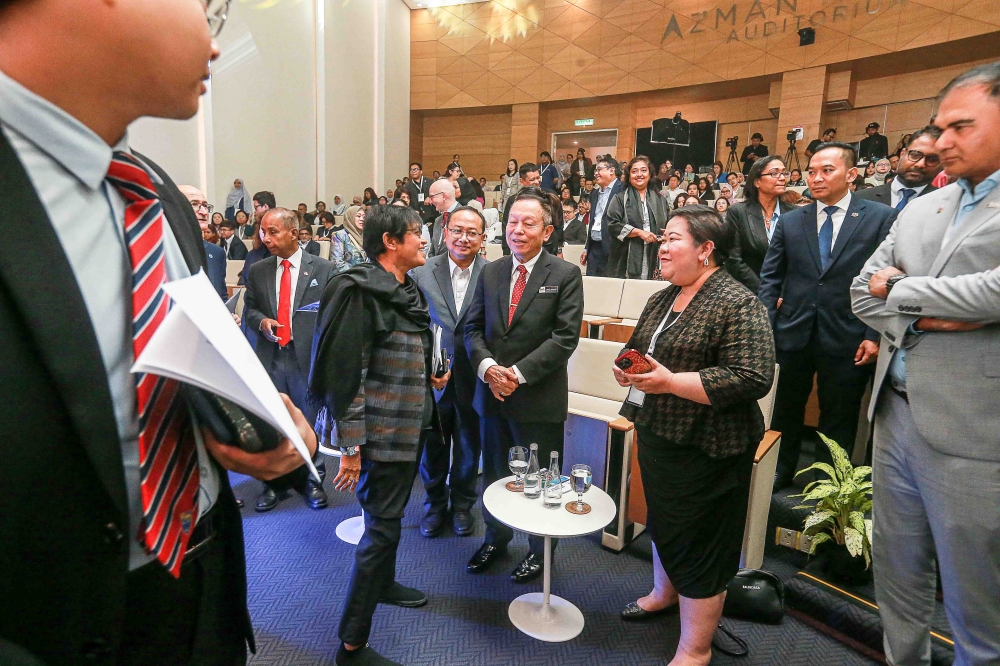

Law and Institutional Reform Minister Datuk Seri Azalina Othman Said (in black scarf) meets participants during the launch of the National Conference on Business and Human Rights 2026 at the Asian Institute of Chartered Bankers in Kuala Lumpur on October 7, 2026. — Picture by Sayuti Zainudin
By Soo Wern Jun
First Published: Wednesday, 07 Oct 2026 11:14 AM MYT
KUALA LUMPUR, Oct 7 — Malaysia must now move from policy to practice on business and human rights, said Minister in the Prime Minister’s Department (Law and Institutional Reform) Datuk Seri Azalina Othman Said.
She said the next phase must focus on turning policy commitments into tangible results under the National Action Plan on Business and Human Rights 2025-2030 (NAPBHR), launched in 2025 with 135 strategic actions covering governance, labour and environment.
“By 2030, our success will not be measured by the meetings we held or the reports we produced, but by the meaningful difference we make for our workers, communities, businesses and people,” she said in her keynote address at the National Conference on Business and Human Rights 2026 today.
At the conference, she also launched the Human Rights Due Diligence Guide for Businesses in Malaysia, which gives companies a practical process to identify, prevent, mitigate and address potential adverse human rights impacts.
The guide takes a risk-based and proportionate approach, recognising that multinational corporations and small and medium-sized enterprises do not necessarily have the same resources or exposure to risk.
Azalina urged businesses of all sizes to use the guide as a management and decision-making tool rather than merely another compliance document.
She said 11 immediate actions had been identified for the first year, with a National Steering Committee supported by three Technical Committees to oversee implementation.
She said the government did not want to create regulation or compliance “for the sake of compliance”.
Instead, respect for human rights should become part of how good businesses operate, from corporate policies to supply chains and decision-making, she said.
“Responsible business conduct should not be viewed merely as a cost.
“It strengthens trust, it strengthens resilience and it protects reputation,” she said.
She added that the government had been engaging regulators, industry and communities in Kuala Lumpur, Sabah and Sarawak, covering issues such as strategic lawsuits against public participation and the rights of Indigenous Peoples.
She stressed that such engagement was important because good policy could not be developed from Putrajaya alone.
“We must listen to those who implement our policies, those who are affected by them, and those whom these policies are intended to protect,” she said.
Azalina described the NAPBHR as a “living and evolving national commitment” that would require continued learning and adaptation through 2030.
“Business and Human Rights is not about choosing between economic growth and human dignity.
“A modern economy must be capable of delivering both,” she said.
KioskNews shows a cleaned-up reading view extracted from the publisher’s page — the original always lives on their site, not ours.