The 10 Most Controversial Books of All Time, Ranked

Jeremy has more than 2800 published articles on Collider to his name, and has been writing for the site since February 2022. He's an omnivore when it comes to his movie-watching diet, so will gladly watch and write about almost anything, from old Godzilla films to gangster flicks to samurai movies to classic musicals to the French New Wave to the MCU... well, maybe not the Disney+ shows.
His favorite directors include Martin Scorsese, Sergio Leone, Akira Kurosawa, Quentin Tarantino, Werner Herzog, John Woo, Bob Fosse, Fritz Lang, Guillermo del Toro, and Yoji Yamada. He's also very proud of the fact that he's seen every single Nicolas Cage movie released before 2022, even though doing so often felt like a tremendous waste of time. He's plagued by the question of whether or not The Room is genuinely terrible or some kind of accidental masterpiece, and has been for more than 12 years (and a similar number of viewings).
When he's not writing lists - and the occasional feature article - for Collider, he also likes to upload film reviews to his Letterboxd profile (username: Jeremy Urquhart) and Instagram account.
He has achieved his 2025 goal of reading all 13,467 novels written by Stephen King, and plans to spend the next year or two getting through the author's 82,756 short stories and 105,433 novellas.
Sign in to your Collider account
There’s a whole history of controversial books that the following ranking might well only scratch the surface of. There are various ways a book can cause controversy, and sometimes, controversy is a good thing, or at least intended. Controversy can also be silly, and the kind of thing most people are better off ignoring, and it can come about regardless of whether a book is good or bad.
Well, that speaks to the different reasons a book can be controversial. With the following, they're mostly good books that have been divisive for reasons other than their overall quality. Also, there’s only going to be works of fiction below, with this particular ranking of the most controversial books of all time, so if you're expecting to see any really divisive or historically alarming works of non-fiction (there are so many, of course), sorry!
10 'Naked Lunch' (1959)

So, Naked Lunch is hard to describe, by design, and you can find it being called an antinovel, so even if you’ve never heard that term before, you do probably know what you're in for, to some extent. You won’t be able to make sense of things, in all likelihood, and the novel will feel like a joke at your expense.
Even then, it’s still possible to get annoyed at Naked Lunch, and then there’s also all the bad-taste stuff to consider here, with this being truly shocking stuff by the standards of the 1950s. Hell, Naked Lunch is still kind of shocking today, and definitely about as nightmarish as books get without it feeling like a full-on – and traditionally definable – horror novel. You get confusion and repulsion here, two bad emotions for the price of one, and so should controversy and alarm being caused here really be all that surprising?
9 'Brave New World' (1932)

Brave New World scores points as far as controversy goes when you take into account its age, and the sorts of things it was putting down almost 100 years ago that people probably weren’t ready for, at least not widely. It’s got a lot more adult content than most famous and widely-read books of its time, and even if it’s not graphic by today’s standards, the alarm it still caused has to be taken into account to some extent.
There are also different groups of people that, at different points in history, have objected to what Brave New World may or may not be saying about science, religion, and society at large. There are different readings here, and different things to interpret, so Brave New World has ended up being one of those books that raised a whole bunch of different pairs of eyebrows for a whole variety of reasons.
8 'The Amber Spyglass' (2000)

Unlike with Brave New World, there’s one real point of contention when it comes to The Amber Spyglass. Honestly, other than that, this is pretty safe for most younger readers, though it’s part of a trilogy (His Dark Materials) that can be enjoyed even if you're a little older, since some intense things happen and there are definite stakes, albeit the heaviness isn't so overwhelming for a young adult audience.
The whole trilogy, to some extent, is controversial because of what it says about science versus religion, but the third book, The Amber Spyglass, is being highlighted here because it has that conflict really play out at the forefront, and what might've been closer to subtext earlier on is full-on text here. There might just be a vocal minority getting angry at this book, and the trilogy, but it is something that’s always associated with His Dark Materials; maybe even an elephant in the room that you do more or less feel obliged to address, most of the time.
7 'A Clockwork Orange' (1962)

A Clockwork Orange is something of a sci-fi novel, but not really hard sci-fi, since science isn't truly emphasized here, and the novel is more concerned with social issues and a certain kind of technology’s impact on society, crime, and justice. There’s a young man who gets imprisoned after a crime spree, and then he’s effectively brainwashed into feeling repulsion whenever he gets an urge to do something violent, or even when he comes close to thinking a violent thought.
Necessary to this whole arc is the requirement for the main character to do some genuinely horrible things, and that’s a source of controversy here for sure. Also, A Clockwork Orange is bleak and doesn’t have very many optimistic things to say about the State and the prison system, either. There’s violence perpetrated on both sides of the conflict, and it makes the whole book feel (intentionally) incredibly despairing and hopeless.
6 'Scary Stories to Tell in the Dark' (1981)
If you're looking at all the horror books ever written, there are technically more frightening ones than Scary Stories to Tell in the Dark, especially if you're just looking at what the stories say – like, the text. It’s a compilation of horror stories aimed at younger readers, and some might be intense and too spooky for especially young readers, but it’s the artwork in the original version of the book that makes it controversial overall.
Stephen Gammell was the illustrator, and the images he conjured up here are genuinely kind of unpleasant to look at, even if you're older. The illustrations make Scary Stories to Tell in the Dark controversial, especially with it being, at least on the surface, something aimed at kids. If people saw some of these drawings at a young age and were genuinely traumatized by them, you honestly can’t blame them.
5 'American Psycho' (1991)

See, here’s American Psycho, which doesn’t have illustrations (though the cover artwork above there is a bit unsettling), but is much more extreme with its text, obviously, than Scary Stories to Tell in the Dark. You might think being labeled as a book only for readers over the age of 18 would stop it from feeling too controversial and/or contentious, but American Psycho really pushes things as far as the content is concerned.
The narrator here is beyond awful, and also especially disturbed, and American Psycho has him narrating his crimes in truly graphic detail, all the while also putting the same amount of passion into describing all the shallow things that make up his life.
If you’ve seen the movie, then the book makes that movie look like something from Disney in comparison. The narrator here is beyond awful, and also especially disturbed, and American Psycho has him narrating his crimes in truly graphic detail, all the while also putting the same amount of passion into describing all the shallow things that make up his life. It’s effective satire, sure, but definitely not an easy read, and it’s understandable why the book’s sometimes sold shrink-wrapped.
4 'Gravity's Rainbow' (1973)

There is a commitment to gross and upsetting content throughout the whole of Gravity’s Rainbow that you might have to read to believe, but it’s also a hard book to recommend to most people unless they're aware they're entering into something well and truly extreme, as far as postmodern works go. It takes place during World War II and features a great deal of profanity, violence, debauchery, gross-out stuff, and other, um, “explicit” content.
It’s all in service of a book that’s hard to break down, in terms of finding and laying out a synopsis or something. People are searching for a missile of some kind, and then other people aren’t, and there are so many people, and few storylines seem to intersect in any immediately apparent way. Gravity’s Rainbow is very much shocking, and it’s famous (or infamous?) for breaking the Pulitzer Advisory Board in 1974.
3 'IT' (1986)

If you want to pick a Stephen King book to highlight for its controversy, you're spoiled for choice. You’ve got the seventh The Dark Tower book, which has a very bold and somewhat shocking conclusion to a long-running saga, The Stand, which ends infamously abruptly, Pet Sematary and its particularly intense feel, and then maybe a few books divisive because of their quality, or lack thereof (oh hey, Lisey’s Story… yeah, you can’t hide; don't ever think you can hide).
But with IT, it’s got a bit of everything. It’s very dark and confronting with its content, it has a somewhat alarming ending, and it also has quite an odd final few chapters that wrap up a story you have to spend a lot of time with, in order to finish. There’s also the fact that it involves kids for a good chunk of its duration, having all sorts of terrible things happen to younger characters, including opening with a grisly child murder and just getting worse from there. IT is a lot, and by design, sure, but it’s not hard to note several reasons why it’s caused some controversy in its 40 years of being available on shelves.
2 'Lolita' (1955)
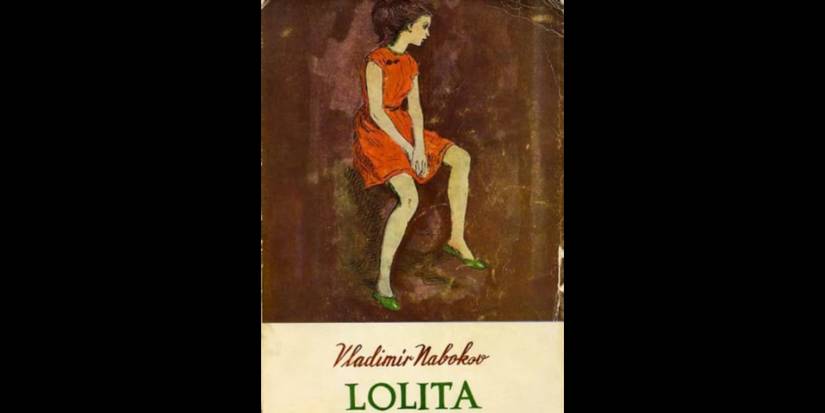
Lolita is that book about the guy, you know, doing… uh… well, that’s a testament to Lolita and how confronting it is. It’s hard to summarize because it’s about something that most books don’t touch, even if it’s some kind of villain who’s not seen particularly often and does what Lolita’s main character does, or something comparable. In Lolita, you're in that guy’s head the whole time.
And this guy can write, as the framing device is him penning a memoir of sorts, rather than a confessional in the strictest sense, since he doesn’t regret what he’s done, and he spends a lot of the book talking about how he sees himself as superior. It’s an iconic character study of one of the worst characters imaginable, and though things are described in as graphic detail as American Psycho, Lolita might well feel even more taboo, and it came out so much earlier, laying the groundwork for later novels like American Psycho and A Clockwork Orange to build upon further.

Lolita
- Release Date
- June 13, 1962
- Runtime
- 154 minutes
- Director
- Stanley Kubrick
- Writers
- Vladimir Nabokov
-

James Mason
Prof. Humbert Humbert
-
Shelley Winters
Charlotte Haze
1 'The Catcher in the Rye' (1951)

The Catcher in the Rye has endured for a few reasons, one of them being that it’s well-written and certainly an interesting book. Another is how it does speak to youthful alienation in a rather timeless way, making it relatable if you're a teenager reading it in the 21st century, much as it would've surely felt relatable to younger/teenaged readers back around the middle of the 20th century.
And the other main reason is the controversy. It has surprisingly become associated with several murders or attempted murders, which is the cloud that really hangs over a book that’s already angst-filled and quite dark on its own. Also, the uncompromising way it looks at what it chooses to explore, all the while not being afraid to have a very intense and divisive protagonist/narrator… like, yeah. The Catcher in the Rye, for reasons intended and unintended, is perhaps the most controversial well-known book written in the English language.
KioskNews shows a cleaned-up reading view extracted from the publisher’s page — the original always lives on their site, not ours.