From Irom Sharmila’s fast to NEET stir: Jantar Mantar a site of many protests
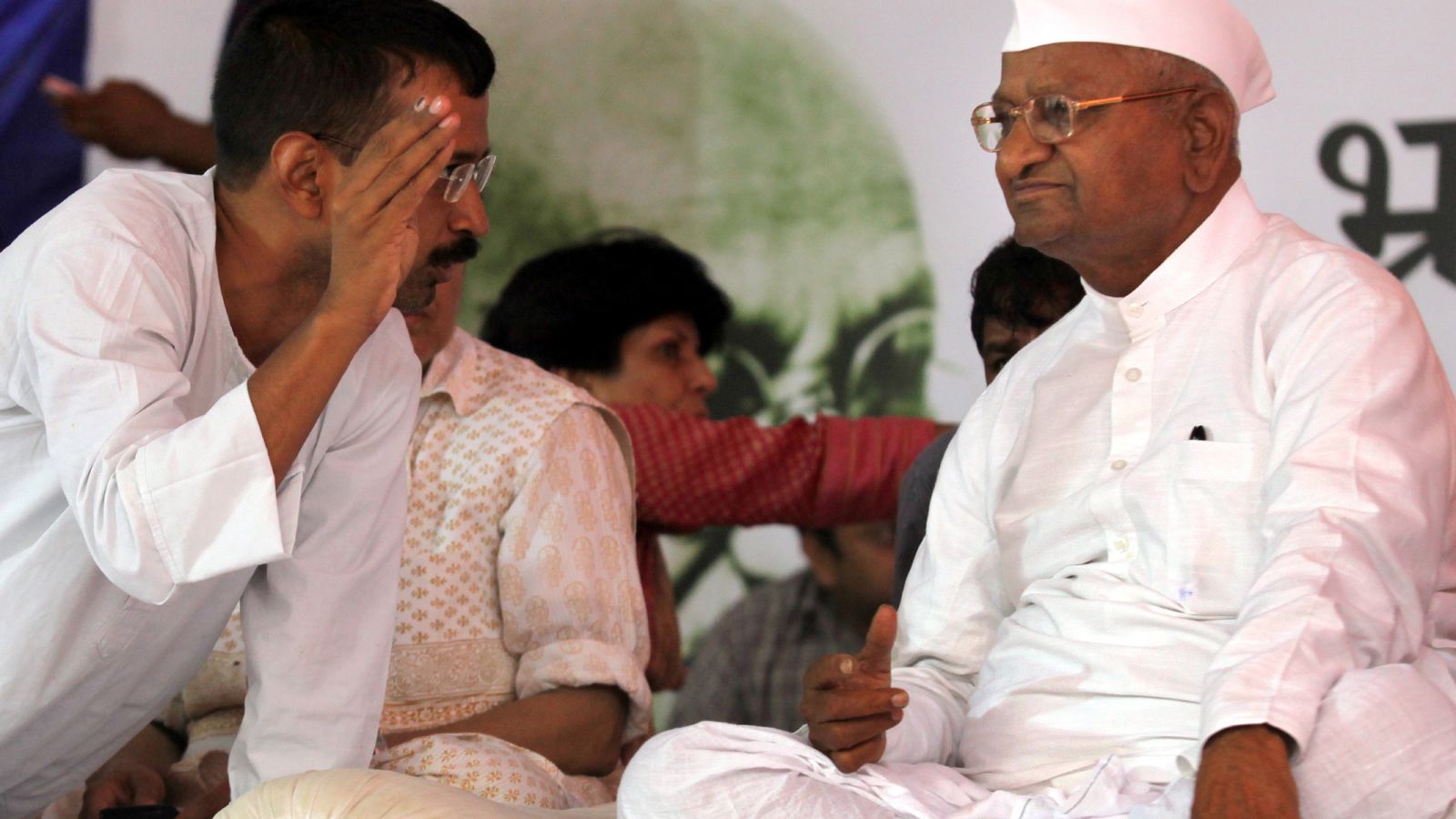
The hunger strike of April 2011 by social activist Anna Hazare was one of the biggest protests at Jantar Mantar. (Photo Credits: Ravi Kanojia/ Express Archive)
When Jantar Mantar first emerged as the Capital’s new ‘designated’ protest site in the mid-1990s, academic-activist Shaswati Mazumdar recalls, she felt activists like her had been “pushed into a corner.”
The site, next to the 18th-century astronomical observatory off Parliament Street, became the seat of protests closest to Parliament after the Boat Club Lawns, the earlier site, was sealed off under prohibitory orders in 1993.
According to historian Sohail Hashmi, the Lawns, a large open field next to Krishi Bhawan and Rajpath, was the first post-Independence “protest site.”
“It was within earshot of Parliament. I remember a couple of demonstrations in which I had participated, MPs had come to receive memorandums from protesters. That was the city’s protest site for around four decades,” he said.
Over the decades, the Boat Club Lawns had been witness to protests led by figures such as Chaudhary Charan Singh, farmer leader Mahendra Singh Tikait and Jayprakash Narayan (JP). Ramlila Maidan, near Chandni Chowk, was also a major site of protest during the JP Movement in the mid-1970s.
In her paper “Spatial Language of Dissent in New Delhi: Public Space, Protests, and the National Capital (c. 1947–2022),” historian Harleen Kaur suggests two reasons for the decision to move protesters out of the prime location of Boat Club Lawns. The first was the week-long farmers’ protest led by Tikait in 1988 at the India Gate lawns and Parliament Street, which “had rendered these spaces inaccessible for the ruling party rally.” The second, and more immediate, was a rally scheduled by an ascendant Bharatiya Janata Party (BJP) for February 1993. She writes that “there were around 200,000 policemen deployed to form a human wall to prevent protesters from reaching Boat Club” ahead of the rally.
It was after this that Jantar Mantar emerged as a protest site. On Monday, the Delhi Police denotified it as a designated protest site and named Ramlila Maidan and Burari Ground in north Delhi, and CBD Ground in east Delhi, as alternatives.
Story continues below this ad
Although Jantar Mantar has become an iconic venue, Mazumdar, who was a student activist from the 1970s and went on to become the first woman president of the Delhi University Teachers’ Association, said the shift to a more sequestered space from the Boat Club was disappointing to activists, even though it is only less than 2 km away from Parliament.
“From the Boat Club, we would go right up to Rafi Marg. But Jantar Mantar was a corner where nobody could see the protesters. Only those who were participating in a protest were privy to it. But the idea of a demonstration was that the public should see it, hear the slogans and what the protesters are saying. The space has acquired a new character now because of the Cockroach Janta Party (CJP) protests and of the reach of voices and visuals from there through social media, but we always thought of it as a strange place where we were hidden in a corner,” she said.
Still, like lakhs of people over the decades, she has protested at Jantar Mantar several times.
The site has witnessed several defining moments of dissent: Irom Sharmila’s 16-year-long fast against the Armed Forces Special Powers Act in Manipur; the protests after the 2012 Delhi gang-rape; the India Against Corruption movement; the Narmada Bachao Andolan; the protest by top wrestlers against then Wrestling Federation of India chief and BJP MP Brij Bhushan Sharan Singh; and, most recently, the anti-NEET paper leak protest led by the CJP in July, which led to the resignation of then Education Minister Dharmendra Pradhan.
Story continues below this ad
Apart from these headline-grabbing movements, some of which even forced change, Jantar Mantar has also hosted smaller protests nearly every day over the years. At times these have involved Accredited Social Health Activists (ASHA) workers demanding better wages, and at others safai karamcharis protesting the deaths of their colleagues in sewers.
Despite its popularity, the use of Jantar Mantar as a protest site has been contentious. In 2017, the National Green Tribunal (NGT) directed that protest activities there be stopped after residents living nearby petitioned over noise and traffic. However, the order was reversed in 2018.
Of the three new venues designated for protests, Ramlila Maidan is 6 km from Parliament, while Burari Ground and CBD Ground are over 13 km from the seat of power.
“The Burari site has been tried by the State as a protest site several times earlier. But it is just too far from the centre of power. People protest in the Capital to raise their voices and make it heard in the Parliament,” said Hashmi.

Sukrita Baruah is a Principal Correspondent for The Indian Express, based in Guwahati. From this strategic hub, she provides comprehensive, ground-level coverage of India's North East, a region characterized by its complex ethnic diversity, geopolitical significance, and unique developmental challenges. Expertise and Experience Ethnic & Social Dynamics: Deep-dive coverage of regional conflicts (such as the crisis in Manipur) and peace-building efforts. Border & Geopolitics: Tracking developments along India’s international borders and their impact on local communities. Governance & Policy: Reporting on state elections, tribal council decisions, and the implementation of central schemes in the North East. Specialized Education Background: Prior to her current role, Sukrita was a dedicated Education Correspondent for The Indian Express in Delhi. This experience provided her with a sharp analytical lens for: Policy Analysis: Evaluating the National Education Policy (NEP) and university-level reforms. Student Affairs: Covering high-stakes stories regarding campus politics, national entrance exams, and the challenges within the primary and secondary education sectors. ... Read More
KioskNews shows a cleaned-up reading view extracted from the publisher’s page — the original always lives on their site, not ours.