EVA Air, partners sign sustainable fuel deal
ZERO CARBON GOAL: The partnership helps transform corporations’ need to reduce emissions to a market demand for sustainable fuel, the FPC president said
By Shelley Shan / Staff reporter


EVA Airways and AIT Worldwide Logistics yesterday signed an agreement to promote the airline’s Green Transportation Program, which is expected to help Microsoft reduce its carbon emissions by 15,000 tonnes in the first year.
The four-way partnership — comprising EVA Air, AIT Worldwide Logistics, Formosa Petrochemical Corp (FPC) and Microsoft — aims to accelerate the adoption of sustainable aviation fuel and decrease carbon emissions across the supply chains in the aviation, technology, transportation and energy sectors.
EVA Air president Clay Sun (孫嘉明) said at a ceremony in Taipei that the airline is committed to increasing the use of sustainable fuel, produced by FPC from used cooking oil, as part of its goal of achieving net zero carbon emissions by 2050.
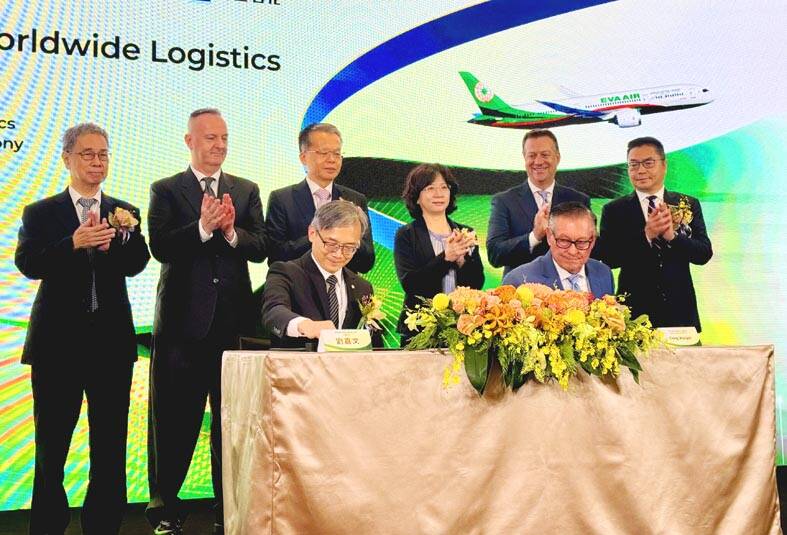
Representatives of EVA Airways and AIT Worldwide Logistics sign an agreement yesterday in Taipei to promote the airline’s Green Transportation Program.
Photo: Huang Yi-ching, Taipei Times
“The civil aviation industry’s transition to the zero-carbon model requires collective efforts of airlines, aviation fuel suppliers as well as logistics service providers and their corporate customers,” Sun said.
The partnership can enable Microsoft, an important corporate customer of AIT Worldwide, to reduce its carbon footprint generated by cloud equipment transportation by approximately 15,000 tonnes of Scope 3 emissions.
No company can solve aviation’s decarbonization challenge alone, AIT Worldwide chief strategy officer Greg Weigel said, adding that sustainable fuel adoption requires both supply and demand.
Aside from airlines, corporate customers such as Microsoft can help create demand, he said.
“The more important thing is that it [the partnership] sets a foundation for the future,” Weigel said, adding that AIT Worldwide hopes that the initiative would encourage more airlines, fuel suppliers, freight forwarders and corporate customers across Asia-Pacific to participate.
FPC president Lin Ke-yen (林克彥) said that sustainable aviation fuel serves as an important means for the aviation industry to reduce carbon emissions.
However, the supply is limited, and the cost is relatively high, he said.
The partnership helps transform the need for corporations to reduce carbon emissions to a market demand for sustainable fuel, Lin said.
Increased use of sustainable fuel would help expand FPC’s production and lower operational costs, he added.
Vincent Shih (施立成), general manager of corporate, external and legal affairs at Microsoft Taiwan, said that Microsoft has set the goal of achieving carbon negative, water positive and zero waste by 2030.
The partnership helps the technology giant resolve the problems with Scope 3 emissions, which refers to carbon emitted at the logistics’ end, Shih said.
Civil Aviation Administration Director-General Ho Shu-ping (何淑萍) said that Taiwan last year launched the sustainable fuel demonstration project in the civil aviation industry.
Taiwan is capable of producing 6,500 tonnes of sustainable aviation fuel in a year, Ho said.
Microsoft’s goal for zero carbon emissions can serve as an important force to propel the further development of the market for sustainable aviation fuel, she added.
American Institute in Taiwan commercial deputy chief Eric Crowley said that Taiwan is the US’ fourth-largest trading partner, and the US has become Taiwan’s largest export market.
During the first five months of this year, Taiwan was the 18th-largest source of international visitors to the US, up 15 percent year on year, Crowley said.
About 170 passenger flights are dispatched between Taiwan and the US each week, while air-cargo demand between the two countries continues to grow rapidly, he added.
“This agreement represents a critical step forward in decarbonizing modern supply chains. The cross-industry partnership shows that economic growth and environmental protection can coexist, and serves as an example of how the US and Taiwan can promote green and sustainable trade together,” Crowley said.
The airline said that sustainable aviation fuel accounts for only 0.5 percent of its total aviation fuel consumption due to limited supply, and about two-thirds of sustainable fuel it uses is procured from other countries.
Sustainable aviation fuel costs about three to five times higher than regular aviation fuel, it added.
KioskNews shows a cleaned-up reading view extracted from the publisher’s page — the original always lives on their site, not ours.