AQI hits ‘425’ at Bandra Kurla Complex: Why the Mumbai’s air is worsening this early
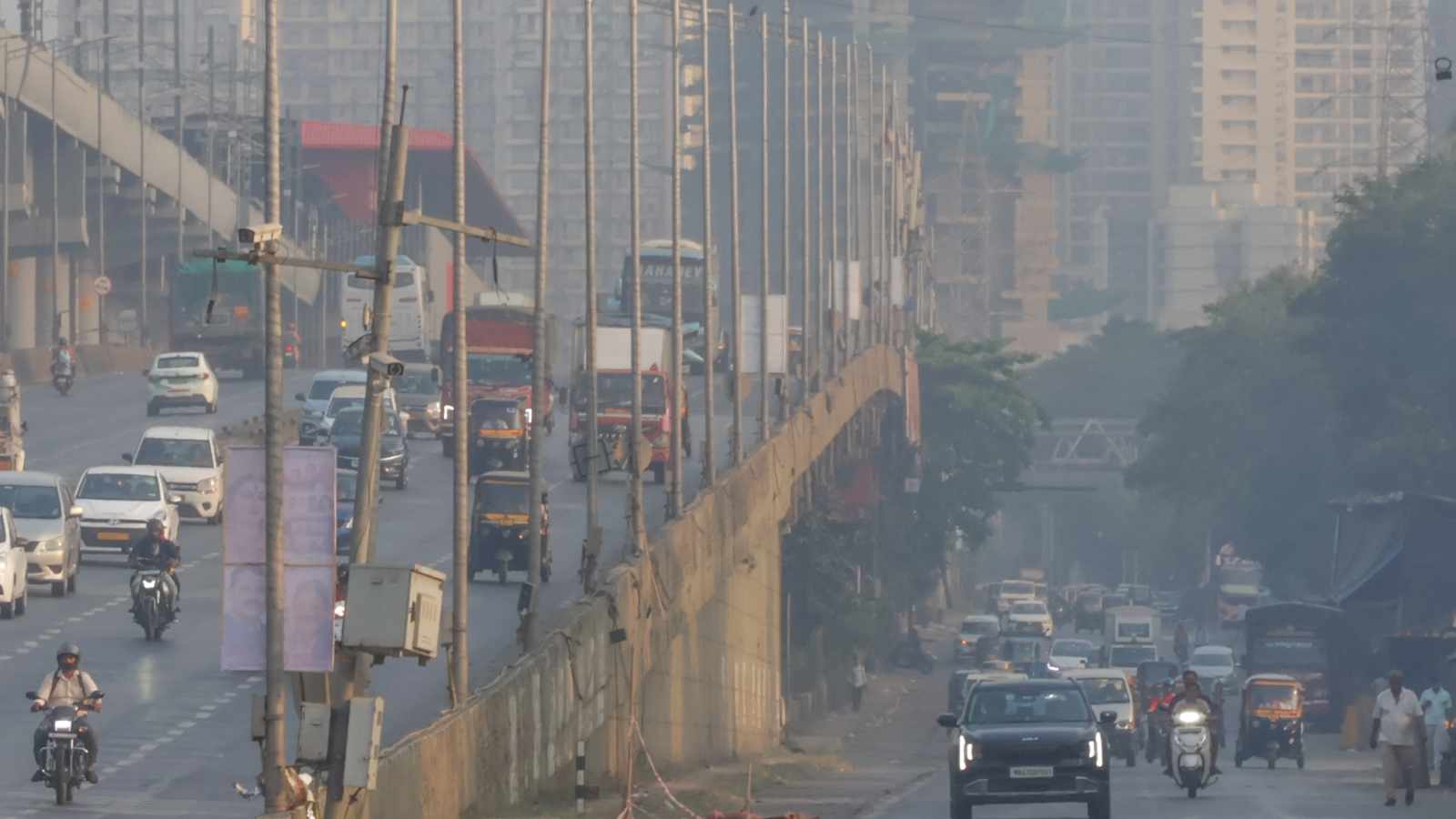
Mumbai’s air quality deteriorated to unhealthy levels nearly two months before the onset of winter. On Sunday morning, the Bandra Kurla Complex (BKC) recorded an Air Quality Index (AQI) of 425, categorised as ‘Severe’, while areas such as Chembur, Deonar, Kurla, Mazgaon and Navy Nagar also recorded elevated pollution levels on the Central Pollution Control Board’s (CPCB) dashboard.
Mumbai’s AQI typically deteriorates around Diwali and remains elevated through the winter. This year, however, experts have warned that residents could be exposed to unhealthy air for a longer period due to El Niño-related climatic conditions, which can alter global weather patterns and influence monsoon rainfall and temperatures. Civic officials, however, maintained that the readings were not uniformly severe and attributed the spike at BKC to a possible malfunction in the monitoring system.
Mumbai’s deteriorating air quality
Mumbai’s overall AQI entered the unhealthy range for the first time on October 2, a day before the India Meteorological Department (IMD) announced the withdrawal of the monsoon. In the 10-day period since then, the city recorded AQI levels above 100 on at least three days — October 2, 8 and 10. On Sunday morning, Mumbai’s overall AQI stood at 101, placing it in the ‘Moderate’ category under CPCB standards.
 The CPCB dashboard showed that over the past week, AQI readings at these locations ranged between 120 and 199, with PM2.5 and PM10 identified as the primary pollutants.
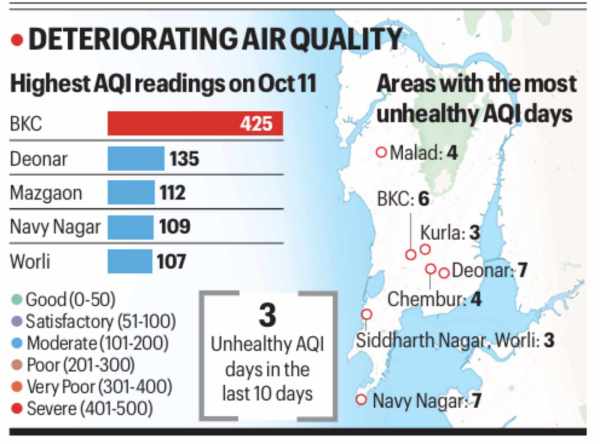
At the local level, several monitoring stations recorded elevated AQI readings on multiple days. Navy Nagar and Deonar recorded seven days each with unhealthy-range readings, followed by BKC with six days, Chembur and Malad with four days each, and Kurla and Siddharth Nagar in Worli with three days each.
The CPCB dashboard showed that over the past week, AQI readings at these locations ranged between 120 and 199, with PM2.5 and PM10 identified as the primary pollutants.
According to CPCB standards, AQI readings of 0-50 are categorised as ‘Good’, 51-100 as ‘Satisfactory’, 101-200 as ‘Moderate’, 201-300 as ‘Poor’, 301-400 as ‘Very Poor’ and readings above 400 as ‘Severe’.
“This year, Mumbai is experiencing an El Niño pattern of climate, as a result of which wind speeds have slowed down considerably while temperatures remain hot and humid. This is preventing air circulation, causing pollutants to settle in the lower atmosphere and leading to a rise in pollution levels,” Gufran Beig, atmospheric scientist and chair professor at the National Institute of Advanced Studies (NIAS), Indian Institute of Science (IISc), told The Indian Express.
Story continues below this ad
On Sunday morning, BKC recorded an AQI of 425, categorised as ‘Severe’. The CPCB dashboard identified PM10 as the primary pollutant. This was the first time since 2023 that the station’s readings had crossed the 400 mark.
“PM10 generally comprises dust particles displaced from roads and construction sites. It is possible that a source nearby is emitting dust that is not being monitored,” Beig said.
Civic officials, however, attributed the spike to a possible malfunction in the monitoring equipment.
“The AQI monitoring station recording a reading above 400 is maintained by the Indian Institute of Tropical Meteorology (IITM). There appears to be a malfunction in its PM10 sensor, which is why the readings are unusually high. We have informed the institute and asked it to replace the sensor immediately and stabilise the system,” Avinash Dhakane, additional municipal commissioner, told The Indian Express.
Story continues below this ad
Local-level factors
Civic officials and Maharashtra Pollution Control Board (MPCB) officials said deteriorating air quality at the ward level could be attributed to several local factors, including construction activity, vehicular emissions and garbage burning.
In Deonar, garbage burning remains a recurring concern because of the area’s proximity to the city’s largest and oldest landfill. Officials said vehicular emissions also contribute to pollution in areas such as Navy Nagar and Malad.
“If garbage or plastic waste is burnt in Deonar, the resulting pollution does not remain confined to that area. This is why places such as Chembur and Kurla, which are close to Deonar, are also recording elevated AQI levels as air currents carry pollutants across locations,” an MPCB official told The Indian Express.
Officials said the BMC and MPCB were jointly issuing notices to construction sites across Mumbai, directing stakeholders to comply with pollution-control measures. They added that construction activity in an area would be stopped if AQI readings crossed 200.
Story continues below this ad
“In BKC, we are not stopping construction activity at present as the issue is likely to be with the sensor. We will monitor the situation for 24 hours,” another official said.
The BMC has also directed officials in all 26 wards to identify pollution hotspots and implement local measures. Officials in Deonar, Kurla and Mazgaon are visiting slum areas and conducting awareness campaigns to help keep pollution levels under control.
KioskNews shows a cleaned-up reading view extracted from the publisher’s page — the original always lives on their site, not ours.