A road when it’s dry, a river when it pours: How KL’s SMART Tunnel switches from highway to flood channel
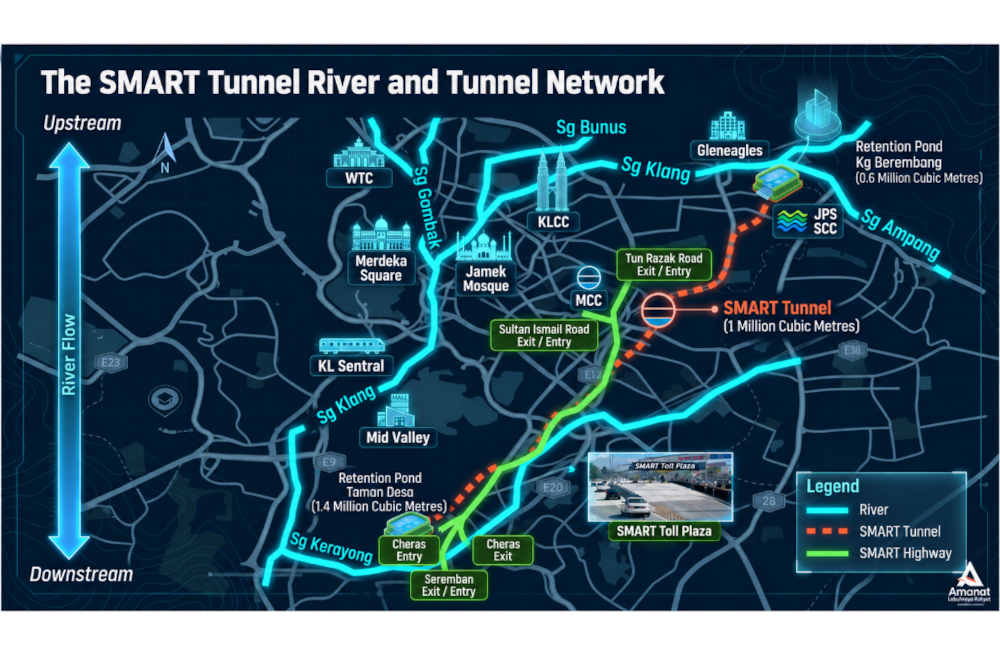

SMART Tunnel river and tunnel network. — Picture courtesy of Amanat Lebuhraya Rakyat (ALR)
By Soo Wern Jun
First Published: Thursday, 29 Oct 2026 7:00 AM MYT
KUALA LUMPUR, Oct 29 — To most motorists, the SMART Tunnel is a way to bypass traffic congestion on the southern approach to Kuala Lumpur’s city centre. Its primary purpose, however, goes beyond moving vehicles.
The 9.7km Stormwater Management and Road Tunnel combines a 3km double-deck motorway with a flood-control system designed to divert excess water away from the city centre during heavy rain.
It channels water from the Klang-Ampang catchment to reduce downstream flood risks, including around the confluence of the Klang and Gombak rivers near Masjid Jamek.
According to Amanat Lebuhraya Rakyat (ALR), the holding company of the SMART Tunnel concessionaire and three other highway concessionaires, the system has a combined water-storage capacity of three million cubic metres and has recorded 685 flood-mode incidents.
Project documentation puts the overall cost at approximately RM1.93 billion.
Why was the SMART Tunnel built?
Kuala Lumpur has a long history of flooding, with major events recorded in 1926 and 1971.
In April 2001, floods inundated Jalan Ipoh, Jalan Gombak and Jalan Munshi Abdullah.
Further incidents in June 2002 and June 2003 affected areas around the Klang River, Jalan Gombak and Dataran Merdeka.
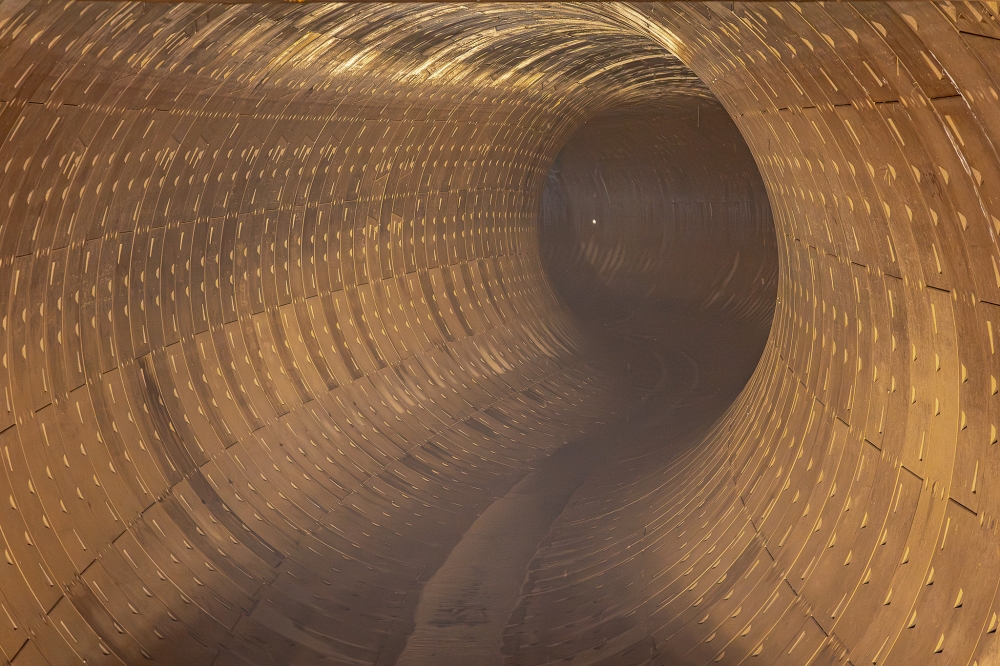
The 9.7km-long floodwater tunnel that channels floodwater to the Taman Desa holding pond. — Picture by Firdaus Latif
The SMART Tunnel idea emerged in 2001, when the government sought private-sector proposals to address recurring floods while easing congestion on the southern approach to the city centre.
How was the dual-purpose model developed?
Gamuda Berhad, working with engineering consultants Sepakat Setia Perunding Sdn Bhd and Mott MacDonald, developed a flood-diversion tunnel proposal before partnering MMC Corporation Berhad in 2002 to incorporate a motorway.
The project involved both the government and private sector, with the Department of Irrigation and Drainage (DID) and Malaysian Highway Authority among the agencies involved.
The government commissioned the stormwater management component to divert floodwater from the Klang-Ampang catchment through the tunnel and into downstream storage.
Meanwhile, the motorway was developed under a privatisation arrangement based on a Build-Operate-Transfer (BOT) model.
The private-sector joint venture formed Syarikat Mengurus Air Banjir dan Terowong Sdn Bhd to implement the project and operate the motorway concession.
Construction began in 2003, and the tunnel opened to traffic in 2007.
How does the tunnel work?
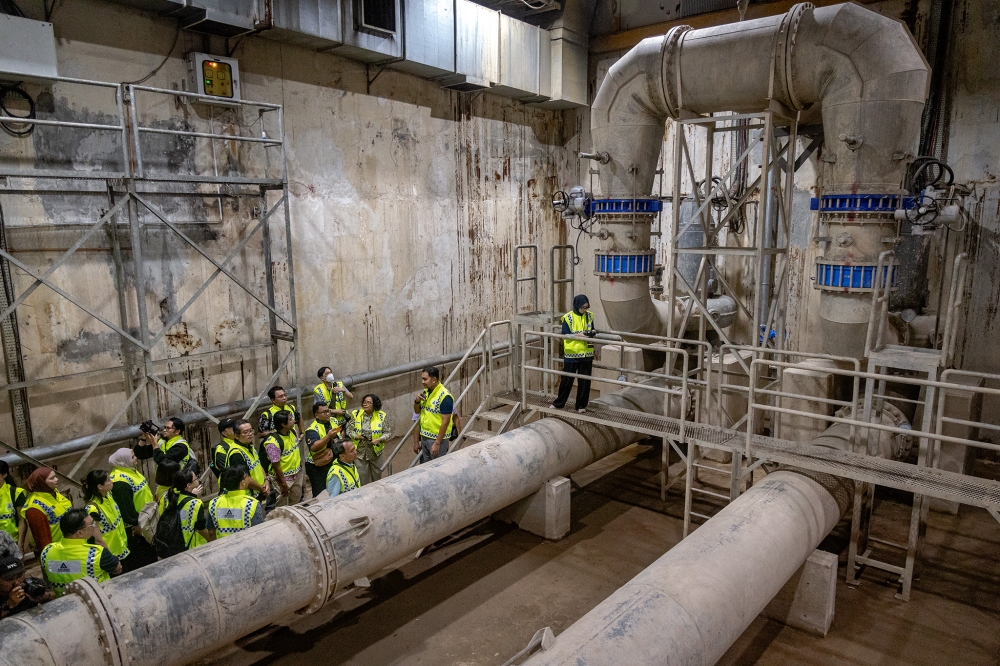
The pump room located 30 metres below ground level. — Picture by Firdaus Latif.
The SMART Tunnel forms part of an integrated system that diverts excess water from the Klang and Ampang rivers towards downstream storage facilities.
According to ALR, the system has a combined capacity of three million cubic metres, equivalent to about 1,200 Olympic-sized swimming pools. This comprises:
- Kampung Berembang holding pond: 600,000 cubic metres
- SMART Tunnel: one million cubic metres
- Taman Desa holding pond: 1.4 million cubic metres
During heavy rain, excess water is diverted into the system near Kampung Berembang and channelled towards Taman Desa for temporary storage before being released into Sungai Kerayong.
Two control centres oversee different aspects of the operation:
- SMART Control Centre: Under DID, it monitors rainfall and river flows, issues flood warnings and directs water into the system.
- Motorway Control Centre: Operated by ALR, it manages traffic diversion and clearing, as well as cleaning and restoring the road before reopening.
Safety features include 220 CCTV cameras monitored around the clock, variable-message traffic signs, 42 emergency telephones, 16 radio units, watertight doors and 10 emergency exits and escape routes.
There are four tunnel modes
Mode 1: Normal operation
During ordinary weather, traffic uses the motorway as usual, with no floodwater diverted through the tunnel.
Mode 2: Heavy rain
When water levels rise, excess water is diverted through the lower channel beneath the motorway, allowing traffic to continue. ALR’s operating matrix identifies a flow range of 70 to 150 cubic metres per second for this mode.
Mode 3: Motorway closure
When the flood model forecasts a flow rate of 150 cubic metres per second or more, the motorway is closed and cleared of vehicles in preparation for possible floodwater diversion.
The motorway compartments may not need to be flooded if conditions change.
Mode 4: Prolonged severe storm
If the storm persists, the motorway compartments are used to carry floodwater after all vehicles have been evacuated.
The motorway remains closed until the water has been drained and the road cleaned and inspected.
The distinction is important: a motorway closure does not necessarily mean the tunnel will be flooded.
Mode 3 prepares it for possible use as a floodwater channel, while Mode 4 involves diverting water through the motorway tunnel.
Closure of the SMART tunnel also meant that no tolls are collected throughout the flooding of the tunnel and recovery stages.
The numbers are an illustration only, not verified current losses.
Actual foregone revenue would depend on current toll revenue, traffic patterns, timing of closure, and whether traffic would otherwise have paid the toll.
What happens after the tunnel floods?
The tunnel cannot immediately reopen once a floodwater diversion operation ends. According to ALR, recovery involves six stages:
- Stage1: Notification — DID issues a notification and monitors river flows and water levels.
- Stage 2: Pumping — Floodwater is pumped out and the main flow checked.
- Stage 3: Safety inspection — The tunnel is checked for gas and other potential hazards.
- Stage 4: Cleaning — Machinery removes debris and sediment, with operations running around the clock.
- Stage 5: System restoration — The tunnel’s systems are restored and checked.
- Stage 6: Final inspection — Safety checks are completed before the motorway reopens.
This is a four-day reopening target, with an average recovery period of two days. The actual duration depends on the work needed to restore safe operating conditions.
Major maintenance may also be required after Mode 4, including replacing tunnel fixtures or repairing structural damage caused by floodwater.
How much flood damage has the tunnel prevented?
ALR reported 685 flood-mode incidents and estimated that the system had avoided RM4.94 billion in potential flood damage.
The incidents comprised 556 Mode 2 operations, 118 Mode 3 operations and 11 Mode 4 operations.
The estimates also cover areas and populations ALR said were protected during these operations. They represent potential damage avoided, rather than a direct accounting of losses that would certainly have occurred without the tunnel.
While the SMART Tunnel’s primary purpose remains flood mitigation, its motorway component also operates under a toll concession. Its financing and management arrangements have since changed as the government sought to reduce compensation payments, avoid toll increases and bring forward the return of the concessions to the government.
Why was the concession restructured?
The restructuring covered four Klang Valley highway concessions: SMART, KESAS, LDP and SPRINT.
Under the original agreements, the government faced compensation payments when tolls were kept below the rates concessionaires were contractually entitled to charge.
For SMART, ALR previously cited a contractual toll of RM5 for a Class 1 vehicle, compared with the prevailing rate of RM3 at the time. The contractual rate was scheduled to rise further.
The restructuring aimed to address three issues:
- Reduce government compensation: The government had been paying concessionaires the difference between the tolls motorists paid and the rates stipulated in their agreements.
- Avoid toll hikes: Without restructuring, the government would have had to continue paying compensation or allow toll rates to rise.
- Shorten the concessions: Revenue would go towards debt repayment instead of shareholder dividends, allowing the highways to return to the government earlier.
ALR was established as a private, not-for-profit holding company to acquire the four concessionaires.
In October 2022, it issued RM5.5 billion in sukuk to finance the acquisition and refinance existing debt.
The SMART concessionaire, Syarikat Mengurus Air Banjir dan Terowong Sdn Bhd, became an ALR subsidiary.
ALR said it would not distribute dividends to shareholders, with revenue instead used to cover operating and maintenance costs and repay financing obligations.
The model was designed to maintain existing toll rates without government compensation under the restructured concessions, while directing funds towards debt repayment and an earlier return of the highways to the government.
The restructuring changed the financial and concession arrangements, not the tunnel’s flood-control function.
Who operates the tunnel now, and what happens next?
The SMART Tunnel concession is held by Syarikat Mengurus Air Banjir dan Terowong Sdn Bhd, which is wholly owned by ALR.
ALR aims to return all four highway concessions to the government by 2033, five years before the sukuk programme’s final maturity in 2038.
The return would not automatically make the highways toll-free. The government would decide on future toll arrangements, including whether to remove tolls or retain nominal charges to cover maintenance.
KioskNews shows a cleaned-up reading view extracted from the publisher’s page — the original always lives on their site, not ours.