Institute touts its new umami seasoning powder
By Esme Yeh / Staff reporter


The Ministry of Agriculture’s Taiwan Agricultural Research Institute on Wednesday said it has developed soybean-based umami seasoning powder that is low in sodium and sugar, and high in protein.
The institute said that it fermented and aged domestically produced soybeans, converting their soy protein into free, umami amino acids.
The amino acids were further processed into additive-free umami seasoning powder, it said.
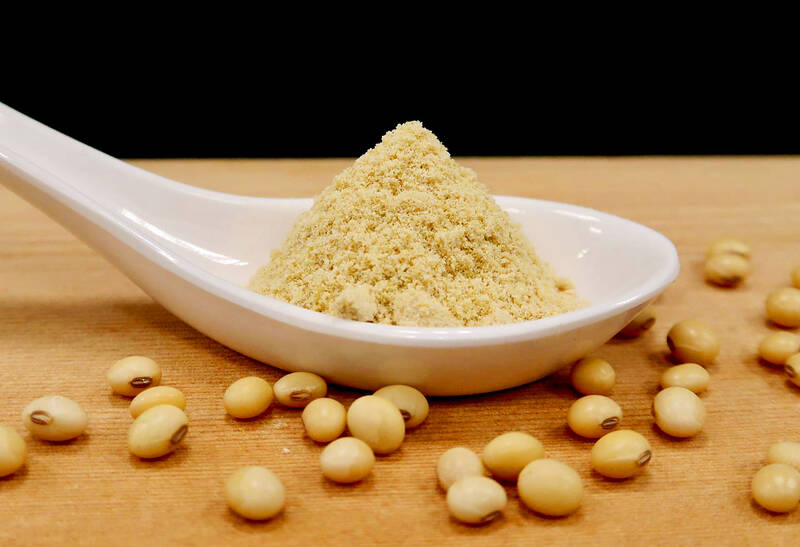
A spoon holding soybean-based umami seasoning powder is pictured in an undated photograph.
Photo courtesy of the Ministry of Agriculture’s Taiwan Agricultural Research Institute
Typical salt consumption in Taiwan tends to be high and most umami seasoning products on the market, such as mushroom seasoning powder, have relatively high sodium content, the institute said.
A key concern for Taiwan’s food industry is to balance keeping the umami flavor while reducing sodium content in seasonings, it said.
Its technique helps microorganisms decompose the proteins in soybeans, which releases a lot of umami amino acids and flavor compounds, the institute said.
The substances can be processed into seasoning products via drying, milling and sieving before being mixed with other raw materials, it said.
Soybean-based umami seasoning alone can provide rich flavors without any additives, it added.
The technique shortens the fermentation and aging process compared with other processes to produce fermented soybean seasonings such as soy sauce and miso, it said.
It also produces seasoning with lower sodium content, given that it does not rely on salt preservation, the institute said.
Most seasoning products on the market either have low sodium and high sugar, or low sugar and high sodium, it said.
However, the newly developed soybean seasoning has low sodium and sugar, it said.
It contains about 2.9g of sodium and 2g of sugar per 100g of powder, much lower than its counterparts’ sodium levels ranging from 15.5g to 20.2g and sugar content at up to 71g per 100g of powder, the institute said.
Its powder also boasts higher protein content at 30.3g per 100g than all of the seasoning products it was compared against, it said.
The seasoning has broad applications, such as becoming an ingredient in the food processing industry that intensifies the flavors of instant foods, soups and snacks, it said.
Aside from the business-to-business market, it can also penetrate the business-to-consumer market to fulfill consumers’ demand for healthy and low-salt foods, it said, adding that its technique was transferred to industry players in May.
KioskNews shows a cleaned-up reading view extracted from the publisher’s page — the original always lives on their site, not ours.