‘You don’t need strategy anymore’: Faldo’s lament as raw power takes over golf
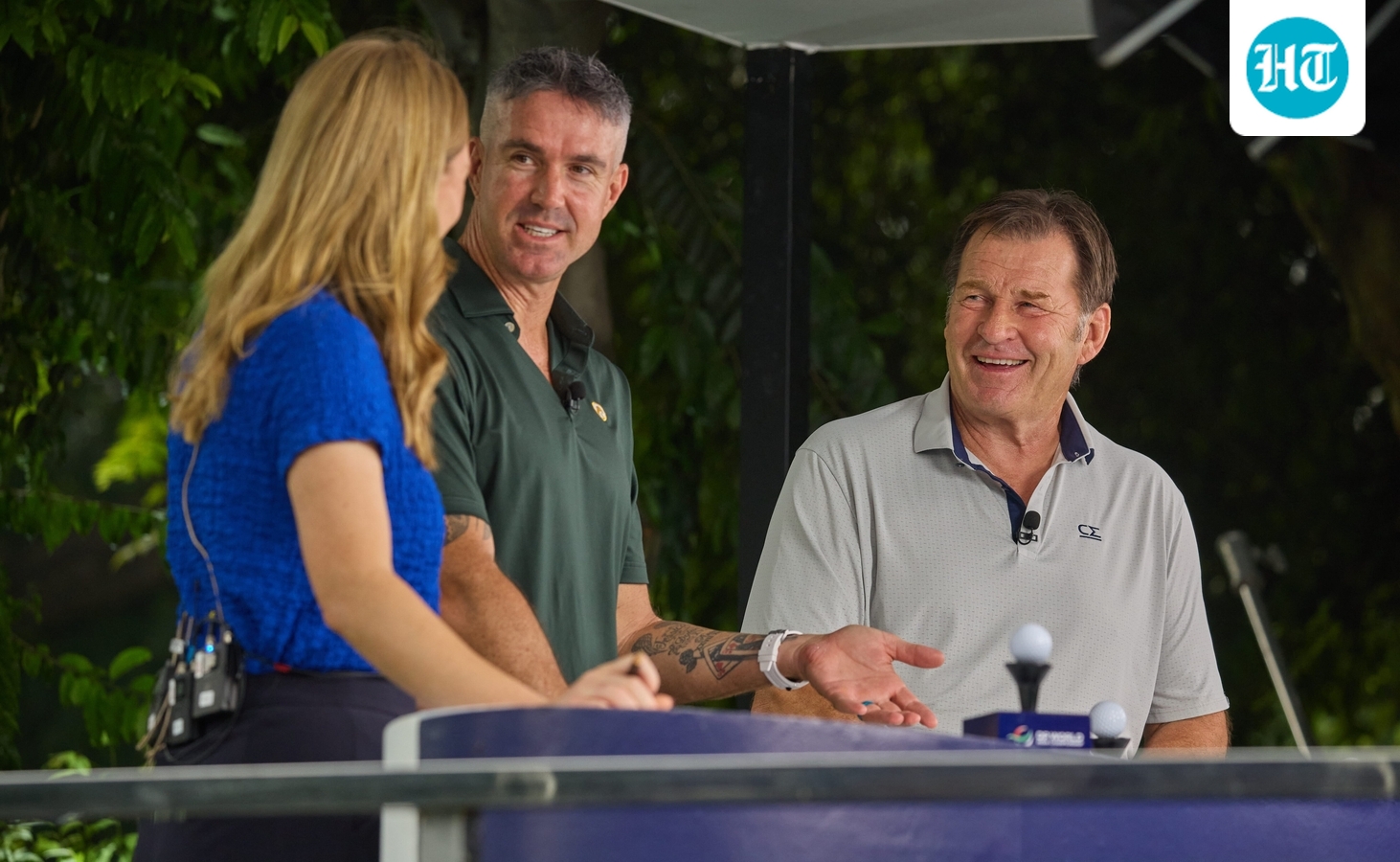
Nick Faldo has just sipped some electrolytes, spent half an hour talking golf with Sachin Tendulkar and Kevin Pietersen for the official studio show of the DP World India Championship. By the time he settles down to speak on the sapping Friday evening, the 69-year-old is panting and sweating.
There are, however, a few things that get him going in an instant, such as the mention of his most famous major win — the dramatic 1996 triumph at The Masters —and the argument of brute power taking over touch play from the sport.
More of that later, because before he got talking on golf, Faldo let slip an important trivia. "I just bowled to Sachin, he hit straight back and I caught it. Gone, first ball! I got Sachin first ball," he laughed. Tendulkar c&b Faldo might be an almighty fluke, but the golf legend is certain of one thing — "You don't need strategy on the golf course anymore."
The steady rise in driving distances has been the Englishman's pet peeve for years, and the sight of pros hitting upwards of 350 yards still hurts the golf tragic in him.
"It's a shame. You no longer need a strategy to conquer courses. I don't know how we rein in things. I'm trying my best to bring back classical ball striking skills. I suggest we try different heads, different lofts. Maybe we stop at 56 degrees, maybe we don't have anything less than 10 degrees of the driver," Faldo said.
The six-time major winner is also a proponent of restricting tee height to one inch from the current 2¼-inch to reduce distance off the tee. A shorter tee tends to lower the ball speed and carry without re-engineering the golf ball, shifting the competitive advantage back to pure ball-striking skill, touch, and course management rather than raw power.
"One-inch tees would be fantastic, because you have to tee it low and you can't get there that easily. Nowadays, they tee it up this high and hit it over the moon, so, little things like that could change it. We've been talking about it for about three decades, we might as well talk about it for another decade, couple more, couple more..."
Remembering '96
Thirty years is a long time, but if you are Faldo, it's as recent as yesterday. The delight and perspicuity with which he recounts his Augusta Masters win back in 1996—where he entered the final day six shots behind the leader Greg Norman and went on to win the competition by five shots after Norman imploded—is indicative of how dearly he cherishes it. Faldo, on sinking the final putt, famously embraced Norman and desisted from celebrating, a compassionate ode to a fellow heartbroken sportsperson.
"Oh, that's the famous one," he smiled.
"It was all about consistency for me on that final day. I had a really good goal in my mind — they call it a gameplan now — which was to get within three shots after nine holes," Faldo recalled.
"I actually did better, I got within two, and by the time we'd stood on the 12th, I realised things were getting serious for me. I was just comfortable churning it out hole after hole. My 67 was my lowest round of the weekend, in fact it was the best in the whole field. The greens were like rock, and you had to position it. It was perfect for my style of play, but more importantly, you've got to believe that I can still do it. That said, you're churning inside, but you still have to hit the good shots under that amount of pressure."
But before the high of '96 came the examination in the mid-80s when Faldo decided to rework his swing in the middle of the season. He calls it "crazy" and "daft" 40 years later, but back then, "it was something I needed to do."
A fairly successful player on the tour, albeit without a major win until then, Faldo worked with coach David Leadbetter to get a more compact backswing and a stable clubface, which ultimately gave him better accuracy. The grip became more neutral, the swing became flatter, and the torque generated from the core became central to this overhaul.
"You have to be brave. It took me two years to get used to it. it was very difficult to play with a new backswing and an old follow-through, but I had the desire to keep improving. I knew I wasn't quite good enough, and I wanted to be the best, consistently," he said.
"I wanted to learn how to go bang, bang, bang, time after time, so I hit millions of balls. It gave me the confidence and the trust that I could do it." Two seasons down the line in 1987, his muscle memory tuned to the new biomechanics, Faldo won his first major at The Open. Five more would follow over the next nine years.
"It's been a great journey and I have loved every part of it. I want the game to go to new geographies. I want youngsters to pick up golf the way I picked it up after watching it on TV," he concluded.
KioskNews shows a cleaned-up reading view extracted from the publisher’s page — the original always lives on their site, not ours.