Women in manufacturing: Inside Manesar’s Japan-India training institute
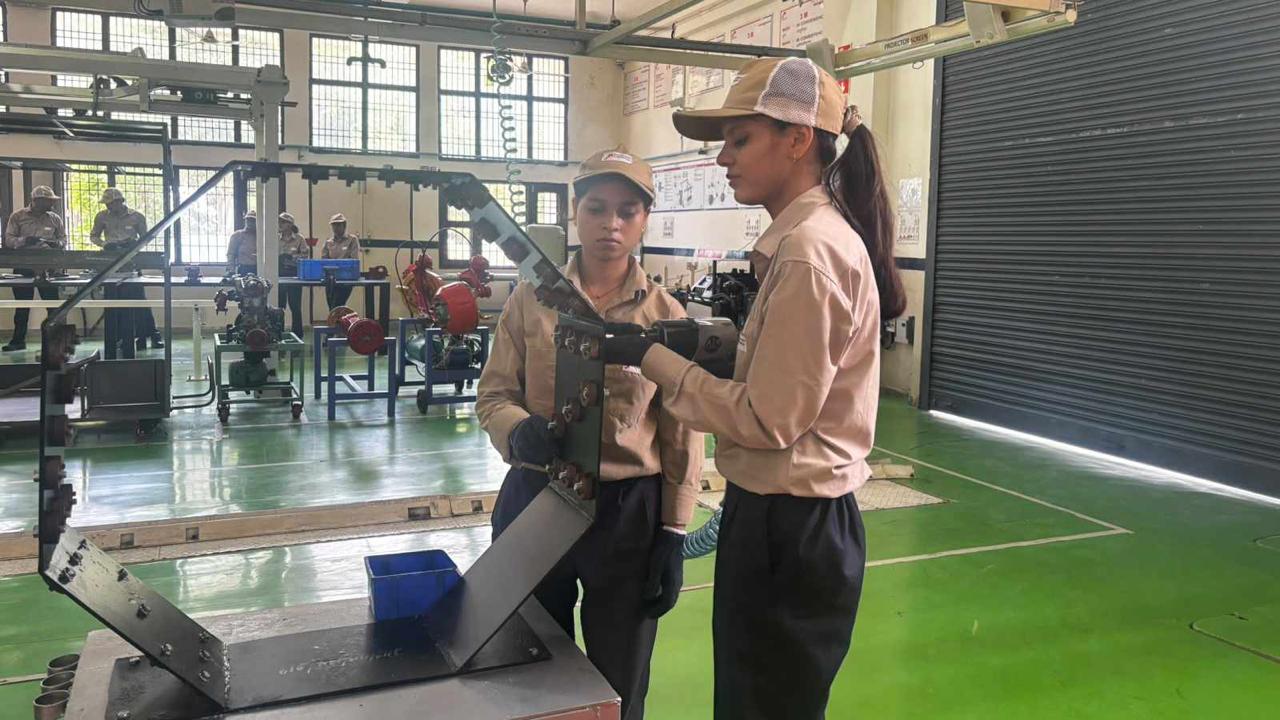
Tucked away from the bustle of the city, the two-storeyed building of the Japan-India Institute for Manufacturing (JIM) is easy to miss amid the lush paddy fields of Haryana’s Manesar. But step inside, and the quietness outside gives way to the hum of machines, the clatter of tools, and students moving from one workbench to another as they learn to operate the equipment.
In between the clamour, Nishika leaned over a workbench, carefully practising how to fit nuts and bolts. She made one attempt after another, trying to get it right with the tools in her hand.
For most students training for the manufacturing workforce, it was an ordinary practical lesson. For Nishika, it was also a step into a field she had been unable to pursue through the conventional academic route.
“I want to do a polytechnic course after this. I could not appear for the entrance exam earlier because I did not have chemistry and physics. Now, I can sit for the exam and directly enter the second year of the polytechnic course,” said Nishika, who hails from Haryana’s Sonepat, speaking to The Indian Express during a visit to the institute.
At JIM Manesar — one of four such institutes set up by the country’s largest automaker Maruti Suzuki — Nishika is pursuing a two-year Mechanic Motor Vehicle course covering car engines, repairs and painting. It is one of five two-year trades — a term used for specific vocational training courses — offered by the institute. The others are Electrician, Fitter, Electronic Mechanic and Electrician-Mechatronics. JIM also offers four one-year trades: Mechanic Diesel Engine, Welder, Mechanic Auto Body Repair, and Mechanic Auto Body Painting.
But in a class of 40 students, Nishika is one of just three girls.
Closing the gender gap, addressing key hurdles
The gender gap extends beyond JIM. Women remain underrepresented in India’s core engineering trades. A new working paper by NITI Aayog found that women accounted for only 5.5% of enrolment in engineering trades such as electrician, fitter and welder across the Industrial Training Institutes (ITIs) between 2019 and 2024. In contrast, women outnumbered men in several service-oriented trades such as fashion design, cosmetology, secretarial practice, and sewing technology.
Story continues below this ad
JIM Manesar has also seen female enrolment rise, though from a low base. Women account for around 9% of its annual intake of about 400 students, up from 5% the previous year and 2% when the institute began. It is now targeting a 30% female share of admissions by 2028-29.
Across the four JIMs, only the Manesar branch has female students, while the other three are yet to admit them.
At Manesar, the institute is taking a multi-pronged approach to increase female participation, including a dedicated women’s hostel, greater representation of women among faculty and support staff — and, from this academic year, a 100% tuition fee waiver for female students, said Rahul Bharti, Senior Executive Officer, Corporate Affairs, Maruti Suzuki India Ltd. “We believe this initiative will encourage more young women to pursue careers in manufacturing and participate in the growth of India’s industrial workforce,” he added.
The hostel could ease one of the practical hurdles for women coming from outside Manesar. Most of the female students at the institute come from different parts of Haryana and Uttar Pradesh, and stay in local paying guest accommodations.
Story continues below this ad
Personal links, training and stipends
Personal connections played a key role in bringing many of them to the institute. “My uncle works at Maruti Suzuki. He said this is a good course and has good job prospects,” said Soumya Gupta, who is from Khushi Nagar in Uttar Pradesh and is enrolled in the Mechanic Auto Body Repair trade.
However, Gurugram’s Kumkum learnt about JIM while she was in school and decided to apply after Class 10. Her family was initially hesitant due to the distance, but agreed after her school friend Pinki Singla also decided to join it. Both are now completing classes 11 and 12 through an open-school programme alongside their technical training.
The programme also allows students to earn while they train: they spend five months in the classroom and the remaining seven on the shop floor, where they receive a stipend. “We will learn here and also do the open school. Otherwise, it would have taken us longer. This way, we can study and get trained for jobs at the same time,” said Pinki.
KioskNews shows a cleaned-up reading view extracted from the publisher’s page — the original always lives on their site, not ours.