Inside the stressful, uncertain world of Formula 1
SINGAPORE – Unemployment and uncertainty are not only issues that average joes face in their work careers – Formula 1 drivers are victims of this too.
This is where Esteban Ocon has found himself at the tail end of the season, after confirming on Sept 30 that he is leaving Haas following a two-year stint with the United States-owned team.
Known as F1’s “silly season”, the driver movements for the 2027 line-up have been minimal, leaving few seats up for grabs.
High-speed thrills and pressure are part and parcel of the job, but for Ocon, the added stress of an uncertain future has been on his mind as he closes out the 2026 season.
The 30-year-old looked worn out as he spoke in front of 30 reporters and a dozen cameras in the press conference room at the Formula 1 Singapore Airlines Singapore Grand Prix on Oct 8, confirming that he will not race in 2027 if he does not get a F1 seat.
He told The Sunday Times: “It is not a good place to be. Having this weight on your shoulders racing every time; you can’t race freely, can you?
“It’s quite tough, but I feel like under this kind of pressure, that’s where I’ve performed better.
“It’s not a comfortable place to be, but I’ve proved it in Baku... putting in some points. That’s the only thing I can do: show that it’s worth me being here for any team out there.”
Ocon’s second season with Haas has not been ideal – he is currently 16th of 23 drivers with seven points. Four of them were earned at the Azerbaijan Grand Prix on Sept 26, when Ocon already knew he would not be with Haas in the new season.
Haas are seventh among 11 teams with 27 points, 20 of which were earned by Ocon’s teammate Oliver Bearman.
Ocon was in a similar position in 2019 when he was left without a seat and became a reserve driver for Mercedes.
He called that season away from racing the toughest moment of his 10-year career.
But he added: “This business is not always fair. That’s how it is.”
He is not the only driver to have experienced the stress of racing amid uncertainty.
Valtteri Bottas was famously put on one-year contracts during his time with Mercedes from 2017 to 2021, before he left the eight-time constructors champions’ for Sauber.
“In this sport you know if you are not signed anything can happen,” he said in 2019, reported The Guardian.
After his departure from Mercedes, he described the experience to Finnish media as “very exhausting”.
“When you feel like you have a knife at your throat, your head doesn’t do very well,” he told a Finnish podcast in early 2022.
On F1’s Beyond the Grid podcast in 2021, he said: “If you have pressure contractually for nine years of your Formula 1 career, year by year, it starts to eat you from inside, you know?”
The 37-year-old now races for new team Cadillac after a stint as a Mercedes reserve driver in 2025.
More recently in 2025, Liam Lawson got a taste of the sport’s cutthroat nature when he was demoted from Red Bull to sister team Racing Bulls after just two races.
High pressure behind the scenes
The pressure-cooker life extends to the engineers, mechanics, strategists, and team principals in the garage.
Ocon’s race engineer at Haas, Laura Muller, described a race weekend as a constant run.
“You just never stop. Your heart rate is on like 120 the whole day because you’re continuously doing something,” the 34-year-old German told ST.
“There’s also this stress, like you just know at this time I have to make a decision, I have to do this.
“I will learn any day now how to manage that pressure,” she joked.
During a race, she could have 10 people talking to her in a span of minutes. But over the course of her 12-year career, she has learnt to filter out the unimportant chatter.
Muller, who also made history as the sport’s first female race engineer, said: “Once you accept that you’re never going to make the perfect decision, you learn to prioritise.
“For example, if the driver says he’s struggling in Turn 1, but he’s not losing time there, you know you don’t have to worry about that and need to worry about a corner where he’s actually losing time. As soon as someone starts talking, I know whether it’s important, and if it’s not, it doesn’t even enter my brain. It’s more like a muscle memory now.”
![Laura Muller, race engineer of TGR Haas F1 Team at a ST interview at the paddock on Oct 8, 2026.[NOTE: F1 photos are for editorial use only and NOT for sale.]](https://cassette.sphdigital.com.sg/image/straitstimes/e1260aa6add01383257c96e6c1fa3197c359908ada9b3149c29acfc7ef814f8e)
Haas race engineer Laura Muller, who works with Esteban Ocon, made history as the first female to hold that role when she was promoted in 2025.
ST PHOTO: CHONG JUN LIANG
Williams team principal James Vowles knows well the scrutiny and stress that comes with the job, having started out in strategy with Brawn GP (later Mercedes) in 2009 before he took charge of Williams in 2023.
The Briton told ST at the Forbes Global CEO Conference: “The stress is that you know that any one decision you do, especially when you’re fighting for a race win, you’ll be adjudicated on by 70 million people. And you know whether you’ve made a mistake or not, normally, almost a minute after you’ve made it.
“The pressure is enormous because in some races, take Monaco, you get one chance. Sometimes, the data is 50-50 and you decide whichever way to go. One minute later, you know if you’re an idiot or a hero.”
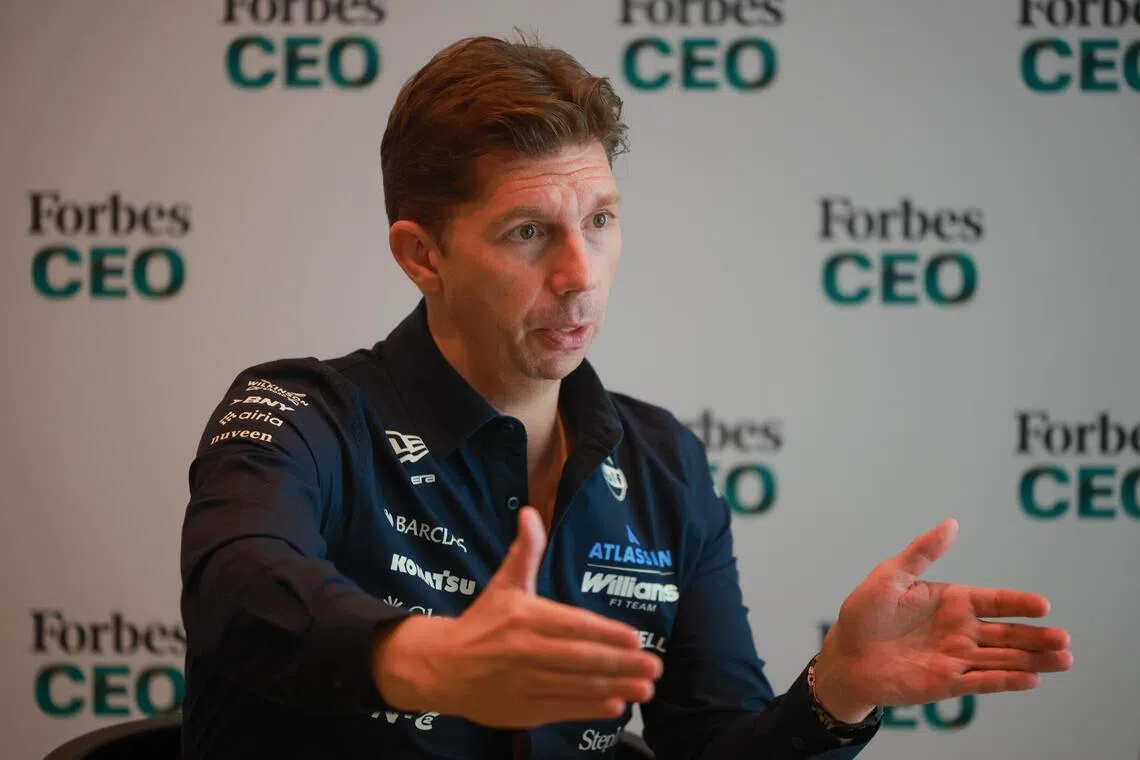
Williams team principal James Vowles has had to manage more responsibilities since taking over in 2023.
ST PHOTO: JASON QUAH
He highlighted the 2015 Monaco Grand Prix, where he made “probably the worst decision” of his career when he pitted race leader Lewis Hamilton during a late safety-car period.
But the pit crew miscalculated the gap they had for the stop, and Hamilton came out behind teammate Nico Rosberg and Ferrari’s Sebastian Vettel.
Hamilton settled for third after he was unable to make up places and Mercedes later apologised to him for the error, which did not prevent him from winning the third of his seven world titles at the end of that season.
Vowles recounted: “Lewis called on the radio and said his tyres were gone. I made a flash decision that we would stop him.
“Literally, the decision was made in 1.2 seconds, but it was the wrong one and we knew a minute later because of where he ended up on track.”
After moving to Williams, the pressure shifted slightly as he has to oversee corporate functions as well.
He said: “I still feel responsibility towards the teams and the fans, but I also feel a responsibility to the 1,300 people that are getting up and doing 12-hour, 16-hour days for us, for the belief in the journey.”
Yet, in spite of the mental toll the sport can have, it is the thrill that they live for and keeps them coming back.
Even for Ocon, the lure remains after experiencing heartbreak again.
He said: “I’m a tough guy. If you want to hit me hard, I hit harder. The mental strength, the motivation, how I grew up by never giving up, that’s probably why I always find the resource.
“Even when I’m completely drained, I find the extra resource deep inside to fight harder and I will never give up because I didn’t achieve what I want to achieve in the sport, and I want to win much more.”
KioskNews shows a cleaned-up reading view extracted from the publisher’s page — the original always lives on their site, not ours.