Why tuning is the most important aspect of Compound Archery
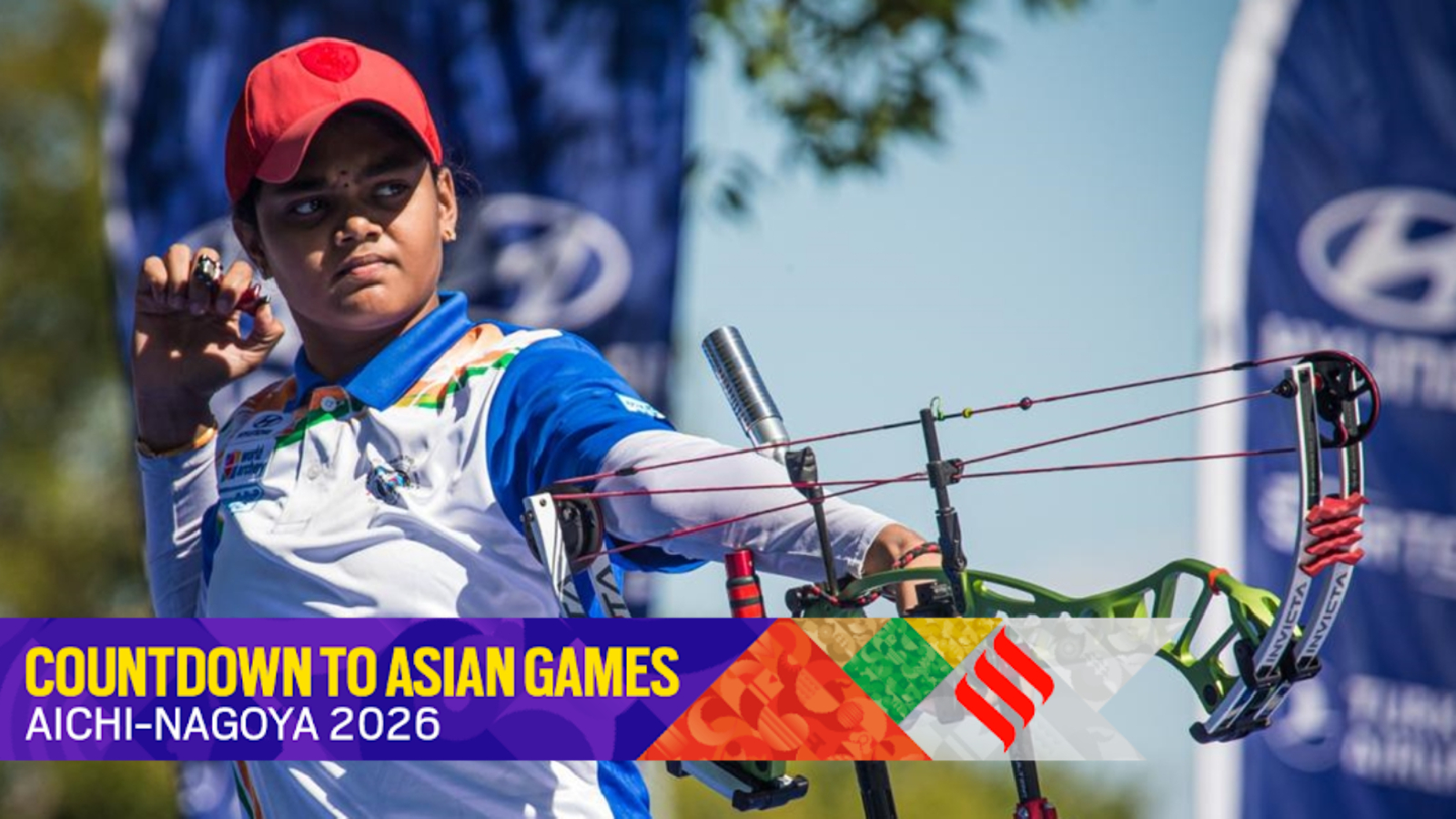
Compound archer Jyothi Surekha Vennam, who won three gold medals in last Asian Games, uses a bow with a draw length of 27.5 inches. Her Asian games team-mate Prithika Pradeep's bow is 25 inches. (File)
A Compound Archery bow has its own super-snappy elastic limbs.
They make it easier for the archer than a more complex Recurve bow. Simultaneously, this factor has kept Compound Archery away out of the Olympics until its inclusion for Los Angeles. Because the bow was considered too simplistic, and far too enabling to test absolute string-drawing and precision-aiming skill. It was being too helpful.
But with its inclusion as a solitary mixed-team event, the focus is on what sets apart the top archers in Compound, from the rest in an event that still makes demands on tiny detailing.
ALSO READ | Shooter Esha Singh’s scintillating 2026 form puts her in line for Asiad success
The force required to draw a Recurve bow using fingers is almost always in excess of 60 pounds. The compound bow has inbuilt mechanized pulleys so the maximum draw weight, has a ceiling of 60 pounds. This peak force required at full draw is 60-75% percent less than Recurve. Compound archers aim with far less strain.
The bow design, which sees use of a levering system of pulleys and cables, thence relies more on its own stretched limbs than the archer’s massive shoulder / back power.
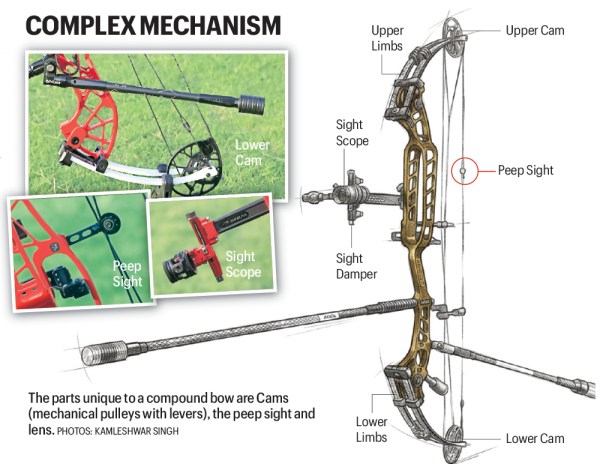 The Compound bow uses a system of pulleys and cables making shooting faster and more accurate than a Recurve bow. (Express Photo by Kamleshwar Singh)
The arrows are clipped on the bow string against a nocking point. Being inside the D-Loop, a short arc of material is connected to the release aid. Sitting on top of the arrow rest, a mechanism added for the first time in 1995, the archer doesn’t need to touch the arrow with their fingers. It’s like a gun on a tripod.
Story continues below this ad
Coach Sanjeeva Singh who brought Compound bows to India back in 2003, says the wheeled bow is all about tuning, draw lengths and archer position. “The position of peep sight changes based on draw length, bido and head positions of archer, as the stiffness of the (bow) limbs. The draw length and position changes due to the mechanical release. It took me a year to learn and our efforts paid off when Paltan Hansda won the junior world title in 2006,” adds Singh.
Worlds silver medallist Jyothi Surekha Vennam, who won three gold medals in last Asian Games, uses a bow with a draw length of 27.5 inches while her Asian games team-mate Prithika Pradeep’s bow is 25 inches. Vennam has a poundage of 55 pounds before the mechanical stop triggers the release aid.
“While mechanical cams are the same, we have to adjust the bow limbs as per the poundage. The draw length once set, does not change and the string will stop at the set length. Then we also have to adjust the long stabiliser as well as the short Vibration Reduction System (VRS) stabiliser with the weights and dampers attached. When the arrow is drawn, the stabiliser absorbs the force as well as brings weight control and balance so that the bow does not fall too much,” says national coach Jiwanjot Singh Teja.
ALSO READ | How Asian Games-bound Rahi Sarnobat is rediscovering her mojo at 35
Story continues below this ad
With the mechanical system, the archers are able to shoot arrows in excess of 300kph. Recurve? Capped at around 200kph.
The bows of Vennam as well as world bronze medallist Rishabh Yadav apart from former world number one Sara Lopez only differ in poundage and the draw length. Teja also talks about more accuracy brought by new materials. “Earlier the bows were made of glass fibre but now bows are made of carbon fibre and other materials. An archer like Rishabh or Jyothi uses Hoyt Concept X with just the difference being the poundage and the size,” adds Teja.
The recurve bow sees archers using their back, shoulder and arm muscles more with archers relying more on technique as well as release through fingers. Teja also outlines one major difference. “In recurve, one needs to have almost perfect body alignment where one’s shoulders, arms and spine form the letter T. In Compound, that’s not the case. We can adjust with the tuning and other aspects of the bow,” he explains.
The Compound bow has an interesting history in India. Back in the 2003 World Archery Championships in USA, the then former national recurve champion Sanjeeva Singh saw compound bows for the first time. Singh immediately bought four of those.
Story continues below this ad
The bow was invented in the USA in 1960’s, only as a more mechanically efficient equipment than Recurve, to carry back home. With India having won 16 medals in compound archery in Asian Games history, Singh, who started training compound archers in 2004, remembers how the bow fascinated him.
“At that time, short height archers would struggle with recurve bows. When I saw the compound bow, I was intrigued by the more mechanical efficient bow,” he recalls. In 2004, John Dudley, a leading name in compound archery, was invited to conduct workshops here and as Singh learnt tuning as well as the complications of the mechanical system. “Things like adjusting the tuning of the arrowhead as well as the spine of the arrows, which are more stiffer as compared to recurve arrows, were taught,” Singh recalls.
© IE Online Media Services Pvt Ltd

Nitin Sharma is an Assistant Editor with the sports team of The Indian Express. Based out of Chandigarh, Nitin works with the print sports desk while also breaking news stories for the online sports team. A Ramnath Goenka Excellence in Journalism Award recipient for the year 2017 for his story ‘Harmans of Moga’, Nitin has also been a three-time recipient of the UNFPA-supported Laadli Media Awards for Gender Sensitivity for the years 2022, 2023 and 2024 respectively. His latest Laadli Award, in November 2025, came for an article on Deepthi Jeevanji, who won India’s first gold medal at the World Athletics Para Championship and was taunted for her unusual features as a child. Nitin mainly covers Olympics sports disciplines with his main interests in shooting, boxing, wrestling, athletics and much more. The last 17 years with The Indian Express has seen him unearthing stories across India from as far as Andaman and Nicobar to the North East. Nitin also covers cricket apart from women’s cricket with a keen interest. Nitin has covered events like the 2010 Commonwealth Games, the 2011 ODI World Cup, 2016 T20 World Cup and the 2017 AIBA World Youth Boxing Championships. An alumnus of School of Communication Studies, Panjab University, from where he completed his Masters in Mass Communications degree, Nitin has been an avid quizzer too. A Guru Nanak Dev University Colour holder, Nitin’s interest in quizzing began in the town of Talwara Township, a small town near the Punjab-Himachal Pradesh border. When not reporting, Nitin's interests lie in discovering new treks in the mountains or spending time near the river Beas at his hometown. ... Read More
KioskNews shows a cleaned-up reading view extracted from the publisher’s page — the original always lives on their site, not ours.