‘Gay men keep my ego going – they message me all the time!’ Ed Gamble on Traitors, true love, weight loss and people-pleasing

Ed Gamble does not like seeing himself on screen. “I know a lot of comics who struggle with watching themselves,” he says. “No one should be having to look at their own face so much. It feels simultaneously arrogant and also the most self-flagellating thing you can do.”
Unfortunately for him, he is inescapable. Gamble presents the BBC’s wildly successful companion show to the Traitors, The Traitors: Uncloaked, along with the hugely popular podcast Off Menu, with the comedian and current Celebrity Traitors contestant James Acaster.
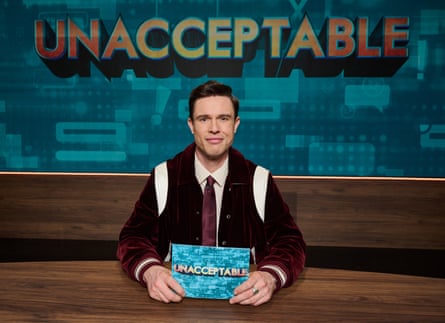
Over the summer, Gamble hosted a new show, Unacceptable, in which comedians try to stand up their worst opinions – a format produced by Romesh Ranganathan, surely the only comic with a heavier workload than Gamble. Another series starts next month. A special for Amazon Prime, based on Gamble’s last two standup tours, will also be available this month. He is, of course, grateful and delighted about all this. It’s a long time since I’ve met someone so self-aware and willing to acknowledge their many privileges without a hint of chippiness.
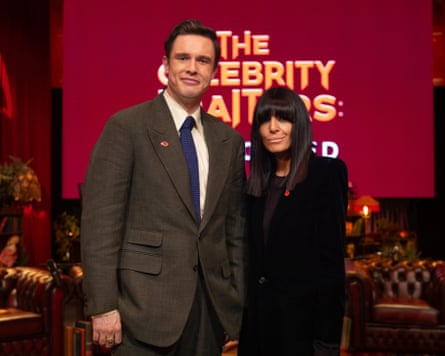
Gamble has known every twist of The Celebrity Traitors, including the eventual winner or winners, since it was filmed some months ago. How does he handle the pressure of keeping it all in?
“Even with my wife, who loves the show, I want to tell her what I’ve been doing on a work day, but I can’t tell her who I’ve met,” he says. Luckily, people don’t generally want to know. If they do ask, Gamble might pretend to be about to tell them. “Then you see their face go: ‘I don’t want that. I want to be part of the national conversation.’”
We meet on a mild October day in a pub garden near his east London home. The actor Myha’la, who had just been banished from the show, had made comments on Instagram, addressing suggestions that unconscious racial and cultural bias exists in interactions between the players. “I certainly wouldn’t like to counteract anyone’s lived experience,” says Gamble. “I also think Myha’la said that she signed her own death warrant with the wink [at Richard E Grant shortly before he was unmasked as a traitor]. But that certainly doesn’t mean it’s not true, and it’s something that needs to be discussed and looked at.”
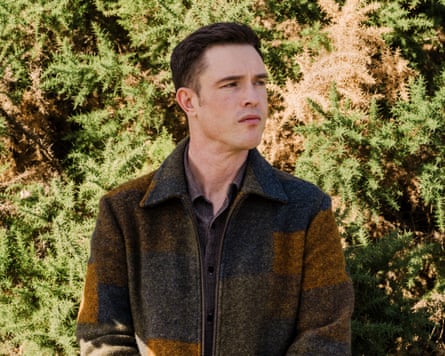
Gamble describes himself as a Traitors “obsessive” (it becomes clear that his capacity for obsessions is part of his personality). “I don’t like it if I think people aren’t playing the game hard enough,” he says, smiling at his own exactness. He knows a lot of the people in this series – fellow comics Ranganathan, Joanne McNally, Rob Beckett and Acaster – but it’s the actor Ross Kemp who, says Gamble, “I was most excited about going in, and I think is bearing out to be my favourite so far.” He and Acaster have had Kemp on their Off Menu podcast. “He’s just such an enigma. He’s obviously got this hard man thing, but also, he’s a proper actor, a total luvvie and, from what we’ve seen on Celebrity Traitors so far, highly sensitive, highly emotional, really cares about the game. I think there’s so many things going on with Ross Kemp that I find adorable and very funny.”
Growing up, Gamble initially wanted to be an actor, “because that’s what I knew about. I loved films and TV, and I probably wasn’t really aware of ‘comedian’ as a job.” When he was 13, his mother took him to see Steve Coogan perform, and he began watching comedy shows on BBC2, such as Goodness Gracious Me. He read philosophy at Durham University, where he did sketch comedy and found like-minded friends, including the comic Nish Kumar, with whom he later shared a flat in London.
After university, Gamble tried standup, “and fell in love with it – just wrestling with performing on stage.” He gigged regularly, did an influential comedy podcast (Peacock and Gamble, with the comedian Ian Boldsworth), then started appearing on TV in the early 2010s. His career since then has seemed unstoppable.
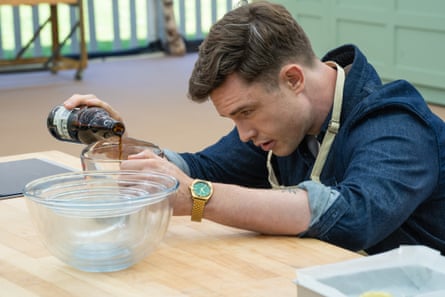
His new standup show, Fresh Hell, which he will tour next year, is, he says, “another really heavy emotional show. Very political, of course. A lot of it is about toilet brushes. It’s hugely silly. It’s stuff that feels really fun to say.” Gamble can be hilariously revolting, but he’s not interested in being edgy. “I find the attitude of ‘I can say what I like, it’s comedy’ such a teenage opinion. Like, that’s true, you have total free speech. But there might be consequences, and some people might not like it, and they might say they don’t like it, and you can’t censor them for saying that.”
There is still a trend for “edgelord” comedians – those who set out to be offensive – but Gamble thinks it’s just part of a cycle. “Quite often they only talk about three topics, and they’ve all got the same angle on it. I think it’s bad for creativity, certainly, but it’ll subside. It’ll keep coming back round again, and it’s often aligned with how things feel politically in the world.”
In an era in which comedy clips can circulate without context, is he concerned about what he says? “I guess so, but I’ve always tried to think about what I say and how things can be interpreted. I think that’s a really important thing to do, as anyone who has a public platform. I’ve never been in the game of trying to upset anyone. That’s not who I am, and that’s not what my comedy is.”
Being likable is important to Gamble. In his 2023 memoir, Glutton, he unpicks his “desperate need to fit in with people”, as he puts it. His greatest fear is some sort of social banishment. He’s that person, he says, who reads 100 nice comments about himself, then thinks about the bad one for a week (he has a device to lock apps on his phone).
“I think it’s that thing of being a desperate people-pleaser, and it’s probably one of the most pathetic elements of my personality. But also, I kind of don’t mind it, because that’s what drives me, and what makes me try to hone what I’m doing. I do wish I had that slight abandon and self-confidence to be like, ‘I’m right about this, fuck you guys,’ but I don’t.”
Has his people-pleasing decreased the older and more successful he gets (he turned 40 this year)? “No, because the more people who see you doing things, the wider the field is of people who might potentially not like you, and then you see that happen.” He laughs. Those objective measures of success are “definitely something to lean on, but the brain’s an odd thing, right? It’s not logical a lot of the time. It will just go: ‘Well, think about what that one person said. That’s the real thing.’” He’s getting better, he says, “at going, ‘That doesn’t make sense, so maybe think about how well things are going.’”
In his book, he acknowledges the cliche that he has sometimes used humour as a defence mechanism. He grew up in south London, attending the prestigious private school King’s College. There, his brand became the “funny fat guy”, he writes. For the first half of his life, Gamble was overweight. “I was conscious that I could be funny, and of what that could do in a social setting. Just throwing in those jokes, going, like, ‘I know I’m bigger than you, but I’m in control of it, and I can make those jokes before anyone else does.’” But it also legitimised them. “People would then feel freer to make jokes about it around me, and I’d put myself in a situation where I had to laugh or build on those jokes. Whereas internally, I think they hurt a little bit all the same.”
He wouldn’t necessarily recommend self-mocking in that situation. “Broadly, what I wouldn’t recommend is making jokes about people’s weight. But you can’t tell kids at school, can you?” He dismisses the idea that he suffered much, though. “I don’t think it was massively difficult.”
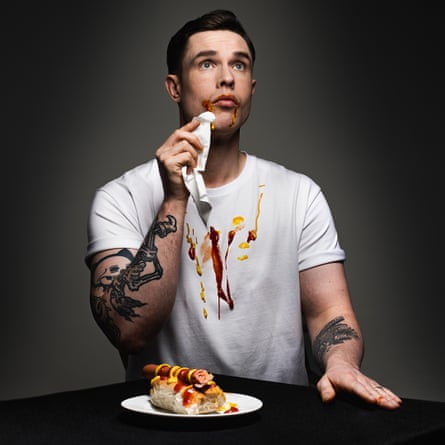
In Glutton, a book with a chapter devoted to his love of cheese, Gamble comes across as someone largely accepting of his weight, which increases in direct proportion to his overwhelming love of food. In his early 20s he reached his highest weight, about 120kg (19st). What made him decide to lose it?
“The whole thing is so vain that I hate saying it, but I was booked for a TV gig,” he says. “I thought, ‘Right, that’s in four months or whatever, so I’m going to see if I can lose a bit of weight before that.’ I started doing all the things that people say you should do – do a bit of exercise, maybe don’t eat all of that.” The weight began to come off. “I know there’s various reasons why that doesn’t work for a lot of people, so I’m not saying it’s as simple as that. But, for me, it started to be.”
It was also a time when he was trying to take control of his health, having been diagnosed with type 1 diabetes a decade earlier, at 13. “The only plus side I would say of type 1 diabetes is your blood glucose levels really tell you what you shouldn’t be eating. So I was keeping an eye on that, and I was trying to eat more nutritiously, and it just worked.” He lost 44kg. Then he became “obsessed” with exercise; he took up running, and ran two London marathons. “It all worked out that way, really. But the basis of it is vanity.”
Was it ambition as well? Did he think he would be less successful if he was larger? “Genuinely, no,” he says. “But that is a thing. I do find it quite sad, but also I am the beneficiary of it, that I probably have got way more work since I’ve lost weight. If I continued to be the size I was back then, I don’t think I would have got half the things I’ve got, because of that.” It’s not news that ours is a sizeist society, and this isn’t just in the entertainment industry, says Gamble. “I’ve read plenty of fascinating articles about this, that people above a certain size don’t get considered for jobs. I don’t know what it is, but it’s quite depressing.”
Gamble’s relationship with food is a lot healthier now, although he has replaced quantity with quality and become a self-confessed food bore. “I still eat whatever I want. I’ve just managed to draw a distinction between want and need, and I go: ‘That’s delicious, I’ve enjoyed that. I’m full now.’” Does he obsess about his weight? “I do sometimes, in terms of body image stuff, but it’s been way worse than it is now. The only time I really started worrying about my weight was when I lost a lot – you start to worry about it coming back – but I think I’m in a good place with that now.”
He is easily influenced by social media, though, he says, and the expectations on men to look a certain way. “If you’re interested in anything fitness, your phone will realise that, and then it’ll just show you pictures of men working out and going: ‘I eat carbs all day, and I still look like this.’ I’m like, ‘Well, you’re 20 and clearly genetically gifted,’ but it will still be ticking over in my mind. I try not to engage in too much of that.”
I’m fascinated by people’s transformations, and although Gamble’s wasn’t too drastic – if he’s hot now, he was also nice-looking when he was larger – it also coincided with becoming famous and, presumably, fairly rich. Gamble writes that, even at university, his role with girls was as “trusted friend and sexless confidant”, so how did he not go wild with all that must have suddenly been on offer?
“I’ve been hugely privileged throughout my whole life, so it’s not like I’ve come from a hard background and suddenly I’ve got loads of money,” he says, matter-of-factly. “In terms of relationships, I met my wife before I lost weight and before I got any massive success within the world of entertainment.” He married Charlie Jamison, a TV producer and musician, in 2021. “So I’ve always had a very supportive home life, and that’s the thing I want to preserve more than anything.”
But he must get women approaching him? “Genuinely, no. I talk about Charlie so much – on stage, in interviews, on podcasts – that I think I’ve now become known as a mega wife guy. What I’ve noticed is no approaches from women, almost, and my social media is open. They’re just very respectful, and I appreciate that.” He smiles. “You’ve got to say thanks so much to the gay men for keeping some sort of ego going, because they don’t care, they’ll message me all the time. I can open my message folder and go: ‘I’ve still got it.’”
When life is good – great marriage, stellar career – is that helpful to his comedy?
“I’d say in some senses, yes, because I’m happy, comfortable, and that’s why I write a lot of silly material. A lot of the comedians I love are more inward-looking, slightly more tortured, if that’s a phrase I can use. I think that’s what some comedy fans prefer, and certainly critically, it’s preferred. But you know what, the trade-off is I’m on stage for an hour a day, and absolutely love the other 23 hours to be nice.”
He has nothing, really, to worry about, he says, “in comparison with a lot of other people”. But still, he adds: “I’ll always find things to worry about. It’s almost funnier to have everything laid out in front of you quite nicely and still fuck up.”
Ed Gamble Live streams on Prime Video from 29 October. The Fresh Hell tour starts 30 January; details at edgamble.co.uk
KioskNews shows a cleaned-up reading view extracted from the publisher’s page — the original always lives on their site, not ours.