‘Someone served sushi off a guy’s naked chest!’ How we made Come Dine With Me
It all started in the early 00s when I tried to throw a dinner party. I was an executive producer during the early days of reality TV – and a house-proud young mum. My posh cousin and her even posher husband came for a meal. I was rushing to get the kids to bed and tidy up, so the food was an afterthought. I’d never made couscous before but decided to serve it with chicken. It was awful. Dry chicken with congealed couscous. At one point, my cousin’s husband stuck his fork in this rock-solid lump, lifted it up and said, “What actually is this?”
When they left, my husband slumped in his chair and said, “I’d give that a three.” I thought there was something funny about scoring somebody’s hosting skills. Everyone leaves those terrible evenings and dissects it with their partner. I came up with the idea of groups of strangers taking it in turns to host, competing for a cash prize.
I pitched it as Ladies Who Lunch, with a Real Housewives vibe. ITV rejected it but Channel 4 daytime were interested. They massively improved it by insisting it should be dinner and everyone had to be a decent cook. The threshold was that contestants had to know what coriander was – that was the test we hit upon. The working title was Let Me Entertain You. Later it became Come Dining, but lawyers worried it was too close to Come Dancing. I suggested Come Dine With Me.
The pilot episode had a narrator who is now a famous actor. He sounded too posh. Replacing him with Dave Lamb’s more casual, sarcastic style took it to another level. The idea of the voiceover talking directly to the contestants was groundbreaking. Dave would throw in “Oh really?” or “God, get a room!”. We’re not there to humiliate or sneer, just to gently take the piss and puncture pomposity, which is a very British trait. Dave walks that tightrope perfectly.
Ratings were pretty good but Channel 4 wavered about recommissioning it. What saved us was that it started doing well on catch-up because students, bless them, alighted on it as hangover viewing. On a Sunday, they’d climb into bed together and watch the omnibus edition. That rescued us. It also gave us traction when selling the format abroad. There are now 50-odd international versions.
It’s a small show that made a big impact. Dinner parties used to be snooty affairs. I hope we helped make them less formal and more fun. I’ve always believed that hosting isn’t to do with wealth, class, the size of your house, or whether you used napkins or paper serviettes. It’s about the warmth of your welcome.
I never imagined Come Dine With Me would run for 21 years. Its staying power is testament to the fact that there’s an endless supply of brilliant ordinary people who make for cracking TV. It’s also cheap to make. We even turned it into a stage musical. I’d like to think we influenced shows like Four in a Bed and Don’t Tell the Bride, maybe even Gogglebox and Love Island’s irreverent narration. And I throw a much better dinner party nowadays. I’ve even nailed couscous.
Dave Lamb, narrator
It started out as a slightly more serious food competition, then they looked at the pilot episode and decided there was more fun to be had by focusing on the people, not the cooking. A few of us comedy performers auditioned to take over the narration. I just improvised around the script. Before long, I was doing lots of asides and mucking about.
“Mango” and “tiramisu” are some of my favourite words to say. I enjoy pronouncing “chorizo” wrongly because it infuriates people. Bruschetta can either be “bru-shetta” or “bru-sketta”, depending on what part of Italy you’re in. Sometimes I’ll do both pronunciations in the same episode, just for mischief. There are filthy bits that don’t make the cut. Occasionally I’ll let go a barrage of truth, shall we say. Obviously that can never see the light of day.

I’m keen for my voice performance not to be unkind. If I wouldn’t say something to their faces, I won’t say it in the voiceover – that’s my yardstick. If contestants are being rude or making fools of themselves, you can see it on screen. It doesn’t need me adding some snide comment.
I realised the show was a hit in 2008 when I was acting in a series called Moving Wallpaper. All these brilliant actors kept saying, “Oh my god, you’re that guy from Come Dine With Me!” I was becoming known as this shouty voiceover bloke. I used to record it sitting down but started losing my voice; a vocal therapist told me I need to stand up because I push it so hard. We do five episodes per session, and by the end I’m spent. My voice only tends to get recognised if I get overexcited. If I get loud and pitch up the register, people go, “You did a bit of it then!”
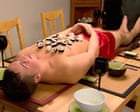
After this long, it all blurs into one, but certain moments stick in the mind, like sushi being served off a naked guy’s chest. Or the guy who stuck an entire whisk in his mouth. Or the time someone got their pet snake out and it pooed all over the dinner table. One of the most notorious clips is the “What a sad little life, Jane” rant. There’s not much you can add to that, but I was quite pleased with my “Doggy bag, anyone?” line. In terms of horrific dishes, there’s been quite a lot of roadkill.
The longevity of it is bonkers. I assumed it would be one and done. It would’ve been beyond my comprehension that 21 years later, I’d be doing the same job. I think the appeal is about people and their houses. We all have a fascination for where other people live and how they feed themselves. The magic for me is this enormously diverse range of people sitting around the same table.
It’s nicely paid but the beauty of it has been a steady income over a long period. We’re closing in on 2,500 episodes. That’s a lot of shouting! Apparently, humans change all their cells every seven years, so I’ve had three entire bodies while doing this and we’re just about to crack into the next.
KioskNews shows a cleaned-up reading view extracted from the publisher’s page — the original always lives on their site, not ours.