Fewer Sec 3 students taking eight or more subjects, more opting for just six
SINGAPORE - Secondary 3 students in 2026 are taking fewer subjects, after changes to junior college (JC) admission scoring.
From 2028, JC admission will be based on students’ performance in five G3-level subjects, instead of six. The current Secondary 3 cohort will be the first to enter JC under this new scoring criteria.
In response to queries from The Straits Times, the Education Ministry (MOE) said the share of Secondary 3 students taking eight or more G3-level subjects in 2026 has more than halved from 34 per cent in 2025 to 14 per cent currently.
Subjects can be taken at G1, G2 or G3 levels, which are broadly mapped from the Normal (Technical), Normal (Academic) and Express standards, respectively.
From 2025 to 2026, the proportion of students taking seven subjects rose slightly from 54 per cent to 57 per cent, while those offering six or fewer subjects more than doubled, from 12 per cent to 29 per cent.
Among students offering six or fewer G3-level subjects, one in five also offers at least one subject at a less demanding level - G2 or G1.
From 2028, JC admission will be computed using a new L1R4 aggregate score, capped at 16, instead of L1R5. This reduces the required number of G3-level subjects from six to five.
The change is intended to give students “more autonomy to recalibrate their curriculum load”, Education Minister Desmond Lee said in Parliament in August, in response to a question from Shawn Loh (Jalan Besar GRC).
Taking one fewer subject means that students can use the freed-up time for broader development, he said.
At the same time, students who aspire to enter JC are still required to take two languages and three subjects from mathematics or science, and the humanities subject groups to maintain a “broad-based” education, he added.
Under the new policy, fewer students in the first cohort are enrolling in geography, physics and Principles of Accounts.
MOE said students remain exposed to these disciplines elsewhere in the curriculum, such as through combined science for physics. And while enrolment for Principles of Accounts has dipped, the ministry said it remains a popular elective subject.
It added that the rise in students offering six or fewer subjects may also reflect revised polytechnic admission criteria for 2028, which will consider four G3-level subjects and one G2-level subject, instead of five G3 subjects.
Lighter curriculum load
Schools have revised their subject offerings, with some students opting for lighter workloads.
Students are also guided in choosing subjects through education and career guidance programmes, subject taster lessons in lower secondary and industry exposure.
About half of the Sec 3 students taking mostly G3 level subjects at Bedok South Secondary School now take six subjects, while the other half takes seven. It no longer offers eight-subject combinations.
The school’s principal, Daryl Koh, said the change was an opportunity to place greater emphasis on well-being alongside academic rigour. It encouraged students to select the right subjects and maintain a sustainable curriculum load, he said.
Swiss Cottage Secondary School in Bukit Batok used to offer only eight-subject combinations for its upper secondary students. This year, more than half of its Sec 3 students taking mostly G3 level subjects have opted for seven subjects.
Its principal Mandy Cheng said academically inclined students can still take nine subjects. Only a handful do so, typically to pursue interests in a third language or G3 computing offered at external venues.
Balancing aspirations
Students said the revised JC admission criteria allowed them to drop subjects they were not interested in. The reduced workload has also given them more time for hobbies and leadership roles, said Linus Fun and Alizee Lam from Bedok South Secondary.
Both 15-year-olds opted to do only seven subjects to better manage their time.
“I want to focus on my well-being and ensure I have time to indulge in my interests. If I had taken one more subject, I would have longer school days and a heavier workload,” said Linus, who holds a leadership position in the school’s National Cadet Corps.
An aspiring lawyer, he enjoys taking part in debate competitions organised by the school. He also spends two hours, twice a week, rock climbing at Lavender, a sport he has been doing since the age of four.
His schoolmate Alizee Lam, had planned to take one Science and two Humanities subjects as part of an eight-subject combination.
She changed her mind to take up Combined Science, which pairs two science subjects into one, and one Humanities subject instead.
“I decided to focus on subjects that I was more interested in, and which align with my goal of studying psychology or law in the future,” she said.
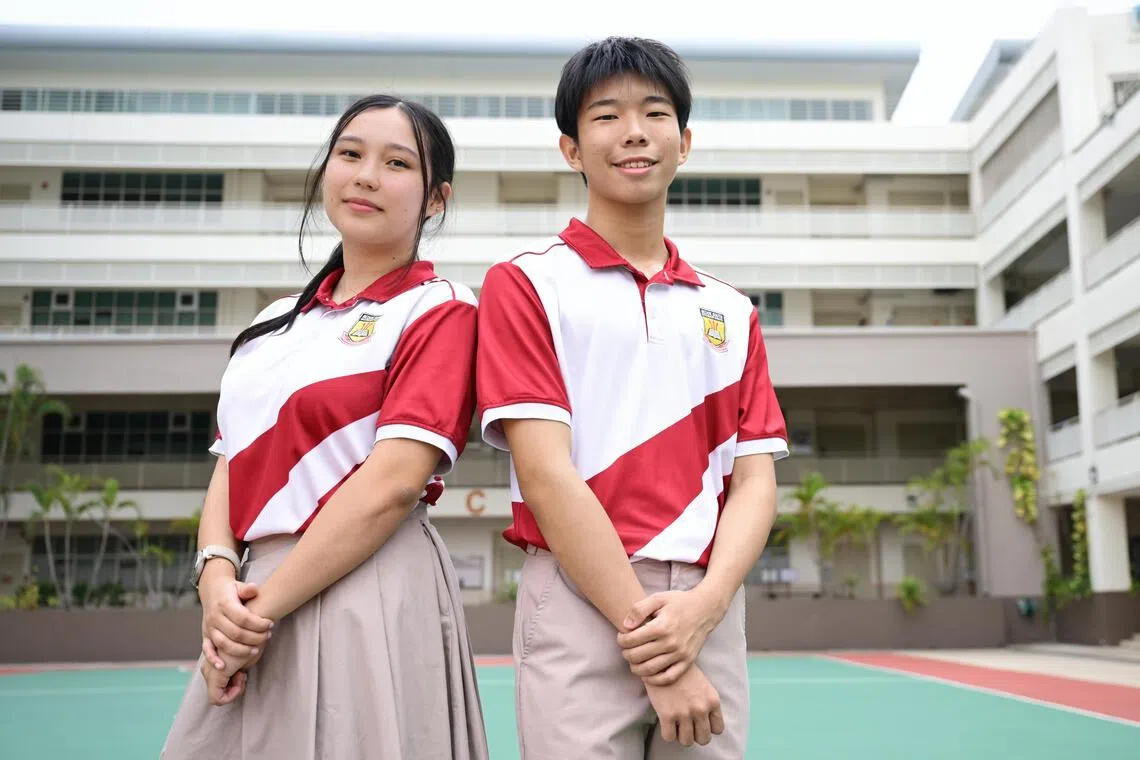
Bedok South Secondary students Linus Fun (right) and Alizee Lam opted to do only seven subjects to better manage their time.
ST PHOTO: NG SOR LUAN
At Swiss Cottage Secondary, Sec 3 students Andi’ Syakirah and Natasha Ng are pursuing starkly different subject combinations.
Syakirah is taking seven subjects, some of which are out of her own interests. For instance, she reads Higher Art, Higher Malay, and Malay literature - part of a humanities subject with social studies.
“I’m the kind of person who usually does well in a subject because I like it,” said the 15-year-old who hopes to become a mother tongue language teacher through the Malay Language Elective Programme in JC.
Her schoolmate, Natasha Ng, 15, chose an eight-subject combination. The aspiring anaesthesiologist is taking biology, chemistry, physics and additional mathematics.
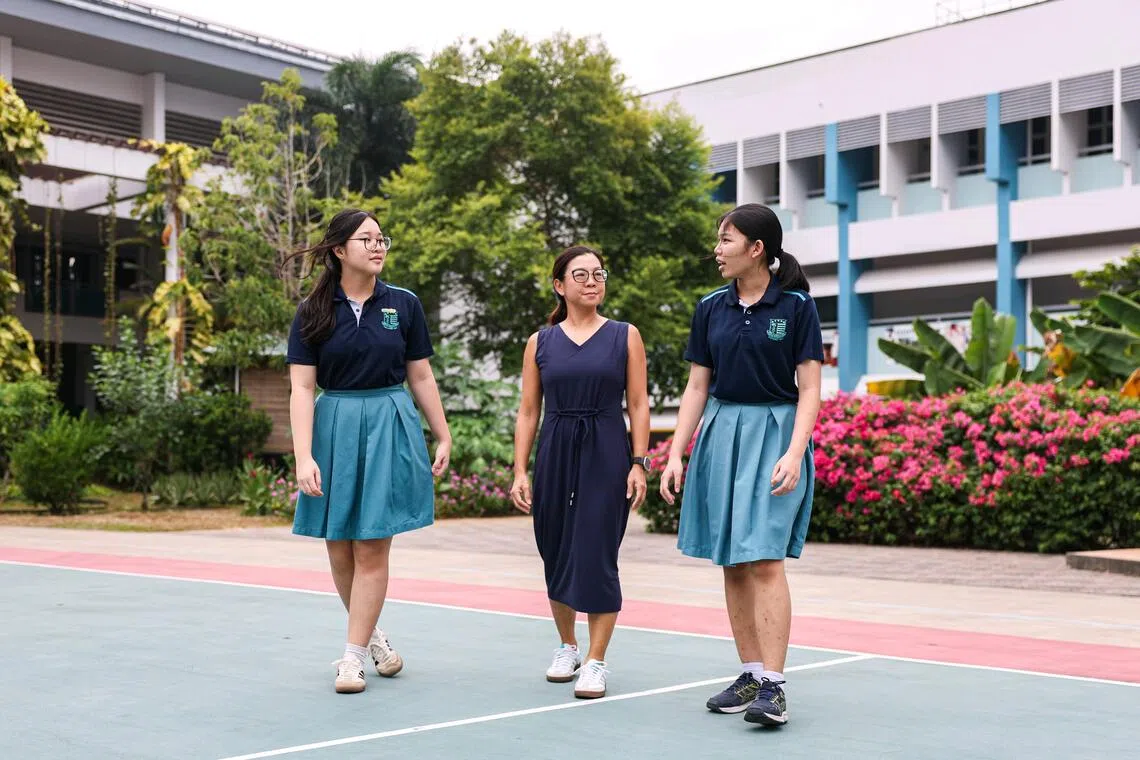
Swiss Cottage Secondary School principal Mandy Cheng (centre) with students Natasha Ng (left) and Andi' Syakirah (right) on Sept 18.
ST PHOTO: BRIAN TEO
“I know triple science is a lot of work, but my ECG counselor gave me the assurance that if I ever felt there was too much work and I couldn’t cope, I could just drop physics later on,” she said.
Natasha, a student councillor and head of photography in the school’s Media Club, said she would have taken nine subjects under the old system.
She said she was comfortable with the eight-subject load and preferred having more options now.
“It’s better to start with more and then drop one if you cannot cope. Because you cannot go from two sciences to three later on. At least you won’t live with the regret of not trying.”
KioskNews shows a cleaned-up reading view extracted from the publisher’s page — the original always lives on their site, not ours.