At 73, a Kelantan craftsman is weaving a future for a fading fishing tradition
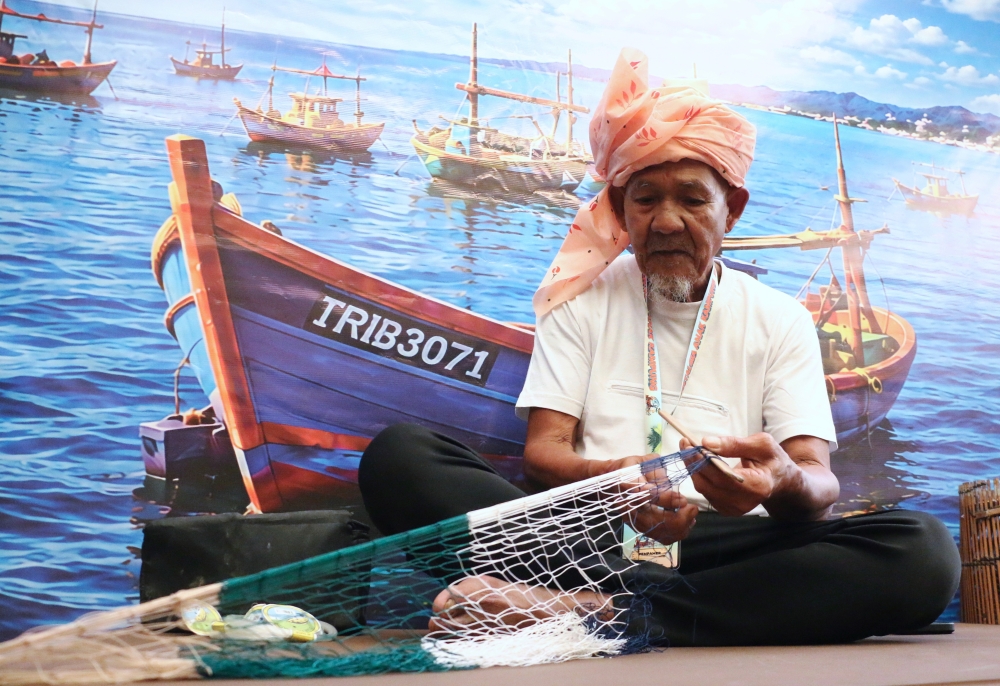

Buniamin Abdullah demonstrates traditional fishing net-making at the National Museum in Kuala Lumpur, a craft he has practised since 1987. — Bernama pic
First Published: Monday, 09 Nov 2026 7:00 AM MYT
KUALA LUMPUR, Nov 9 — With a keen gaze and nimble fingers, 73-year-old Buniamin Abdullah deftly loops and weaves netting yarn, knot by knot, to form the meshes of a fishing net. The traditional skill he learned long ago remains intact despite his advancing age.
Affectionately known as ‘Abah’, Buniamin, who is from Kota Bharu, Kelantan, has been making fishing nets by hand since 1987, carrying on a generations-old craft passed down to him by his parents.
The father of three said that although he no longer has the physical strength to brave the waves of the open sea, his passion for traditional net-making has never faded. Instead, the craft has become a form of therapy that calms his mind and brings him peace in his golden years.
“Whenever I feel bored, I turn to this work. It puts my mind at ease because my attention is focused solely on making the net meshes,” he told Bernama during a traditional fishing net-making demonstration held in conjunction with the ‘Nostalgia Anak Kampung 2026’ programme at the National Museum here.
Buniamin said making a fishing net entirely by hand requires considerable patience and precision, as well as two essential tools — a measuring gauge and a specialised netting needle — and nylon strands as the main material.
Buniamin, who has 13 grandchildren and nine great-grandchildren, said the measuring gauge is used to determine the size of each net mesh, while the needle is used to weave and securely knot the nylon strands together.
The weaving process, he said, has to be repeated thousands of times to ensure uniform mesh openings, which usually measure 1.9 centimetres (cm) for prawn nets and more than 2.5 cm for fish nets.
“For finer nets, you need a finer needle. For larger nets, you use a bigger needle,” he said, stressing that precision in the weaving process is crucial to ensuring a neat and well-finished net.
Buniamin, who was born in Pasir Mas, Kelantan, said a small net could take approximately 20 days to complete, while larger nets require more than a month, depending on the fineness of the mesh.
This inherited craftsmanship has also become a source of income for him, with his handmade nets enjoying strong demand and fetching prices starting from RM500 each, depending on their size and the complexity of the work involved.
Buniamin, however, acknowledged that advancing age and deteriorating eyesight have increasingly limited his ability to produce nets with finer meshes.
Although he is concerned that the traditional craft is gradually losing its appeal among younger generations, he is happy that two of his children, a son and a daughter, as well as several grandchildren, have learned the skill.
“If we want this craft to survive, we must teach our children so they can carry on the work. I have taught my children too,” he said.
Meanwhile, Kelantan State Museum Corporation senior assistant curator (Exhibition Division) Shahrul Hisham Abdul Ra-aid said machine-made fishing nets are generally sold at much lower prices because they are mass-produced in factories, unlike handmade nets, which require considerable effort and dedication and could take months to complete.
“There are still people who are skilled in making handmade nets, but their numbers are small. Most of those who still make traditional fishing nets and fish traps are from the older generation, while interest among young people is declining.
“That is why we invited net-makers like Abah, so the public can witness firsthand how fishing nets are made by hand, rather than simply viewing the finished products,” he said.
He hoped that such exposure would raise public awareness and appreciation of the traditional crafts of local fishing communities, ensuring that this valuable heritage would not disappear altogether. — Bernama
KioskNews shows a cleaned-up reading view extracted from the publisher’s page — the original always lives on their site, not ours.