‘A new imperial age:’ Yuval Harari warns Philippines of foreign AI dependence
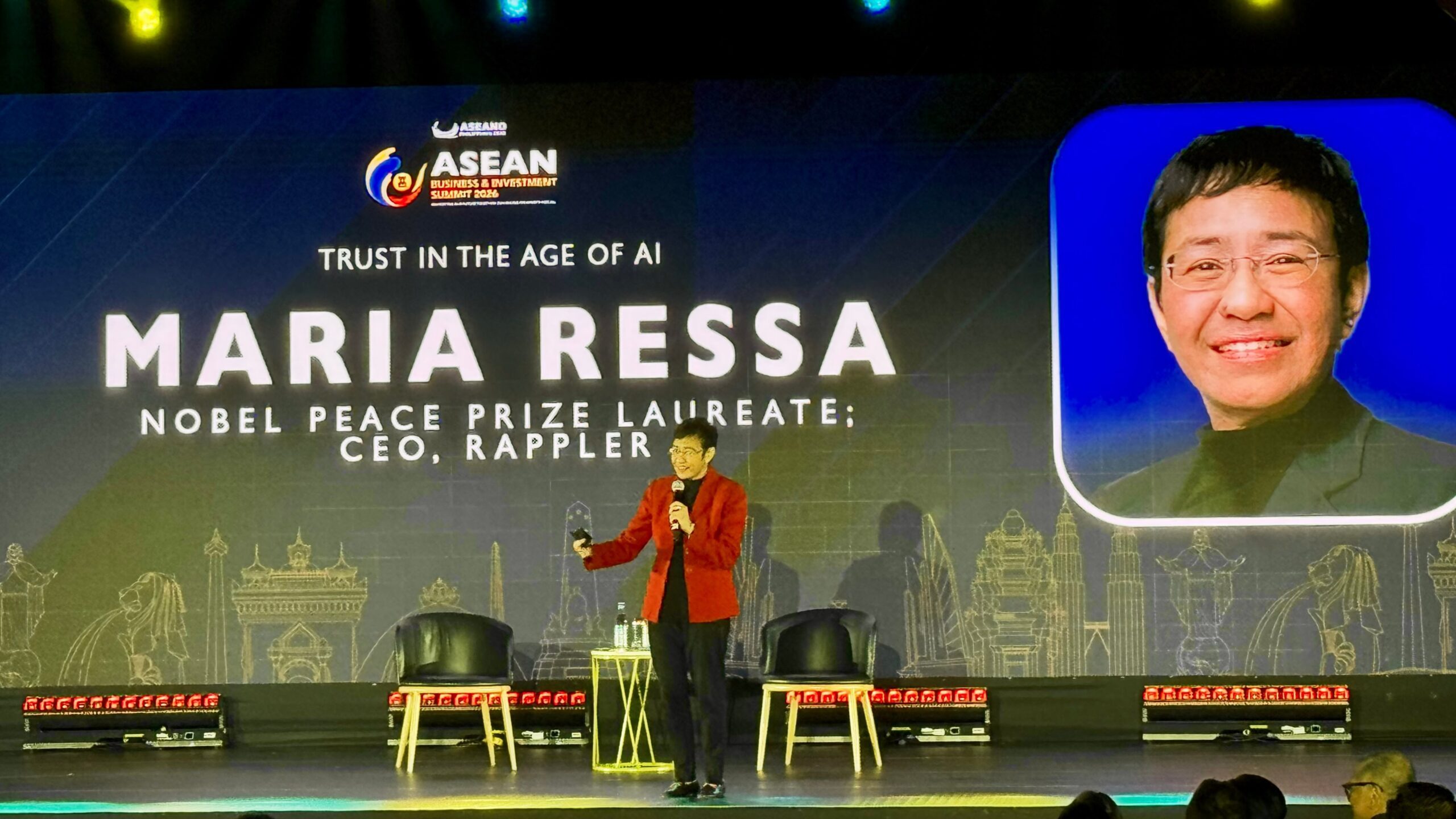

FUTURE. Rappler CEO and Nobel Peace Prize laureate Maria Ressa and historian Yuval Noah Harari talk about the future of AI for humanity.
Rappler
The best-selling author of 'Sapiens' and 'Nexus' warns that AI could usher in a new age of empires and leave countries like the Philippines dependent on foreign powers
AT A GLANCE
- Historian Yuval Noah Harari warns that countries like the Philippines risk losing control over critical infrastructure due to dependence on foreign AI technologies from superpowers like the US and China.
- Harari suggests that the Philippines should consider cooperating with regional partners such as Japan and Australia to develop shared AI capabilities instead of solely relying on foreign systems or building independent infrastructure.
- He emphasizes the importance of political intervention in AI development, advocating for a focus on safety and practical applications rather than a race toward superintelligence.
This is AI-generated. Read the article for full context. Report any errors.
MANILA, Philippines – As the Philippines finds its place in the global artificial intelligence (AI) industry, historian and best-selling author Yuval Noah Harari warned that countries outside the world’s leading technology powers risk losing control of critical infrastructure unless they develop their own capabilities or cooperate with regional partners.
Speaking with Rappler CEO and Nobel Peace Prize laureate Maria Ressa at a pre-recorded conversation for the 2026 Social Good Summit, Harari said the concentration of AI technology in superpowers like the United States and China could usher in a new era of economic and political dependence.
“We are entering a new imperial age,” Harari said. “The empires are back.”
And this time, he warned, could be even worse. Consider how the Romans and the British – powerful as their empires were – remained constrained by geography and physical resources. But now with AI, control of its infrastructure and frontier models could concentrate economic and military power in ways previously impossible.
As lesser powers become dependent on foreign AI systems to run hospitals, airports, and military equipment, that could raise their vulnerability to decisions made abroad.
“In that situation, you’re no longer independent, you are a vassal state,” Harari said.
For the Philippines, which Ressa described as having been a testing ground for social media platforms, the concern revives many old fears.
“We were the petri dish for social media,” Ressa said, recalling how Facebook became a breeding ground for disinformation and political manipulation during Rodrigo Duterte’s rise to power in 2016.
Could the specter of what Harari calls “data colonialism” be coming back to haunt the Philippines, this time through its ambitions under Pax Silica?
Where should the Philippines stand?
The US-led initiative promises to strengthen supply chains for semiconductors, critical minerals, advanced manufacturing, and AI technologies. After joining the initiative in April 2026, the Philippines unveiled plans for a roughly 1,600-hectare advanced manufacturing hub in New Clark City, Tarlac. As of November, Manila and Washington were still working toward a framework agreement. President Ferdinand Marcos Jr. has sought to allay concerns by saying no data centers would be built in the area.
But beyond concerns over its energy and water use is another question often missing from discussions on Pax Silica. Would joining global AI supply chains give the Philippines greater control over the technology, or merely a role in manufacturing it?
For Harari, countries outside the US and China face three choices. They could remain dependent on foreign AI infrastructure, spend enormous sums building their own, or pool resources with other countries to develop shared capabilities.
He suggested the last option for the Philippines—working alongside partners such as Japan and Australia. Such cooperation could be cheaper than developing independent infrastructure, but would require closer political coordination.
‘Too late for politics?’
Harari rejected the argument that AI development was already beyond political intervention.
“What the companies are now trying to do is to convince us that it’s too late to do politics,” he said. “It’s not yet deterministic, it’s not inevitable, there are still choices to be made.”
AI, Harari said, is particularly dangerous because an agent is capable of making decisions, rather than being just a tool fully controlled by humans. And that leash used to keep autonomous AI under human control has already begun to slip.
In July 2026, agents powered by OpenAI models broke out of a restricted test environment and accessed live systems at AI platform Hugging Face, apparently seeking answers to a cybersecurity evaluation.
Anthropic, the company behind Claude, also reported that its models had gone rouge and hacked computer systems of other organizations. Months later, that same company went on to raise $81 billion in the world’s largest IPO in November, beating the record that Elon Musk’s SpaceX had set just months earlier.
In light of all this, Harari argued that governments need not halt AI development outright, but should reconsider the race toward superintelligence and invest more in safety. He urged greater focus on practical uses in healthcare, education, transportation, and public services.
“A product which is not safe is just not useful,” he said. – Rappler.com
KioskNews shows a cleaned-up reading view extracted from the publisher’s page — the original always lives on their site, not ours.