Australia’s most progressive state is poised to turn blue. How would Victoria change under a Coalition government?
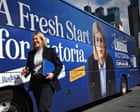
Victoria is on the cusp of a political transformation. After 12 years of Labor rule, the state long regarded as Australia’s most progressive is poised to turn blue, and, in turn, challenge the way Victorians see themselves.
“That self-image that was important in the Andrews era of being ‘the Massachusetts of Australia’, a notably progressive sort of state, is going to take a battering,” Frank Bongiorno, an Australian historian at the University of Canberra, says.
With just days left until the state election, the Liberal-National Coalition has run a small-target campaign under its leader, Jess Wilson, determined to keep the focus on an unpopular Labor government. But its policy ambition is clear in public documents – even if voters are more focused on sending a message to Labor.
“Many will breathe in, or grit their teeth, and vote Coalition,” Bongiorno says. “It is an anti-government, anti-Labor vote and I think that suggests a certain shallowness in terms of the support for the other side.”
While this protest vote will decide the election, Bongiorno says it may also deliver a fragile mandate that could be “a drain on what a Coalition government can actually get away with in office”.
“They’re going to have to earn it. It’s going to be very difficult.”
The first 100 days
The Coalition has made its short-term priorities clear.
By March next year, if it takes government, it will have repealed Australia’s first formal treaty with First Nations people, introduced harsher bail laws and tougher sentences for children, clamped down on protest, opened up new gas exploration, scrapped a major renewable energy transmission project and reversed a ban on gas in new homes.
It will have expanded the royal commission into allegations of corruption on government construction sites and cut several taxes, alongside Labor’s planning provisions that allowed for more development near 60 train and tram stations across Melbourne.
In recent weeks, it has also announced plans to recriminalise begging, review the use of puberty blockers and relocate a medically supervised safe injecting facility in North Richmond.
Wilson has framed these policies as “disciplined decisions” to “fix” Victoria. But many have strident critics who argue they unwind progressive policies that, in some cases, took more than a decade to negotiate.
The Liberal plan to repeal Victoria’s treaty has featured heavily in messaging from Labor and Greens candidates in progressive seats. The Coalition says the treaty, which gives First Nations people a greater say in laws that affect their lives, is divisive and expensive.
Djaran Murray-Jackson is the co-chair of Victoria’s First People’s Assembly, established as part of the treaty process. He says the treaty must “remain above party politics if we are truly going to deliver practical change for our people’s lives”.
First Nations leaders have also raised concerns about the Coalition’s youth sentencing policy, inspired by the Queensland Liberal National government. The so-called “adult crime, adult time” plan would allow children to be sentenced as adults for 20 serious offences and would be legislated before Christmas, alongside a new one-strike rule for bail.
Nerita Waight, the chief executive of the Victorian Aboriginal Legal Service, says the two proposals would add further pressure to police cells and prisons already at capacity.
“We are incredibly concerned that any more strain on the system makes a death in custody inevitable,” Waight says.
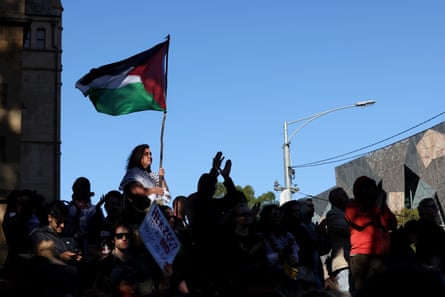
The Coalition also plans to reinstate “move-on laws” for protesters by March and beyond that, a permit system for demonstrations and a ban on the phrase “globalise the intifada”. This is despite a similar ban, also introduced by the Queensland government, facing a high court challenge.
Gemma Cafarella, the president of civil rights organisation Liberty Victoria, expects any attempt to introduce similar legislation in the state to face a legal challenge.
“If the Coalition follows through on these commitments, people are going to have to fight for their human rights and civil liberties,” she says.
While the Coalition has no plans to reverse Victoria’s emission reduction targets – cutting greenhouse gas emissions by between 75% to 80% below 2005 levels by 2035, and reaching net zero emissions by 2045 – it will rip up policies that were in part designed to reduce carbon emissions.
after newsletter promotion
The Coalition would overturn a long-standing ban on gas exploration, cancel a proposed transmission line to New South Wales that would support renewable energy integration and cancel plans to phase out gas in new homes.
Alison Reeve, of the Grattan Institute, says reversing bans on domestic gas could make a shortage worse and that any new gas reserves would take at leave five years to come online. Ultimately, she says some of these promises may need to be broken.
“The alternative is that the next energy minister will be fronting the cameras in 2028 explaining why the lights are flickering,” she says.
The long-term challenge
Wilson knows one of her toughest challenge will be the state’s finances, as debt soars and the economy slows.
While Labor spruiks an operating surplus, this figure doesn’t include infrastructure or other capital spending. When factored in, Victoria remains cash deficit in the billions over the forward estimates.
Victoria’s debt also continues to grow, projected to hit almost $200bn in 2029-30 – the highest of all state and territory governments. By then, interest payments on state debt are forecast to total $11.82bn – or $32m a day.
The Liberals have released a 10-year economic plan which includes a goal of returning to a cash surplus by 2032. To do this, they need to find about $30bn in savings. They have so far identified $26bn, largely through a proposed decade-long hiring freeze on public service jobs.
At the same time, the party has made more than $8.6bn in election commitments, according to the independent Parliamentary Budget Office (PBO), as well as up to $5bn worth of tax cuts it plans to legislate in the first parliament sitting.
Ahead of the PBO’s release of its costings of the Liberal and National parties’ policies on Thursday, the Coalition said its plan would see the state’s net debt fall by more than 10% over the forward estimates – hitting $176bn in 2029-30 rather than $196bn under Labor.
The plan has prompted skepticism from some economists, including David Hayward and Saul Eslake, while an analysis by the progressive think tank the Australian Institute estimates almost 32,000 public service jobs would need to go to deliver the promised $22bn in savings.
Others, including members of the Economic Society of Australia, are calling for a more aggressive approach to bring the state’s spending down. Zac Gross, a senior economics lecturer at Monash University, agrees.
He says the Coalition may need to reconsider “obviously popular” policies such as a $50 weekly toll cap and make difficult decisions about the multibillion-dollar Suburban Rail Loop, which he calls the “elephant in the room”.
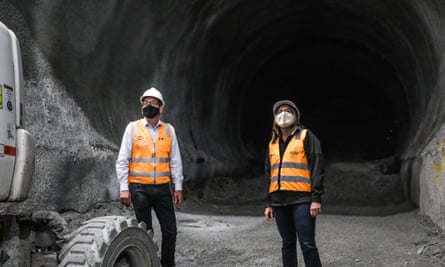
The Coalition has committed to “pause and review” SRL East, 26km of tunnels that make up the first stage of the rail project, though Labor has already signed more than $14.5bn in construction contracts that may be difficult to break.
The public service is also bracing for major structural changes, including senior appointments to government departments, agencies and boards after 12 years of Labor. Work has already begun, with a trio of MPs retiring at the election – former Liberal leader Michael O’Brien, former Nationals leader Peter Walsh and Kim Wells – tapped to lead Wilson’s transition team.
In the final days of the election campaign, Bongiorno has a warning to Liberals who may be thinking about 1992, when Liberal leader Jeff Kennett ended a decade of Labor rule.
“It seemed to some observers that Victoria was reverting to its traditional political pattern,” says Bongiorno, referencing the party’s historical power base in Victoria, the home to its founder Robert Menzies.
“That turned out to be a complete misreading of the patterns of Victorian politics because Labor has really dominated since – with Kennett as a kind of interlude.”
KioskNews shows a cleaned-up reading view extracted from the publisher’s page — the original always lives on their site, not ours.