Two Invitations, Three Interrogations: Did Baffour Awuah tell the whole story?
There is something wonderfully creative about the way accountability can suddenly become frightening when it arrives at your doorstep.
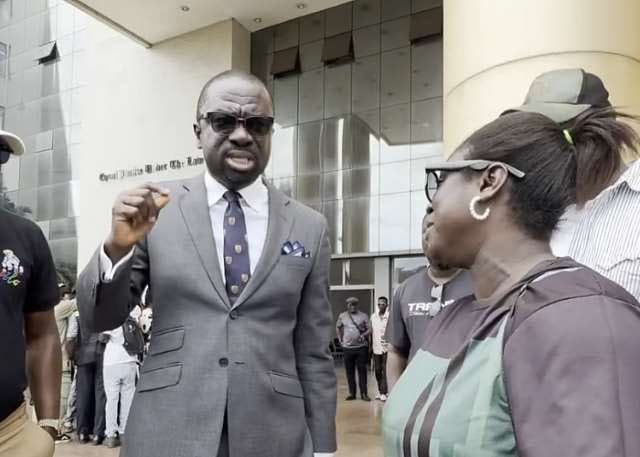
On Wednesday, Ghana witnessed what looked less like a routine engagement with an investigative institution and more like Fast & Furious: Parliamentary Edition. EOCO says it attempted to arrest Manhyia South MP Nana Agyei Baffour Awuah after he failed to honour two invitations issued in February 2026. The MP disputes that account and says the invitations related to the senior partner of his former law firm.
Fair enough. Let the documents, correspondence and ultimately the law settle that dispute.
But one question refuses to leave the room: if the Honourable Member was genuinely ready to cooperate with EOCO, why was the destination suddenly Parliament?
The MP says he feared kidnapping because the woman who approached him did not produce identification or an arrest warrant and insisted that he use EOCO's vehicle. That concern can be examined. But if the concern was merely verification, one would expect the next stop to be EOCO not Parliament. The High Court Complex is much closer to EOCO than it is to Parliament. Instead, the MP drove away and subsequently appeared at Parliament, which is currently on recess. EOCO says it respects parliamentary privileges but that being an MP does not terminate an investigation or place anyone beyond the law.
And therein lies the comedy.
Apparently, Ghana has developed a new emergency protocol:
See investigator → become suspicious → start engine → accelerate → locate Parliament → summon cameras → explain constitutional privilege.
At this rate, perhaps we should install road signs:
“EOCO Ahead — MPs Turn Left for Parliamentary Sanctuary.”
But EOCO itself deserves some serious criticism.
How on earth does an agency conducting an arrest operation send one lady to the middle of a potentially confrontational situation? The video of the encounter makes the operation look painfully under-resourced. If EOCO had decided that an arrest was necessary, it should have gone with adequate reinforcement and a properly coordinated team capable of securing the situation without placing one officer in such an exposed position.
You cannot send one officer to perform what could become a high-risk arrest and then act surprised when the target drives away. This is an investigative institution, not a one-woman roadside collection agency.
Now, back to the Honourable Member.
There is something rather uncomfortable about the sudden transformation of every confrontation with an investigative institution into a grand performance of public advocacy. Some politicians become remarkably vocal defenders of ordinary citizens when the spotlight turns toward them.
And one cannot help but wonder: is every act of public advocacy completely unrelated to the personal circumstances of the person doing the advocating?
That is not an accusation that the MP has committed wrongdoing. The facts must establish that. But public officials should understand that loudly presenting oneself as the defender of the oppressed does not answer questions from investigators.
Otherwise, one begins to wonder whether some politicians are building an “advocacy shield” in advance so that if accountability eventually knocks on their own door, any attempt to investigate them can be portrayed as persecution for defending the people.
That would be a dangerous precedent.
Article 117 protects parliamentary privilege in specific circumstances connected with proceedings of Parliament; it is not a blanket declaration that an MP cannot be investigated or arrested.
So, Honourable Member, if EOCO is wrong, go and prove it wrong.
If its officers acted unlawfully, challenge them.
If the invitations were never properly addressed to you, produce the documents.
If the arrest procedure was defective, let the courts determine it.
But driving away and then running to Parliament makes for excellent television, not necessarily excellent constitutional governance.
And EOCO, please learn from this episode: next time, bring enough officers.
Accountability should neither arrive looking like an ambush nor flee looking like a comedy sketch.
Because in a constitutional democracy, immunity must never become impunity and advocacy must never become camouflage.
DISCLAIMER: The Views, Comments, Opinions, Contributions and Statements made by Readers and Contributors on this platform do not necessarily represent the views or policy of Multimedia Group Limited.
Tags:
DISCLAIMER: The Views, Comments, Opinions, Contributions and Statements made by Readers and Contributors on this platform do not necessarily represent the views or policy of Multimedia Group Limited.
KioskNews shows a cleaned-up reading view extracted from the publisher’s page — the original always lives on their site, not ours.