China Airlines ups SAF use in Amsterdam flight
By Shelley Shan / Staff reporter, in Amsterdam


China Airlines yesterday completed its showcase flight for its fifth participation in the SkyTeam’s Aviation Challenge, operating a direct flight from Taipei to Amsterdam with sustainable aviation fuel (SAF) equivalent to 40 percent of the flight’s fuel use.
It was the first time the airline had used such a high proportion of SAF on a long-haul flight. In last year’s challenge, it used the same percentage on a regional flight to Bangkok.
China Airlines used a “book and claim” model to raise the SAF use on the Amsterdam flight, which was estimated to reduce carbon dioxide emissions by 93.2 tonnes, equivalent to about one-quarter of the amount absorbed annually by Taipei’s Daan Park, the airline said.
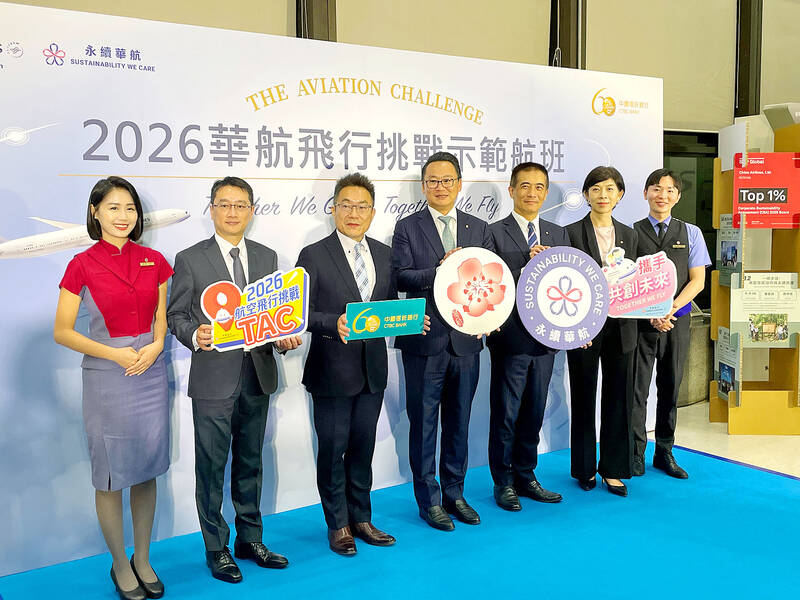
China Airlines representatives hold placards at an event in Taoyuan on Sunday.
Photo: Shelley Shan, Taipei Times
The airline has used SAF on eight flights since 2022, collectively reducing at least 600 tonnes of carbon emissions, China Airlines president Kevin Chen (陳漢銘) said.
“The use of SAF on flights is key to helping the aviation industry transition toward net zero carbon emissions. We are committed to expanding the use of SAF on flights to Europe, North America and Asia, while incorporating low-carbon initiatives into our operations and passenger services,” he said.
The Amsterdam flight also featured several low-carbon initiatives, Chen said.
The airline used tableware in premium business class that is 30 percent lighter than previous versions to help reduce fuel consumption, he said.
The business-class menu and wine list were also printed on recycled paper using soy-based inks, he added.
Passengers were encouraged to check-in online before arriving at the airport and save their boarding passes on their mobile phones instead of printing them on paper, Chen said.
“We send text messages to our members encouraging them to preorder their meals before boarding. This not only helps us better understand passengers’ preferences, but also helps reduce food waste and the fuel required to carry excess food,” he said.
Gourmet plant-based meals developed by Taipei-based Michelin Green Star restaurant Little Tree Food (小小樹食) were served in all classes on the flight, the airline said.
The new Marc Jacobs cobranded travel kits also feature sustainable beauty products and toiletries developed in collaboration with Copenhagen-based design brand FRAMA, it said.
The airline’s Dynasty Sky Reading service has reduced the amount of reading material carried on flights by more than 4,300 tonnes since its introduction, it said.
Meanwhile, the airline expects to receive two Boeing 787-9 aircraft by the end of this year, which are expected to reduce fuel consumption by 20 percent and noise levels by 30 percent, Chen said.
The company aims to have 14 Boeing 787-9 aircraft delivered by the end of next year.
The Taipei-Amsterdam flight was exclusively sponsored by CTBC Bank, which also sponsored China Airlines’ aviation challenge in 2024.
KioskNews shows a cleaned-up reading view extracted from the publisher’s page — the original always lives on their site, not ours.