FEMICIDE CRISIS OP-ED: Target perpetrators, not womxn’s freedom — a call for police action
In the past two months five womxn were murdered in and around Kempton Park in Johannesburg, with similarities between several of the cases. On 14 September, another womxn’s body was discovered in Kwa-Themba, Springs. These murders are disturbing.
The response of the South African Police Service (SAPS) is also disturbing.
If a number of womxn have been murdered in the same area since July 2026 under circumstances that investigators consider sufficiently concerning to warrant further investigation, we must ask: What did the state know, when did it know it, and what did it do to prevent another womxn from becoming a victim?
Instead, womxn are once again being told to be “extra cautious”. We are told not to walk alone, run alone, cycle alone, travel alone or enter certain spaces. This places the burden of preventing violence on those most at risk of experiencing it.
/file/attachments/orphans/MC-TheTotalShutdown-KemptonPark4_825472.jpg "A family-supplied photograph of Elizabeth Moselakgomo during one of the races she participated in. (Photo: Supplied / Family)")
Womxn are not responsible for men murdering them
Femicide is not a womxn’s issue. Gender-based violence is not a womxn’s safety problem. It is a crisis of male violence, patriarchy, misogyny, impunity and state failure.
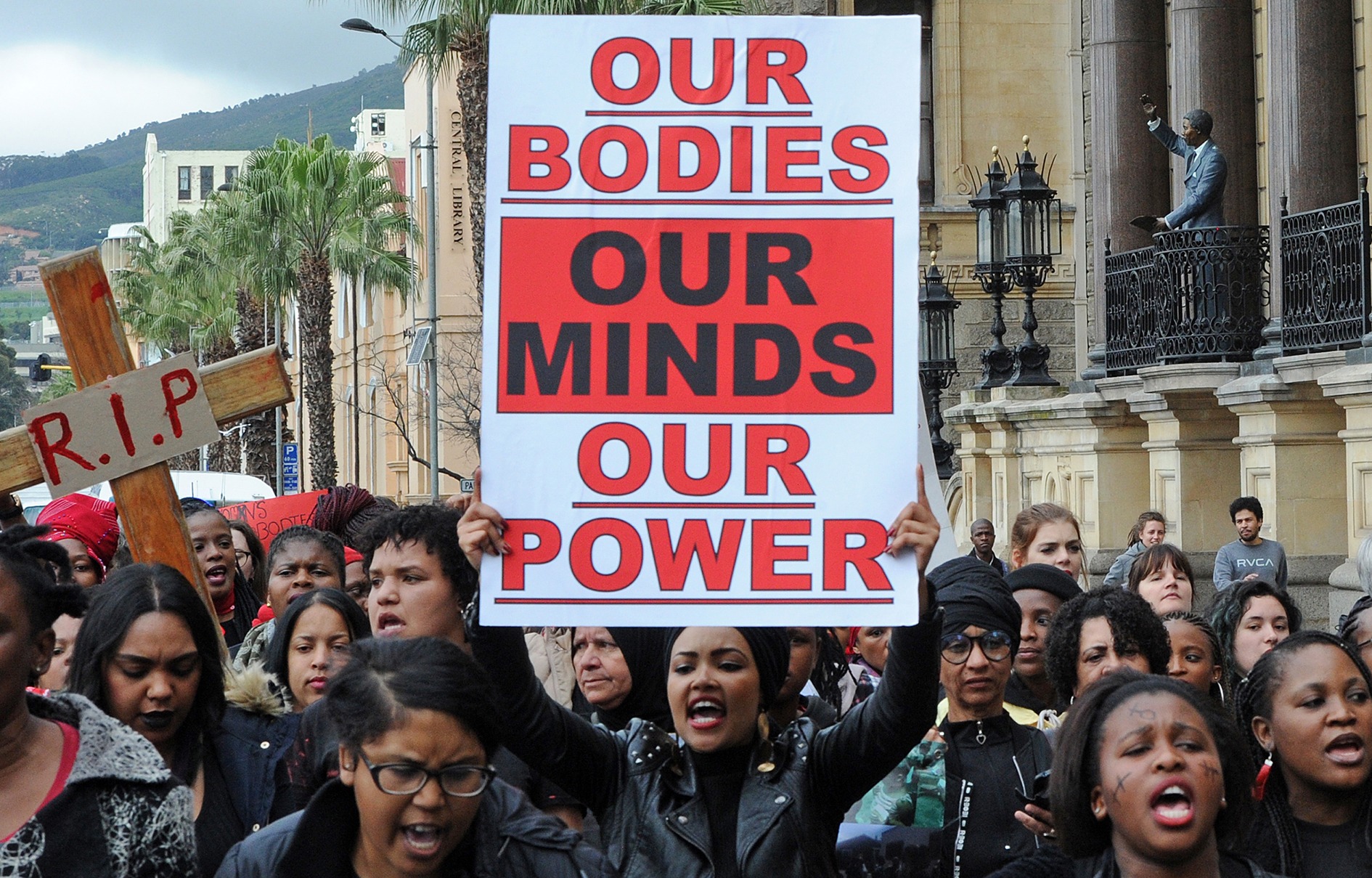
This is precisely why #TheTotalShutdown took to the streets in 2018. We did not mobilise thousands of womxn across South Africa because womxn needed another awareness campaign or another lesson in personal safety. We mobilised because the state has a constitutional obligation to protect us.
In 2018, #TheTotalShutdown presented the government with 24 demands addressing the systemic failures that enable gender-based violence and femicide to continue. While these demands were included into the National Strategic Plan on GBVF, implementation remains uneven.
/file/attachments/orphans/MC-TheTotalShutdown-KemptonPark_825504.jpg "Women march to the Union Buildings during the #TotalShutDown demonstration against gender-based violence on August 01, 2018 in Pretoria, South Africa. Thousands of women across the country embarked on the #TotalShutDown marches to highlight the plight of women and children abuse on August 01, marking the start of Women’s month in South Africa. (Photo: Gallo Images / Sowetan / Thulani Mbele)")
Womxn gave government a roadmap
Eight years later, womxn are still being murdered.
In 2018/19, 2,771 womxn were murdered in South Africa – about seven a day. Between July and September 2024 alone 957 were murdered – more than 10 every day. These are not merely statistics. Every number was a womxn. Every number represented a life, a family and a community left to carry the consequences of violence.
And behind these numbers is a state that has been warned repeatedly.
So when the SAPS tells womxn in Kempton Park to be “extra cautious”, we have a question: What are you telling the perpetrators?
Where is the urgent mobilisation to identify and apprehend those responsible? Where is the intelligence-led prevention? Where is the accountability when patterns of violence emerge? Why must womxn once again change how we live, move and occupy public space because men choose to violate and murder us?
We reject this response.
We refuse to accept that womxn’s freedom must shrink so that men can continue moving freely.
We refuse to accept “be careful” as an adequate response to femicide. And we refuse to accept another memorial, another candlelight vigil or another statement of condemnation after another womxn has already been killed.
We have been warning the state for years.
We were not prophetic. We were paying attention.
We saw the patterns. We named the violence. We organised. We mobilised. We handed the government 24 demands.
Yet here we are again.
If these cases are ultimately found to be connected, the question of whether earlier intervention could have prevented further deaths must be confronted. But even before those investigations conclude, one thing is clear: Womxn should not have to die before the state recognises a pattern.
/file/attachments/orphans/MC-TheTotalShutdown-KemptonPark5_208192.jpg "Police investigate the crime scene in Olifantsfontein where the body of the fifth victim was discovered on 14 September 2026. (Photo: Felix Dlangamandla)")
What policing should look like
A multidisciplinary investigation has now been established. It should include experienced detectives, forensic investigators, crime intelligence and specialised GBVF experts, to determine whether cases are connected and whether previous incidents contain intelligence that could have identified a perpetrator or pattern earlier.
The SAPS should review unsolved murders, missing persons cases and reported attacks in the area over an appropriate historical period, identifying patterns, locations, modus operandi, repeat suspects and gaps in previous investigations. In cases like this, the findings should be documented and used to inform an active prevention strategy. Not just reactive policing.
High-risk areas should have visible, targeted policing, informed by crime intelligence rather than generic advice to womxn. Patrols, rapid response capacity, investigations of hotspot areas and coordination with local authorities and community structures should be a norm of operation.
Womxn should not be expected to provide their own security simply because the state knows an area presents a heightened risk.
With investigations of this nature, the SAPS should provide substantive updates and prevention measures being implemented, while protecting the integrity of the criminal investigations. “The investigation is ongoing” cannot become a substitute for public accountability.
In cases like this, the state should review whether previous reports, missing persons cases, complaints or intelligence were properly recorded, investigated and escalated. Where institutional failures are identified, those responsible must be held accountable rather than allowing failures to disappear into the machinery of the state.
The government must stop measuring progress through campaigns, summits and statements and start measuring it through prevention, institutional performance, accountability, successful investigations and the reduction of violence.
Womxn’s movements and affected communities should be formally included in monitoring these responses. Nothing about womxn’s safety should be designed without the womxn and communities who experience the consequences of state failure.
A fundamental change needs to happen in the state’s public messaging.
Stop telling womxn that the solution to femicide is to modify our behaviour.
Stop telling us to be more careful.
Stop telling us to walk in groups.
Stop telling us to stay home.
Tell perpetrators that the state is coming for them. Tell communities what the state is doing to prevent the next murder. Tell womxn what concrete action is being taken to protect our right to move freely and safely.
We have already changed enough. We have already warned enough. We have already marched enough. We have already buried enough womxn.
Now, the state must do its job.
This is what the SAPS needs to do across the country. In rural communities. In townships. In places where we do not learn their names. This is not a Kempton Park issue, it is a South African issue.
KioskNews shows a cleaned-up reading view extracted from the publisher’s page — the original always lives on their site, not ours.