‘It is our duty to work together’: Opposition chiefs meet, vow to do everything to form ‘a government of repair’
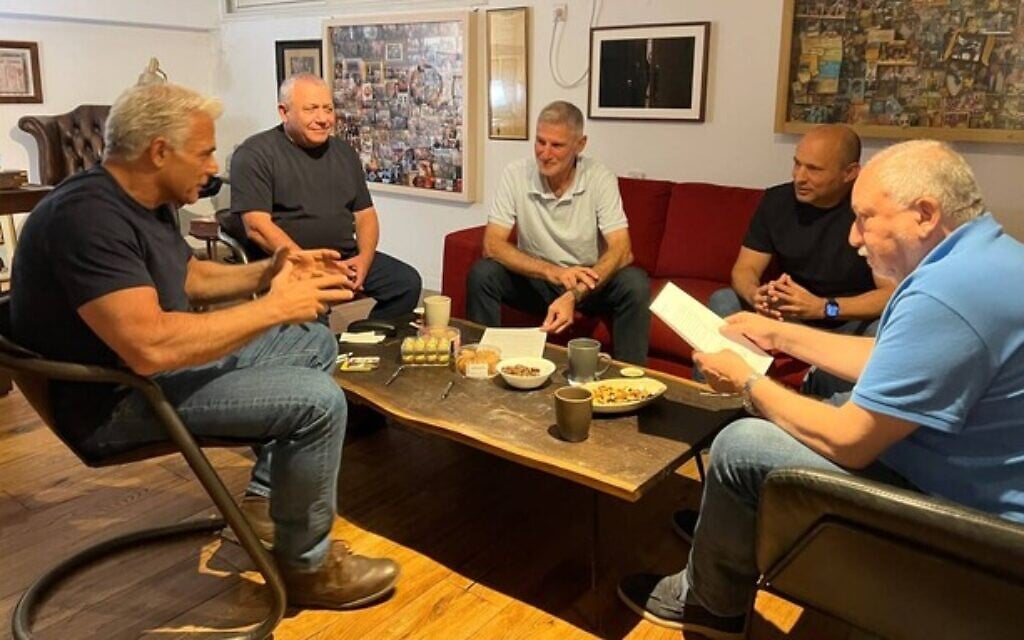
The heads of leading opposition parties met on Saturday to discuss their campaign strategies and published a declaration vowing to work together to form a “Zionist, statesmanlike” government. They pledged not to attack each other on the campaign trail and to cooperate ahead of the October 27 vote in a bid to boost turnout for their bloc and to plan for a future government, including through setting up joint working groups.
The statement of principles was signed by Yashar leader Gadi Eisenkot, B’Yachad chief Naftali Bennett and the party’s No. 2 Yair Lapid, Democrats head Yair Golan and Yisrael Beytenu chairman Avigdor Liberman.
“We are united and determined to bring correction and hope to the State of Israel,” the party bosses wrote in the declaration, which was published after their hour-long meeting at Lapid’s home in Tel Aviv.
0:00 / 0:00
Promoted: Theatron Hotel and Residences
“Despite ideological differences among us, the formation of a Zionist and state-oriented government dedicated to repair and reconstruction is our shared overarching goal, and it is our duty to work together to achieve it,” the leaders wrote.
There has been considerable recent infighting between the bloc’s party heads, with Eisenkot criticizing Bennett and Liberman for refusing to back him as the bloc’s prime ministerial candidate despite his party’s clear, consistent lead over them in opinion polls, and occasional mutual criticism between the left-leaning Golan and the hawkish Liberman.
Get The Times of Israel's Daily Edition by email and never miss our top stories
By signing up, you agree to the terms
In the declaration, the party leaders pledged to “do everything within their respective spheres to expand the voter base, attracting voters from all segments of the public, to secure an electoral majority, and to form a government that will preserve and strengthen Israel as a Jewish and democratic state.”
The declaration said that within 48 hours of its signing, the parties involved shall establish working groups to increase voter turnout and ensure free and fair elections. The working groups will also look to formulate the policies of the next government, including on ultra-Orthodox enlistment and the establishment of a state commission of inquiry into the October 7, 2023, Hamas-led massacre, which Prime Minister Benjamin Netanyahu has refused to do.
The party leaders pledged to immediately work to form a “government of repair and reconstruction” following the elections.
“We call upon every citizen who believes in this country — in its values and its strength — to join us in voting on election day and to shape our children’s future together,” the statement added.
Notably absent from the talks was Blue and White party chief Benny Gantz, who has sought to position his party as belonging to neither bloc and as a potential kingmaker, but who has also failed to cross the electoral threshold in nearly all polls. Gantz placed a mobile billboard outside Lapid’s home during the meeting, declaring that “the blocs are holding up Israel.”
According to the most recent poll by The Times of Israel’s Hebrew sister site, Zman Yisrael, which was published Thursday, the pro- and anti- Netanyahu blocs are tied at 53 seats each, leaving both short of a government if they fail to rely on defectors or on Arab support.
In addition, the poll found that two-thirds of opposition voters want their camp to agree on a consensus candidate for prime minister, which the opposition parties have not done, with Eisenkot, Bennett and Liberman all publicly vying for the top position.
Eisenkot’s centrist Yashar party is consistently leading the polls, with the Zman Yisrael survey giving it 23 seats, while Bennett and Liberman are far behind with 12 and 10 seats, respectively.
The poll had the traditionalist Arab party Ra’am, which has said it wants to join the next government, at six seats.
Ra’am served in the so-called change government that briefly unseated Netanyahu in 2021-2022, after the premier himself negotiated with the party on possibly joining his coalition, though Eisenkot on Saturday publicly vowed not to include Ra’am in a potential government he leads, saying it does not currently fulfill his demands for inclusion.
The prospect of a minority government relying on Ra’am’s support has become a central theme of the coalition’s campaign, with Netanyahu and his allies accusing Eisenkot and the other opposition leaders of intending to form a government dependent on Arab parties.
The Central Elections Committee, where the current coalition has a majority, has disqualified Ra’am and the other Arab-majority party, the Joint List, from running in the October 27 election. However, the High Court of Justice has reversed many such decisions in the past and is widely expected to do so again.
Help us report truthfully on social media

As a multimedia journalist, my job is to take the quality, fact-based journalism produced by The Times of Israel newsroom and make it accessible across every platform — from Instagram posts to podcasts to short-form videos.
This is how many, especially young people, consume news these days. But misinformation is rampant on social media. Our team at ToI produces accurate, responsible short-form reporting on Israel and the Jewish world.
If you believe in the importance of factual social media journalism, please consider joining our reader support group, The Times of Israel Community. Your financial support is essential to sustain responsible multimedia reporting.
— Gabriella Jacobs, multimedia journalist
Support our work Support our work Already a member? Sign in to stop seeing this
KioskNews shows a cleaned-up reading view extracted from the publisher’s page — the original always lives on their site, not ours.