Partially forested area next to Marsiling Park slated for new Woodlands housing estate
SINGAPORE - A partially forested plot of land in Woodlands next to Marsiling Park could make way for housing developments in the coming years.
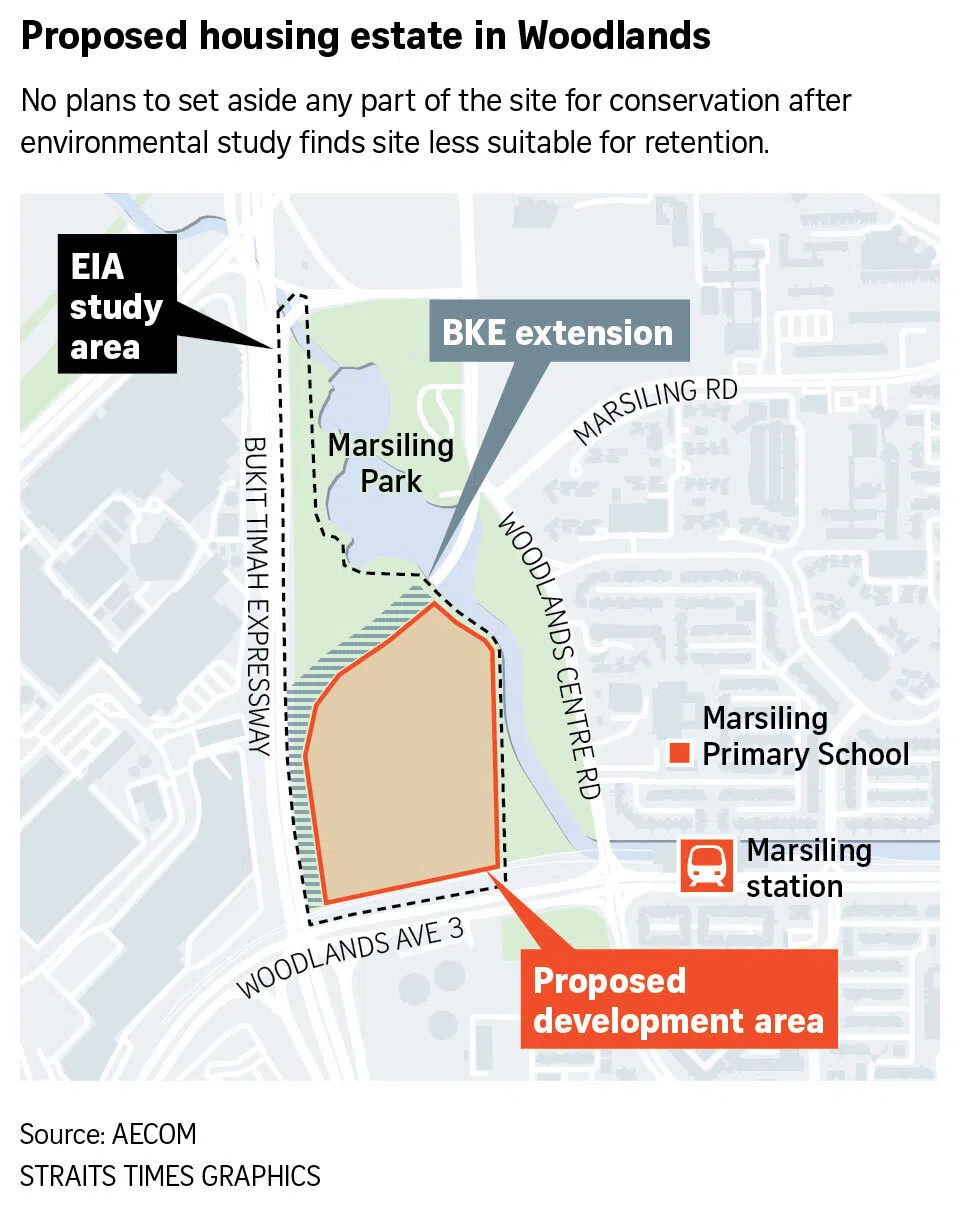
There are no plans to set aside any part of the land for conservation, following an environmental study that listed several reasons for not retaining for conservation a site within the redevelopment area, said the Housing Board on Nov 10.
The area slated for future housing has been zoned for residential use since 1998. It is bounded by Woodlands Avenue 3, the Bukit Timah Expressway (BKE) and an upcoming extension to the BKE, which is part of plans to expand Woodlands Checkpoint.
The environmental report, prepared by engineering consultancy Aecom Singapore, looked at a wider 14.4ha site that includes the area earmarked for housing. It found that about 46% of the entire site was secondary forest.
This includes a part of the area slated for new flats that was found to have moderate ecological value. However, the study cited several reasons for not retaining this area.
The report noted that it has a low density of plants with significant conservation value and its area of native-dominated forest is relatively small.
It added that the area’s central location within the proposed development also makes it less suitable for retention as it would be isolated from other green spaces and surrounded by built-up areas.
For these reasons, the report concluded that the area would have limited prospects for long-term persistence if retained.
Separately, the study found that about 1.12ha of mangroves within Marsiling Park to the north of the proposed housing site have high ecological value, due to the rarity of the habitat and the presence of plant species with conservation significance.
The mangrove and the stream flowing through it could also be home to many animals with significant conservation value like the Asian softshell and mud lobsters, said the report.
However, the study, which also flagged avoiding impacts to sensitive areas like the mangroves as a priority, concluded that the mangroves will not be directly affected by the development as they sit outside the proposed area.
The study recorded 154 animal species within the 14.4ha survey area, including 15 of conservation significance. Among them are the straw-headed bulbul, the smooth-coated otter, the changeable hawk-eagle and the bamboo bat.
That said, only the bamboo bat and the long-tailed macaque were observed within the area slated for housing, said the report.
It added that animals within the 14.4ha study area have already been exposed to prolonged disturbance from ongoing construction due to the redevelopment of Woodlands Checkpoint and other nearby developments.
The report said the continued presence of animals with conservation significance despite these disturbances suggests that the species in the area are relatively tolerant of disturbance.
However, it warned that bird species of significant conservation value like the straw-headed bulbul, as well as the Sunda pangolin, are expected to experience major negative impacts to their movement due to the proposed development.
This is because such birds are highly dependent on continuous or well-connected forest canopy, while pangolins are highly sensitive to the fragmentation of their natural habitats and urban encroachment.
Meanwhile, 156 plant species were recorded within the study area. 11 of them were of conservation significance, though only three species fall within the proposed housing site.
The report recommended several measures to mitigate the environmental impact of development in lieu of retaining parts of the site for conservation.
During construction, the report suggested managing the use of artificial light at night to reduce disturbance to animals and planting fast-growing native trees and shrubs to improve connectivity for wildlife, which was highlighted as a key concern.
The report recommended creating linear green spaces along the new development’s eastern and western edges. It said this would facilitate the movement of wildlife between green areas in the north, such as the Mandai Mudflats and Mangroves, and green spaces in the south such as the Mandai Planning Area and the Central Catchment Nature Reserve.
Another suggestion was to include biophilic water features in the new development. Biophilic design aims to connect building occupants more closely to nature through elements like natural lighting, materials and ventilation to improve overall well-being.
According to the report, nature groups were engaged on June 30 to share findings from the study and discuss proposals to mitigate the environmental impact of development.
It added that the report was further revised and finalised based on feedback received during the session.
HDB has published the environmental study on its website. The public can provide feedback to the agency via an online form until Dec 7.
Tony O’Dempsey, a member of the Nature Society of Singapore’s conservation committee, said there is marginal value in retaining the area with moderate ecological value as most animals and plants of conservation significance are located in exotic-dominated and abandoned land forests that lie outside the area.
On the proposed mitigation measures proposed in the report, O’Dempsey said the proposed linear green strips will have limited effectiveness in connecting wildlife because they are only about two to three metres wide.
Peer-reviewed scientific papers recommend at least 10m for avian connectivity and roughly 60m for mammal connectivity, he added.
He suggested further facilitating the movement of wildlife by reimagining a stormwater drain to the east of the study site in the style of national water agency PUB’s Active, Beautiful Clean Waters (ABC) programme.
The ABC Waters programme aims to spruce up water bodies here and transform concrete canals and drains into areas that can be used for community events and recreation.
Ho Xiang Tian, co-founder of environmental group LepakInSG, said that while the area slated for housing is currently not the most biodiverse, development there will affect wildlife connectivity between the northern part of the Central Catchment Nature Reserve and the Mandai Mudflats and Mangroves.
Separately, Muhammad Nasry Abdul Nasir, executive director of Singapore Youth Voices for Biodiversity, said he does not expect the ecological impacts of the development plans to be significant, but is concerned about the potential impact they might have on mangroves downstream, such as the Berembang and Dungun Air trees.
KioskNews shows a cleaned-up reading view extracted from the publisher’s page — the original always lives on their site, not ours.