From lived experience to expertise: Parents of neurodivergent kids get trained in special education
SINGAPORE – For years, teaching was where Lisa Poh, 46, found fulfilment. Before moving to Canada in 2010, she was a General Paper teacher at a junior college, and knew the mainstream school system well.
But when her son was two, his daycare flagged that he might have special needs. Although responsive to his parents, he seemed to regress in the classroom – becoming non-verbal, struggling socially and developing restrictive eating habits.
One year later, he was diagnosed with Autism Spectrum Disorder (ASD).
“At first I had difficulty accepting it and felt ill-equipped... My way of coping was doing a lot of research and studying on ASD because I wanted to be as well-informed as possible,” she said.
With long waiting lists for early intervention in Canada, the family moved back to Singapore, where her son received about 20 hours of therapy each week, including speech therapy, occupational therapy and applied behaviour analysis, a form of behavioural intervention.
Now 13 years old, he attends Grace Orchard School and is thriving.
Fellow mothers of children with special needs encouraged Poh to formalise the knowledge she had gained through years of supporting her son.
“They said, why don’t you just formalise it, and add that credential to your name, so that when you work together (with the professionals), it is as equals. It really spoke to me,” she said.
Now attending a two-year part-time master’s degree course in special education at the National Institute of Education, she will graduate at the end of 2026.
Training institutes in Singapore are seeing more parents like Poh taking up courses on special educational needs (SEN).
These range from short courses for basic certification in areas like behaviour management and sensory experiences to longer degree programmes for educators and specialists.
At the Dyslexia Association of Singapore (DAS) Academy, parents of children with SEN form a significant group of learners in its training programmes. These range from short, practical workshops to help parents understand attentional challenges and impulse control to certificate, specialist diploma and master’s programmes.
Responding to queries from The Straits Times, a DAS Academy spokeswoman said that over the last two years, overall enrolment has increased by 20%, from 489 to 585. Enrolment for certificate courses rose from 267 to 335, an increase of 25%.
More adults are also signing up for certification in dyslexia and literacy teaching, as well as in supporting learners with specific difficulties in executive function skills.
“These figures indicate growing demand for training that helps adults better understand and support children with learning and developmental needs,” said the spokeswoman.
She added that as the academy does not consistently record parental status across all its programmes, it cannot attribute the growing demand specifically to parents. But it has seen parents progressing from shorter courses to more advanced qualifications.
Other institutions like the Autism Resource Centre (Singapore) Learning Academy also offer a range of foundational and more targeted autism-related training courses.
Stephenie Khoo, the centre’s deputy executive director, told ST that they continue to see a steady demand for more than 3,000 training opportunities.
“Over the years, we have observed growing interest from caregivers in deepening their understanding of autism and learning strategies to support their child,” she said, adding that this comes amid higher awareness of autism and greater availability of online learning resources.
Putting what was learnt into practice
Poh’s master’s course helped her understand the specific learning challenges her son faced and how to better help him.
For example, she learnt that beyond a child’s IQ, other aspects like working memory and processing speed also affect the ability to pick up mathematical skills.
“So now that I understand this... I know that he’s not being forgetful or inattentive. It is difficult for him to remember things and his processing is slower, so you have to be patient and give him time,” she said.
Poh also read research evidence that strongly points to early vocational training and daily living skills as being more important in helping SEN children be independent and gainfully employed. This, she said, changed her priorities.
Quoting Temple Grandin, a well-known autistic scientist, author and speaker, she said: “Teach the independence and work skills first, and the studies can come later when they know what they want to learn.”
Poh hopes children with SEN will have the option of pursuing further studies through continuing education and professional certification after entering the workforce.
She will become a teacher at a special education school in January 2027, after she graduates.
Another parent, Tina Tan, 51, has also taken up special needs education to bolster her lived experience of supporting her 22-year-old son who has autism, attention deficit hyperactivity disorder (ADHD) and dyslexia.
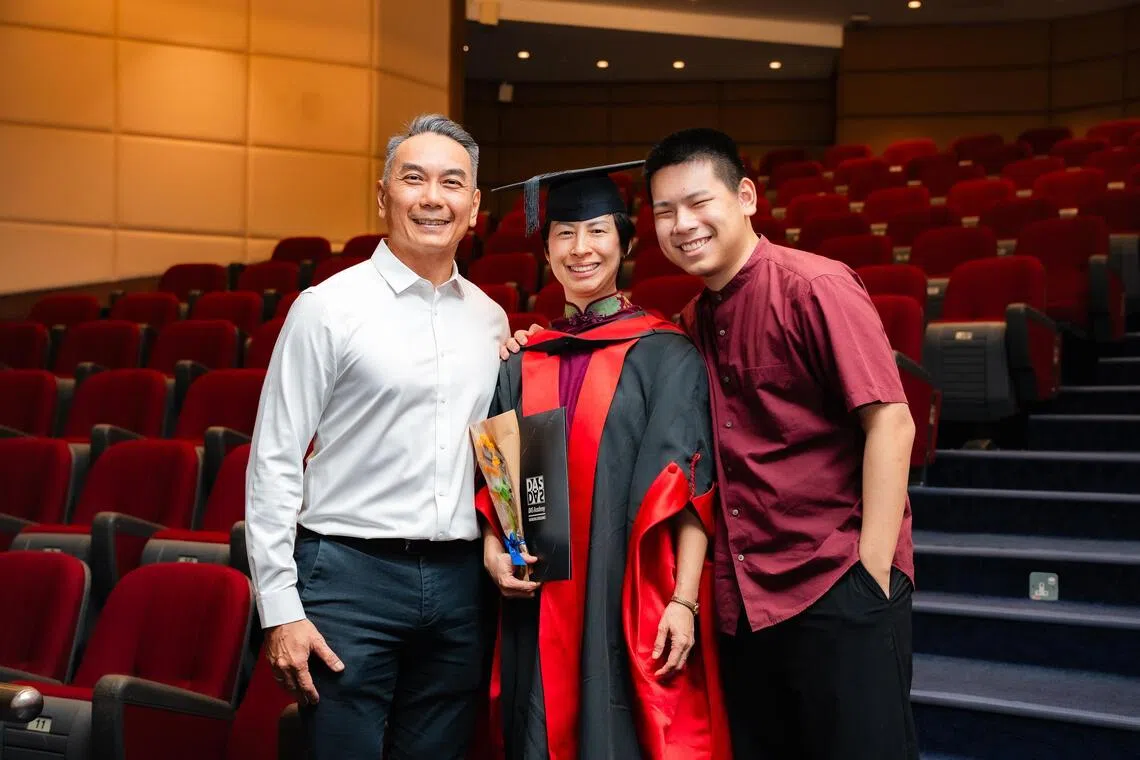
Tina Tan at the DAS Academy graduation ceremony with her husband Frankie Tan (left) and second son John Tan, who was diagnosed with dyslexia, ADHD and autism in primary school.
PHOTO: DYSLEXIA ASSOCIATION OF SINGAPORE
The trained social worker and mother of three boys has been supporting other families facing similar challenges with raising children who have special needs.
She first conducted parent training and workshops on a freelance basis, and even co-wrote a course on ADHD with the DAS Academy.
Tan also volunteers with a parent support group for ADHD, and is a member of COMmunity and PArents in Support of Schools, or COMPASS, an advisory council established by the Education Ministry to strengthen collaborations between schools, homes, and communities.
“No one questioned my work because of my lived experience, but I wanted proper training so I knew I was backed by science and research,” she said.
In 2024, she began a social enterprise – Shed Training and Consultancy – which is focused on ADHD and mental health inclusion.
She graduated from the DAS Academy in September 2026, with a master’s degree in SEN and applied learning needs, a course she started in 2023.
Tan is now able to turn dense research into simple, practical advice for parents who feel lost.
“You don’t need a master’s degree to be a good parent. But when you mix real empathy with real knowledge, you can guide other parents so they don’t fall into the same traps,” she said.
KioskNews shows a cleaned-up reading view extracted from the publisher’s page — the original always lives on their site, not ours.