Monarch butterfly saved after landing in refried beans
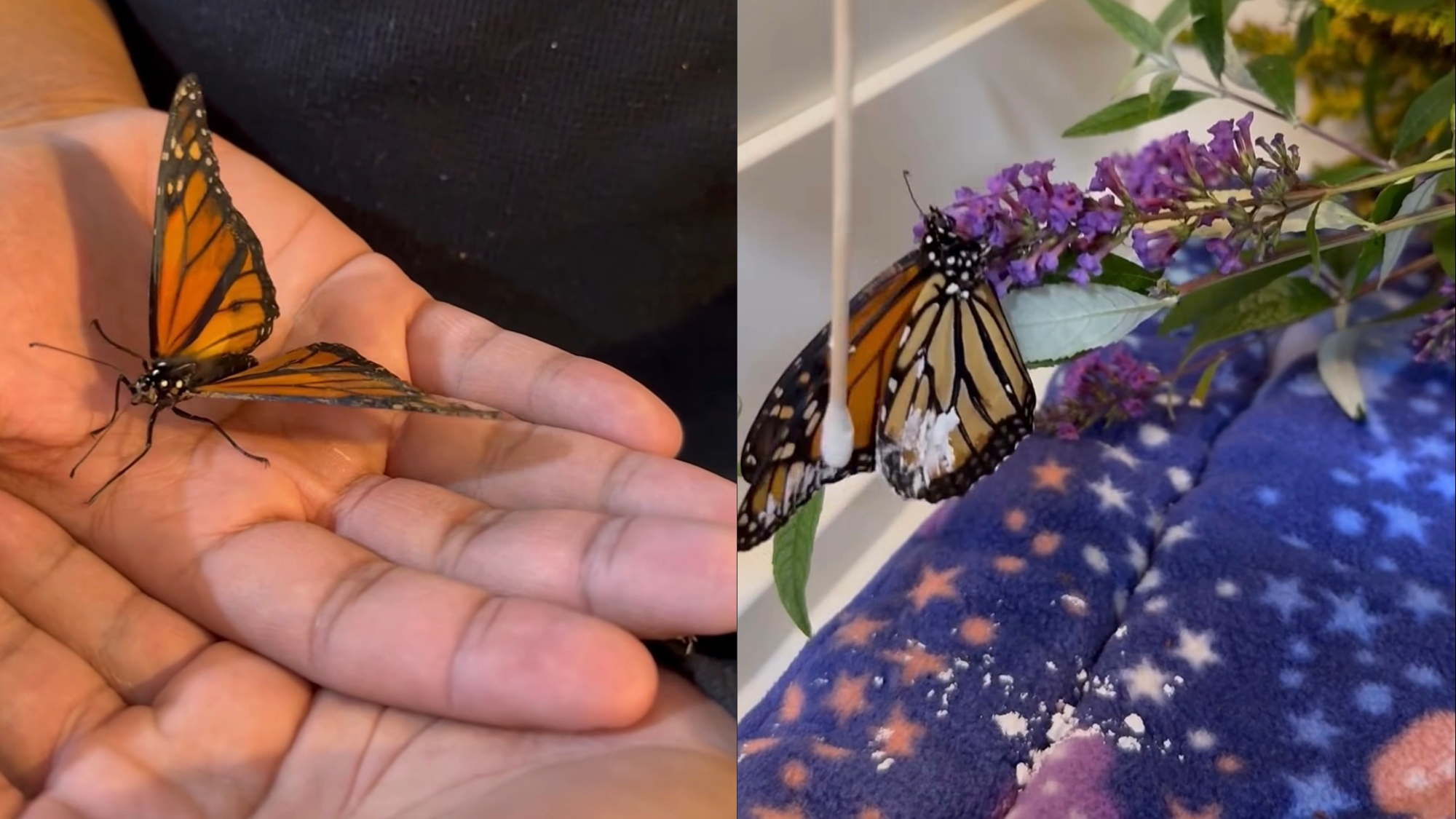
A migrating monarch butterfly (Danaus plexippus) recently brought into Sweetbriar Nature Center in Smithtown on New York’s Long Island came with a unique backstory. The male butterfly flew into a nearby house and landed on a pot of refried beans. The man living there took the butterfly out of the pan, but by morning the butterfly still could not fly. There was only one thing left to do for the injured insect—bring him to the professionals.
“Butterflies are incredibly delicate, and even handling them can cause additional damage or leave them unable to fly,” Janine Bendicksen, Sweetbriar Nature Center’s Director of Wildlife Rehabilitation, tells Popular Science. “That makes butterfly rehabilitation especially challenging—we have to be extremely careful with every step.”
The team got to work on fixing this unusual patient. They started by checking the butterfly for a parasite called OE (Ophryocystis elektroscirrha) that can live on monarchs. If the insect is parasite-free, the team can then assess the injuries and determine whether rehabilitation is possible. Butterflies are very delicate, and just handling them can cause additional damage.
“In cases where a monarch has lost part of a wing, we may be able to transplant a portion of a donor wing,” says Bendicksen. “When the circumstances are right, we can carefully attach the donor wing to the injured butterfly.”
The team gently sprayed the butterfly’s wings with water several times to remove the bean residue that prevented him from flying. Then, a challenge arose. How do you remove the greasy residue from such delicate wings? The solution came from a common powdery substance found in kitchen panties—cornstarch.
“We use starch regularly in wildlife rehabilitation to help dry out materials, and we had also previously used starch when replacing a wing on another monarch,” Bendicksen explains. “Because we already knew it was safe and effective in that context, we felt it was a good option for this particular situation. We were looking for something that would help remove the remaining moisture and residue without causing additional damage to the delicate wings.”
The cornstarch trick worked. The monarch was able to fly again. The team gently transported him outside and he took to the skies. Monarchs are currently on their way to the overwintering grounds in the forested mountains of Central Mexico. Their migrations are multigenerational, with roughly four generations of monarch butterflies emerging throughout the year. This butterfly may have been in the third generation (lays eggs in the north, but does not migrate) of the fourth generation that treks south.
“It’s not often that we are called upon to rehabilitate a butterfly,” Bendicksen says. “Most butterflies have relatively short lifespans, but when we receive a monarch in the fall—especially one that will travel thousands of miles on its migration to Mexico—we do everything we can to give it the best possible chance.”
KioskNews shows a cleaned-up reading view extracted from the publisher’s page — the original always lives on their site, not ours.