Thailand Hosts a Controversial Guest
Article by Kheetanat Wannaboworn and Walden Bello. The views expressed are those of the authors and do not necessarily reflect those of Khaosod English.
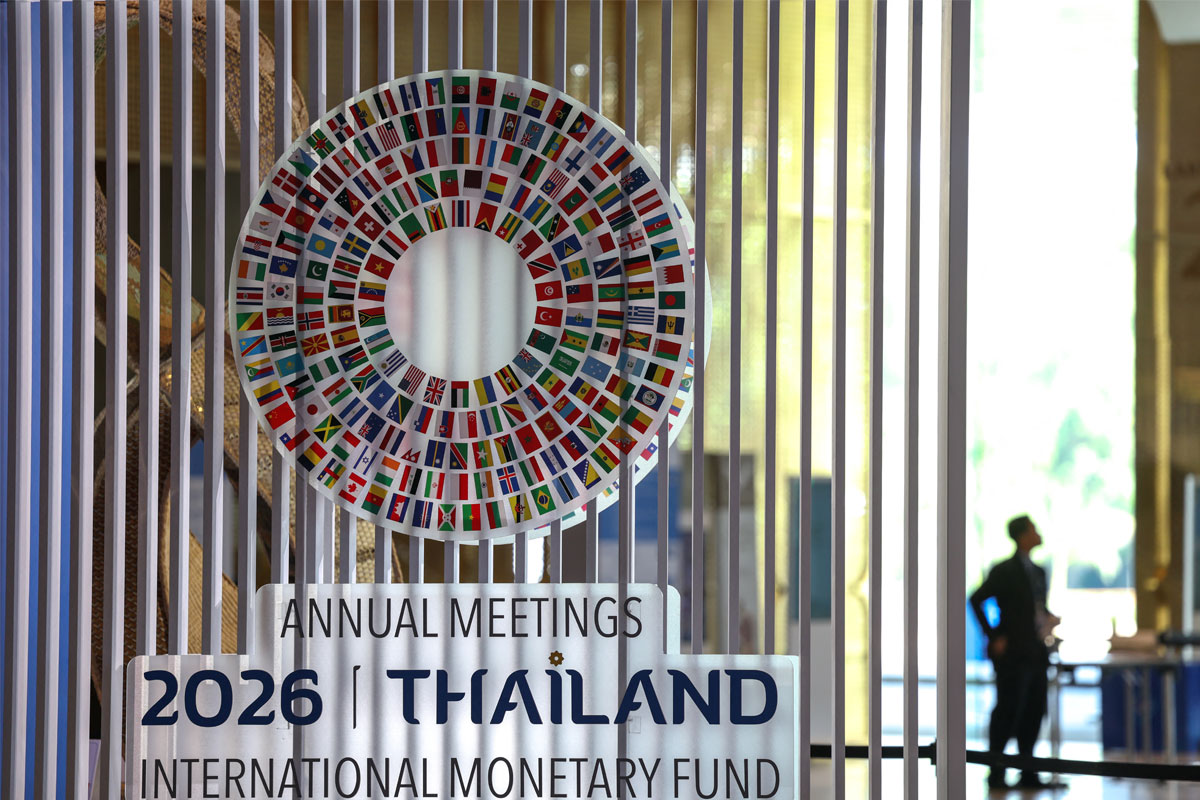
Perhaps the two international agencies that would score lowest in popularity among Thais would be the International Monetary Fund and the World Bank. This is why many Thais have greeted with consternation the news that these sister agencies will be holding their 2026 fall meeting in Bangkok from October 12 to 18.
The Bank and the Dam
Mention the World Bank, and the first thing that comes to mind in this country is the Pak Mun Dam. In December 1991, the Bank provided a $24 million loan to help fund the $250 million hydroelectric dam constructed by the Electricity Generating Authority of Thailand (EGAT). To build the massive structure, about 1700 households were dislocated. After it went into operation, the dam ended up blocking fish migration from the Mekong River, causing a catastrophic 60% to 80% loss of fish species and destroying the livelihoods of over 20,000 local fisherfolk. Over the last three decades, the balance of costs and benefits have been clearly weighted towards costs, so that the affected communities continue to advocate decommissioning it.
The Pak Mun Dam is just one example of the mega-dam projects that have displaced millions and earned the Bank a bad name in international civil society. According to the International Rivers Network, until around 1993, the Bank had made 527 dam-related loans for the construction, expansion, or rehabilitation of dams in 93 countries. The Bank has also come under fire for the billions it has spent supporting fossil-fuel projects throughout the Global South. Over the last few years, the Bank has extended at least $21 billion for coal, oil and gas energy projects despite the worsening impact of climate change.
The Pak Mun debacle is not the only problem associated with the Bank in Thailand. In 1997, during the Asian Financial Crisis that was caused partly by their pressure to liberalize the country’s capital account, the Bank and the IMF contributed $5.5 billion towards a $17.2 billion “rescue fund,” not to rescue Thais suffering from the crisis but to reimburse foreign investors and speculators that had lost their money. To pay off the loan consortium, the government raised the value added tax (VAT) from seven to ten percent, causing severe economic suffering, provoking a deep recession, and plunging one million Thais below the poverty line in a few short weeks.
“Attacking” Poverty While Living in the Lap of Luxury
In recent years, the Bank has defined its mission as ending poverty in the developing world. To fulfill this goal, its lending has risen from nearly $55 billion in 2015 to $123 billion in 2026. But if ending global poverty is universally regarded as a worthy cause, why is the World Bank so controversial?
To manage its operations, the Bank’s full-time staff rose from nearly 12,000 in 2015 to over 20,758 full-time staff globally in 2026. These figures are just the tip of the iceberg. If one includes all employees—permanent, non-permanent, contractual, part-time—throughout the world, the Bank employs close to 41,000 people. The vast majority, 26,000, or 63 percent, work out of the World Bank headquarters in Washington, DC, enjoying tax-free salaries, and only 3,200 are located in Africa, where a vast number of people classified as living in extreme poverty live.
The Bank’s economists and top administrators are among the highest paid financial functionaries in the world, which explains why the Bank is a major cause of the brain drain from developing countries: a great number of highly trained economists from developing countries prefer to work at the Bank instead of their home countries, with some going straight from Ivy League or British graduate schools to Washington, DC.
Despite the massive increase in personnel, the Bank admits that global poverty reduction “has slowed to a near standstill, with 2020-2030 set to be a lost decade.” Some 3.5 billion people, or 44 percent of the globe, remain poor, after decades of massive World Bank lending. And a major part of the reason, critics say, is that World Bank programs have created poverty instead of alleviating it.
The Bank and Structural Adjustment Programs
Central in the creation of global poverty and inequality have been the World Bank and IMF’s “structural adjustment” or austerity programs guided by the radical principles of the “Washington Consensus.” Structural adjustment is a program that promotes trade liberalization, deregulation, and privatization, along with severe cuts in government spending. Its goal is supposedly to promote growth and reduce poverty.
Over 100 developing and post-socialist countries have been brought under World Bank and IMF structural adjustment regimes. The interesting thing is that over the last 47 years, there have been few or no successes at all, so that many countries remain under adjustment indefinitely, becoming, in effect, permanent wards of the two institutions. Very few developing countries graduate from structural adjustment.
At its height in the 1980s and 1990s, structural adjustment programs accounted for 20 to 30 percent of total World Bank lending. But so meager were the positive results of the program that it was renamed “Poverty Reduction Strategy Program.” However, investigations, such as that conducted of adjustment programs in Vietnam, Laos, and Cambodia by our organization Focus on the Global South, saw the so-called reform of structural adjustment as no more than sugar-coating: “The PRSP is upheld by the World Bank and the IMF as a comprehensive approach. That it certainly is, but not for poverty reduction. The PRSP is a comprehensive program for structural adjustment, in the name of the poor.”
Expert Panel: World Bank Policies Based on Questionable Findings
The reason World Bank projects and programs don’t work or create exactly the opposite of their intended goals is because they are based on questionable propositions built on little or no empirical evidence. An assessment made a few years ago by an all-star team of renowned economists led by Princeton’s Angus Deaton, a recipient of the Nobel Prize for Economics, was damning:
“[The] panel had substantial criticisms of the way that the research was used to proselytize on behalf of Bank policy, often without taking a balanced view, and without expressing appropriate skepticism. Internal research that is favorable to Bank positions was given great prominence, and unfavorable research ignored. In these cases, we believe that there was a serious failure of checks and balances that should have separated advocacy and research.
“The panel endorses the right of the Bank to strongly defend and advocate its own policies. But when the Bank leadership selectively appeals to relatively new and untested research as hard evidence that these preferred policies work, it lends unwarranted confidence to the Bank’s prescriptions. Placing fragile selected new research results on a pedestal invites later recrimination that undermines the credibility and usefulness of all Bank research.”
Austerity and Hierarchy
Some economists are more critical, like the noted Italian economist Clara Mattei, who claims the reason for the failure of austerity or adjustment programs is that they are meant to fail. She contends that though cloaked in the language of scientific economics, the aim of the paradigm is not to restore economic growth or achieve popular well-being but to reinforce a class hierarchy or “capital order” that is under siege from below.
“Much economic research has established that austerity has almost never worked as promised, neither stimulating growth nor reducing debt,” she writes. “So why does it continue to be the preferred course of action for governments? We cannot simply attribute its structural presence to the stupidity or corruption of those in government. The true measure of austerity’s effectiveness is its ability to impose or reinforce a class structure, the very order that underpins economic growth. In this sense, austerity has never been an irrational calculation.”
The Bank’s refusal to acknowledge real-world refutations of its pro-globalization advocacy and its unbalanced, one-sided research led to justifiable rejection of its advice by the people who were suffering from the policies it was implementing, confessed Paul Collier, head of the Bank’s Research Development Department of the Bank from 1998 to 2003:
“The profession has been unprofessional, fearful that any criticism would strengthen populism, so that little work has been done on the downsides of these different processes [of globalization]. Yet the downsides were apparent to ordinary citizens, and the effect of economists appearing to dismiss them has resulted in widespread refusal of people to listen to “experts.” For my profession to re-establish credibility we must provide a more balanced analysis, in which the downsides are acknowledged and properly evaluated with a view to designing policy responses that address them. The profession may be better served by mea culpa than by further indignant defenses of globalization.”
From EOI to AI
Recently, the Bank has been trashed for its advocating export-oriented industrialization (EOI), or focusing on turning out products not for the domestic market but for developed country markets. Since the early 1970’s the Bank kept telling countries in the Global South that export-oriented industrialization was the way to go. Now, with the US under President Donald Trump imposing high tariffs on some 100 countries, this advice has proved disastrous. Developing economies have been totally unprepared for this, so that owing to a lack of an alternative model to the export oriented growth model in an era of protectionism in northern markets, they are scrambling for new paradigms.
Now the World Bank is promoting another silver bullet for Thailand: Artificial Intelligence (AI)-driven-growth. The Bank is pushing this despite a grim warning from its sister agency, the IMF, that in emerging markets and low-income countries, AI is expected to negatively affect 40 percent and 26 percent of jobs, respectively. “Many of these countries,” says the Fund, “don’t have the infrastructure or skilled workforces to harness the benefits of AI, raising the risk that over time the technology could worsen inequality among nations.”
But mass unemployment and ecological disruptions by data centers do not pose the only, or even most serious, threat to countries like Thailand. It is disconcerting that the Bank is speaking in glowing terms about AI when leading AI firms like OpenAI and Anthropic are now saying AI’s development and adoption should be reined in owing to the “existential threat” (that is, extinction) advanced AI programs pose to humanity.
The Law of Bureaucratic Inertia
Despite the high rate of failure of its lending programs acknowledged in internal World Bank assessments, the World Bank administrative budget that supports the high salaries of its economists and other high-level staff just keeps growing. The World Bank (IBRD/IDA) administrative budget was approved at $3.6 billion for FY26, a sizable rise from the $2.8 billion authorized for FY 2021, or nearly $800 million, with no convincing reason at all.
To many it seems strange that an organization keeps growing and growing despite obviously failing in its mission. Sociologists are not surprised, seeing this as the operation of the “law of bureaucratic inertia,” for which the AI definition is “the tendency of an organization to perpetuate its established processes, expand its size, and take on a life of its own, even when it is completely failing to achieve its original objectives or when those objectives are no longer relevant.” In other words, the fundamental objective of the Bank is to grow and perpetuate itself, not eliminate global poverty. The means has become the end.
A number of our friends who have worked at the World Bank in Washington have told us that, as one of them put it, “if you join the Bank, you will never be fired, you’ll continually be promoted, and your salary will continue to rise even if you put in minimal work.” This is probably an exaggeration, but it asserts something that is essentially true. Workers said of the old so-called socialist regimes of Eastern Europe: “They pretend to pay us, and we pretend to work.” It seems like one can say the same of the highly-paid massive bureaucracy at the World Bank.
In this regard, defunding the World Bank is one area where the agendas of the right and the left coincide, though for different reasons—the right because it thinks the Bank is wasting money, the left because it is convinced the Bank is doing harm to the people and the planet.
Kheetanat Wannaboworn is a Bangkok-based analyst with Focus on the Global South while the Manila-based Walden Bello is the author of Paper Dragons: China and the Next Crash (Bloomsbury, 2019) and A Siamese Tragedy (Zed, 1998).
KioskNews shows a cleaned-up reading view extracted from the publisher’s page — the original always lives on their site, not ours.