AI innovation should be measured by impact on people, Josephine Teo says at UN platform
SINGAPORE – The real measure of artificial intelligence innovation is not how powerful its models become, but whether the technology improves people’s lives, said Minister for Digital Development and Information Josephine Teo on Sept 22.
Laying out Singapore’s approach to AI development and adoption at a United Nations General Assembly platform, she said the country focuses on how AI can make a difference to people, including by deploying the technology across the public service to help officers work more effectively and improve services for citizens.
Almost 70 per cent of public officers now regularly use AI tools for tasks such as analysing information and preparing drafts.
The Government is also exploring the use of AI agents to redesign entire workflows, while keeping public officers accountable for important decisions, she said at the headline segment of the Digital@UNGA, which profiles how governments and industry are deploying AI innovatively.
AI is also being used to route public feedback to relevant agencies more quickly, identify anomalies among millions of cargo shipments at Singapore’s borders, and detect signs of phishing and impersonation scams.
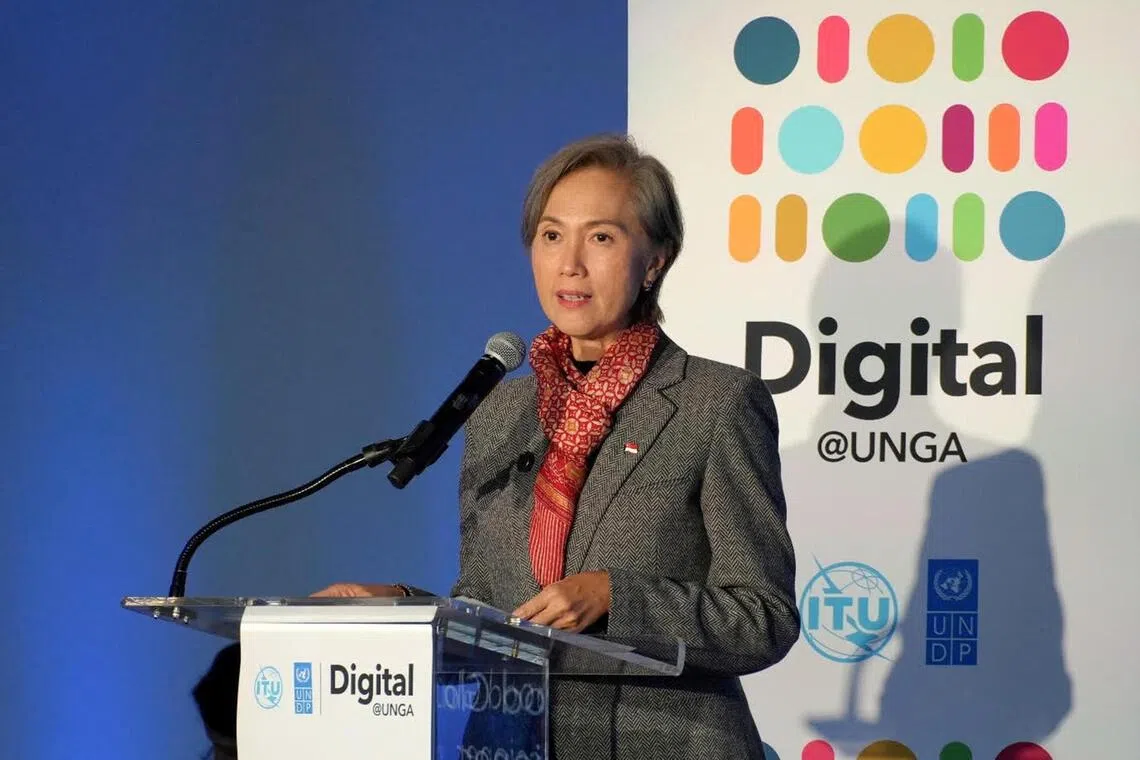
Minister of Digital Development and Information Josephine Teo laying out Singapore’s approach to AI development and adoption at Digital@UNGA on Sept 21.
PHOTO: MDDI
But for people to continue relying on AI as its use becomes more widespread, they must also be able to trust the technology, said Teo.
AI could amplify existing threats, such as making scams more convincing and personalised and cyberattacks easier to execute. Putting safeguards in place to manage these risks would therefore allow AI to be adopted with greater confidence, she added.
“From that perspective, trust does not constrain innovation. In fact, trust allows innovation to scale,” said Teo.
She is on a working visit in the United States from Sept 21 to 24, where she will be participating in events held alongside the United Nations General Assembly, and engaging with leaders in industry and academia in New York and Boston.
Apart from improving government services and implementing safeguards,
a third priority is broadening participation in AI, so that more countries and communities can benefit from the technology,
she added.
South-east Asia, for instance, is linguistically and culturally diverse, but many AI models have a weaker understanding of the region’s languages, accents and cultural contexts.
Singapore has sought to address this through the development of SEA-LION, a family of open-source AI models designed around South-east Asian languages and cultures, including the multilingual speech and code-switching commonly used in the region.
Research institute AI Singapore is also working with partners including the Gates Foundation, Google and the United Nations Development Programme on Project ATLAS, which aims to build AI-ready datasets for under-represented languages around the world.
Teo said countries do not all need to develop their own frontier AI models, which require vast amounts of computing resources and capital. Instead, they should be supported to adapt existing AI technologies to their own languages, cultures and needs.
“For us, this is how AI inclusion can be meaningfully expanded,” she said
Singapore is also sharing its experience with other countries through the Digital Pillar of the Forum of Small States, a grouping of 108 countries, as well as providing open-source digital tools and sharing ways to build digital capabilities.
The Republic has also set up the Singapore Digital Gateway, an online platform where other countries can access digital toolkits and resources developed or used by Singapore.
“Ultimately, the success of AI should not be measured by how powerful our machines become. It should be measured by how many people are empowered by them,” she said.
KioskNews shows a cleaned-up reading view extracted from the publisher’s page — the original always lives on their site, not ours.