What Mexican elderly care can teach us about living in the present
Aging is something I’ve been grappling with of late. Not my own aging, to be clear. But the aging of those around me: my parents, relatives, and the parents and grandparents of my closest friends, some of whom have recently lost a parent.
All of this got me wondering: Who are the oldest people in my life? How do they show up? And how do I — and those around them — show up in return?
In the past year, I’ve started to pay closer attention to the elderly community, perhaps somewhat subconsciously. Living in Mexico, after all, has put me into closer proximity with senior citizens than I would have otherwise experienced in my normal routines as a working millennial Californian.
The demographics of aging in Mexico
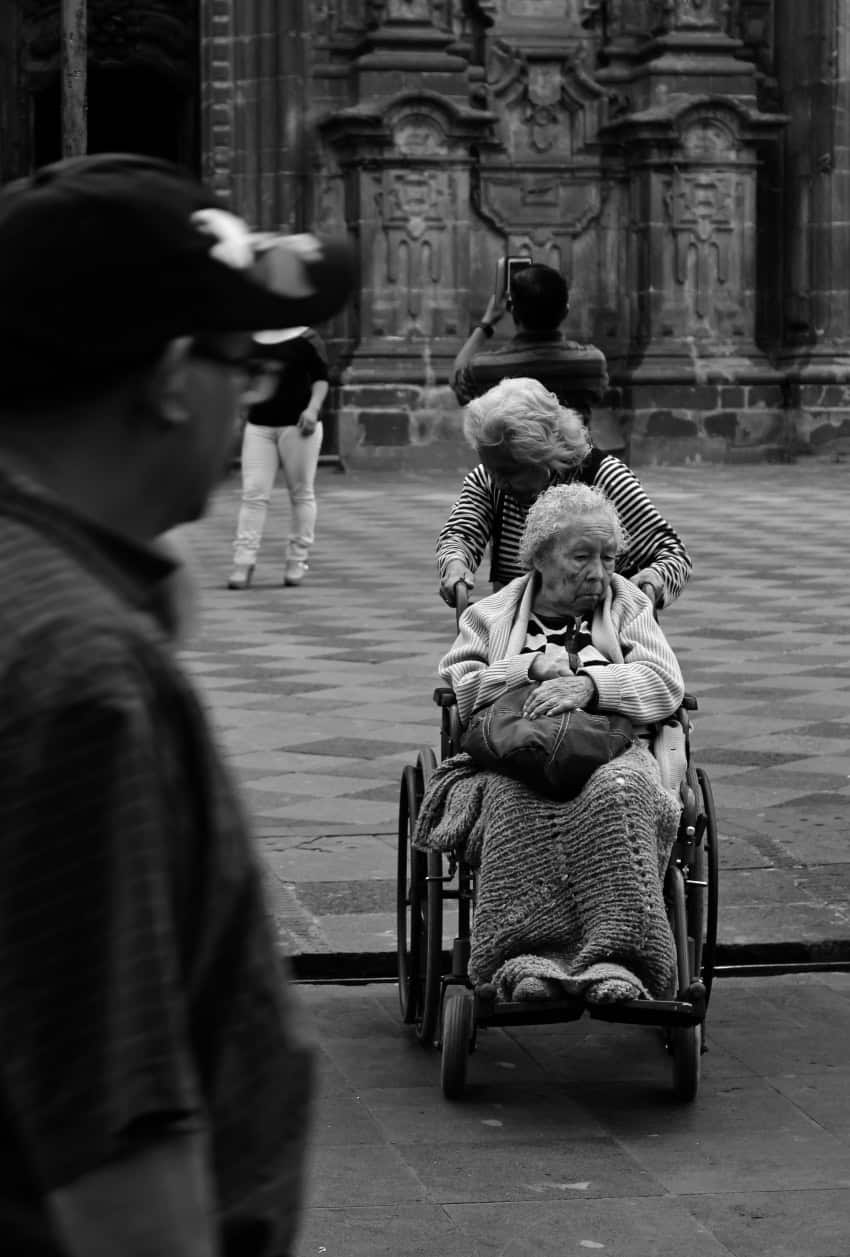
According to data provided by the Instituto Nacional de Estadística y Geografía (INEGI), nearly 15% of Mexico’s population — more than 19.2 million people — is currently 60 and older. On top of that, the National Health and Aging Study revealed that Mexico’s unmarried population between ages 50 and 59 has more than doubled since 2012.
Yet in a recent Milenio report on elderly care in Mexico, one thing was glaringly clear: Mexico does not have the infrastructure it needs to professionally support its aging population.
Let’s do the math. There are simultaneously more elders in Mexico than ever before, and more of those elders are without a partner to assist them or provide companionship. If that’s not eye-opening enough, the National Autonomous University of Mexico’s (UNAM) School of Social Work commented on the gravity of the situation, estimating that by 2050, nearly 1 in 4 Mexicans will be an “adulto mayor,” or senior citizen.
A cultural norm of intergenerational care
Unlike the U.S., where nursing homes are abundant, albeit increasingly unaffordable, Mexico has never had the same kind of cultural view toward its elders. That is, grandparents aren’t simply sent away to live elsewhere under the care of a trained professional once they lose their ability to live independently or care for themselves.

Throughout my life as a Mexican American, I’ve never known a Mexican family — on either side of the border — that has opted for an elderly family member to live outside of another family member’s home. Of course, it is both a miraculous feat and a personal burden to support elderly family members until the very end.
And it is something I admire and worry about in my own life, as my parents age without the necessary retirement savings to be economically stable.
It’s something I’ve been more attuned to since my mom became the full-time caretaker of my abuelo — the only living grandparent remaining in my life — about a year ago. Of my four grandparents, each was born, raised and — in the case of all but my living abuelo — buried in Veracruz, without ever wanting to live elsewhere.
In many ways, Mexico is the ideal place for an elder: All of my grandparents lived happily with or around their children. Once my tíos and tías were old enough to provide for my grandparents, it became a mutual system of care and support for as long as it was needed. And it was never questioned.
Imperfectly sharing joy and gossip
My family always travels during Día de Muertos. Here’s what we’ve enjoyed most
Often, whenever I’ve visited a relative’s house in Mexico at various points of my life, there has always been at least one, if not two, elders in their 60s, 70s, 80s, or in some cases even 90s or 100s, permanently living in that space. And that number multiplies drastically at a family party: Seemingly half are elders, while the other half is a mix of younger generations who take turns carrying the heaviest weights, pressures and responsibilities of keeping the larger family unit afloat.
My millennial generation is currently figuring out how to take the reins from our own parents, who are visibly nearing retirement in the next few years, if they haven’t already.
By contrast, I have very few memories of visiting a home in the U.S. and interacting with someone above a certain age, particularly grandparents or great-grandparents. It occasionally happens, sure. You might meet someone’s grandma or grandpa at a birthday party. But in Mexico, it’s a cultural norm to inhabit an intergenerational home that is brimming with young children, middle-aged parents and older grandparents, all occupying the same space and, imperfectly, sharing joy — and chisme — together.
Navigating daily life under one roof
In my case, I’ve built a room for my mom and abuelo in my house. Though they don’t live with me permanently, they often come over for periods of time — from a week to nearly a month — and become a part of our daily lives. That’s when I am most able to see the complications of caring for an elder, through my mom’s labor. It can be a thankless job.
While my wife and I have our hands full raising our toddler son, I see the work mirrored in how my mom must assist my abuelo — who can barely walk or speak these days — with feeding, bathing, clothing, using the bathroom and getting from one end of a room to the other. We have occasionally taken road trips together as a unit — sometimes to the beach in the port of Veracruz, other times to a nearby Pueblo Mágico to sit in the plaza. But in general, his immobility and unpredictable eating and sleeping habits make it so that my mom often can’t go to many places with us, so she usually stays behind with my abuelo. (I assure you that doing anything with a toddler and an elder in tow is entertainingly goofy, slow-moving, erratic and stressful in various ways.)
Messy but integrated
It’s not an experience I would ever have if I had stayed living in the U.S.: helping my mom so that she can help take care of my son and her father, in the same home, at the same time. We split the load as best as we can.
I don’t know what my abuelo’s life would be like if he had moved to California. Even then, I’d imagine he would still live with another family member or us, rather than in a nursing home.
It simply isn’t a part of Mexican culture to cast off the oldest among us into an unknown living space. They are integrated into our lives, sharing meals and watching movies and going to the park whenever possible, despite Mexico’s crooked sidewalks and under-equipped infrastructure. It’s messy, but you rarely feel alone here in your familial struggles and needs.
Embracing the muégano lifestyle
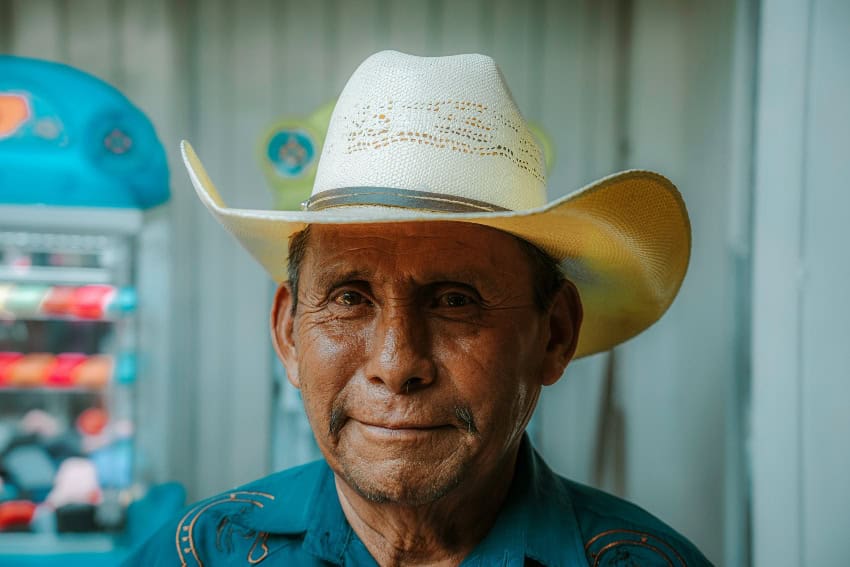
I’ve learned that this family structure in Mexico is known as “muégano” — a reference to the traditional Mexican treat that is sticky, sweet and clumped together. It’s a poetic and beautiful way to live, and one that becomes increasingly valuable as I get older, though, of course, it has its frustrations, like a lack of independent time or private space to unwind or recalibrate.
Instead, the muégano lifestyle is about being in constant proximity to your family, always being there for them in a time of need, and in return, them being there for you. It’s antithetical to the independent-minded, self-motivated upbringing I had in the San Francisco Bay Area, where time and opportunities move faster, and one doesn’t always have the time to stop, chitchat and ask for everyone’s opinion in the room on every matter.
The Mexican way
Both cultural approaches have their merits and values. When it comes to taking care of elders, though, Mexico is unmatched, even if nursing home care isn’t as easily accessible as it is in the U.S.
If I had grown up my whole life with that outlook, I may have been more prepared to take on the responsibility — a deeply personal one, at that — when the time comes with my own parents.
As of now, I’m still learning. Maybe we all are.
Alan Chazaro is the author of “These Spaceships Weren’t Built For Us” (Tia Chucha Press, 2026), “Notes from the Eastern Span of the Bay Bridge” (Ghost City Press, 2021), “Piñata Theory” (Black Lawrence Press, 2020), and “This Is Not a Frank Ocean Cover Album” (Black Lawrence Press, 2019). He is a graduate of June Jordan’s Poetry for the People program at UC Berkeley and was selected as a Lawrence Ferlinghetti Poetry Fellow at the University of San Francisco. His work can be found in NPR, The Guardian, SLAM, GQ, L.A. Times, and more. He is currently based in Veracruz.
KioskNews shows a cleaned-up reading view extracted from the publisher’s page — the original always lives on their site, not ours.