Frustrated with cryptic crosswords? Read this guide to finding ‘that fabulous aha! moment’
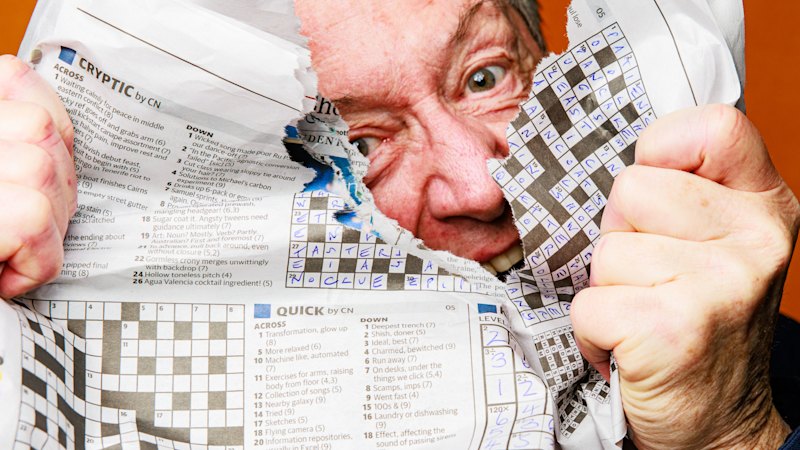
Let’s start with my all-time favourite cryptic crossword clue: Gegs (9,4). It stumped me but I loved learning the solution (printed below as ¹ so you have time to work it out yourself before checking).
It was brilliant, clever and fun.
As much as I’m drawn in, I have a love-hate relationship with cryptics. I’ll often start a holiday enthusiastically tackling one. Then I’ll usually reach a point where a mystifying clue or an unsatisfying solution will have me tossing the paper aside in frustration and grabbing a book.
But countless fans disagree. Crosswords have a growing audience, driven by digital formats and younger solvers’ interest on Instagram and TikTok.
So the launch of two books with a selection of puzzles from The Sydney Morning Herald and The Age is timely. It’s a chance for fans to revel in their love of wordplay and for newcomers to get involved.
I’ve asked three of the puzzle creators from 101 Cryptic Crosswords – David Astle aka DA, Rachel Kelly (RK) and Rose McGinley (RM) – for their favourite cryptic moments and some tips on how to approach them.
The three setters imagine different types of solvers when they devise their puzzles.
The great Astle, who has been creating cryptics for the two papers for more than four decades, pictures an amateur detective, with a coffee or something harder at their elbow, cracking the case clue by clue.
“As the weekly law-bender I’m happy to be outfoxed, the puzzle completed but not without a tussle,” he says. “As the hardest setter in the stable I want my grids to promise a mental tug-of-war.
“Adding a few gentler clues is also important – morsels to draw you deeper into the labyrinth.”
Kelly, a professional musician whose interests when compiling puzzles include the day’s news and popular culture, loves that the solver could be “absolutely anyone”, from the prime minister to a friend or relative.
“I like to imagine it’s part of their daily ritual and something that brings them joy and a fun mental challenge,” she says.
On where she aims her cryptics on the scale of “easy” to “impossible”, Kelly says it’s somewhere in the middle.
“A good balance is the key,” she says. “Some easy clues to give the solver a way in and then others that take a little more brain power, with a few doozies thrown in so the solver feels extra clever when they’ve worked them out.”
McGinley, whose interests include astrophysics, linguistics and tap dancing, imagines herself, before she became a compiler, trying to work out “the various tricks and wordplays involved in solving them”.
She likes to mix some easy clues with at least a couple of difficult ones. “Generally, I aim to make them challenging but definitely not impossible,” she says.
So why should someone who’s never attempted a cryptic give it a try?
“A cryptic a day keeps the cobwebs away, giving you a new zeal for words and what they mean or don’t mean,” Astle says. “Plus a greater appreciation of dad jokes, gotchas and eurekas.”
Kelly thinks cryptics are far more interesting and satisfying to solve than quick crosswords.
“The clue usually contains a synonym of the answer, like a quick, but also has wordplay to help you figure it out,” she says. “The trick is knowing which part is which.
“So you’re locked into this tussle with the setter, who’s trying to deceive you a little but ultimately wants you to figure it out and have that fabulous aha! moment when you do.”
McGinley agrees that cryptics are much more fun than quicks. “You only have to master a few well-used tricks and you’re on your way,” she says.
So what are their all-time favourite clues written by someone else?
Astle cites this one from UK setter Methuselah: A B-52 possibly spoonerised Love Shack? (7)²
Kelly: Must’ve? (5,7,2,3,3)³
McGinley: Forced union to raise legitimate issue (7,7)⁴
What about their favourite clue that they’ve written?
Astle cites this year’s favourite: Cooler way to defy 007? (4)⁵
Kelly quite likes this one from her first cryptic published in the Herald and Age: Kn$pfler s$ng? (5,3,7)⁶
McGinley: Arrive late for these bonfires (5)⁷
What’s turned out to be the most difficult-to-solve clue that they’ve written?
Astle says one July clue felt like an optical illusion for the brain, the wordplay also acting as a fractured definition of the answer: Struggle for anyone (not!) getting time to focus essentially?! (9,7)⁸
If your head hurts even thinking about solving that clue, you will understand why DA has come to stand for Don’t Attempt.
Kelly once unwittingly wrote a clue with two possible answers that both worked in the grid: Vegetables for kitty first then little piggies (8)⁹
McGinley thinks it would be: Make sinner thinner (4)¹⁰
So what’s the best advice from our setters for first-timers?
“Spend time between clue and solution, seeing how things fit,” Astle says. “It’s not cheating but reverse engineering. You’ll soon see almost every clue has two parts: wordplay and definition or vice versa.
“The more you dabble, tackling the kinder levels like Monday’s RM or RK on Thursdays, the more your brain will adapt. All that, and it’s fun.”
DA’s cryptics appear on Fridays. Or, as he says, “Friday is the Try-day for solvers”.
Kelly thinks most people learn by getting someone else to show them how it’s done.
“I made my way into cryptic-solving by sitting beside my mum after dinner each night and trying to spot the anagrams,” she says. “If you’re flying solo, look for the anagram clues first, as they are often the easiest to solve.
“There are usually several of these in every puzzle. Look up the different clue types, as these will help you know what kind of wordplay you could be dealing with.
“Another method is to check the answers and then work backwards, trying to figure out how to get there from the clue. Most importantly, keep at it. You’ll get better the more you try.”
McGinley keeps it simple.
“Bear in mind that 90 per cent of cryptic clues are one of the following two structures: quick clue plus wordplay, or wordplay plus quick clue,” she says. “The quick clue, a synonym for answer, is usually there for you.”
Solutions:
1. SCRAMBLED EGGS 2. HAIRCUT, which is a spoonerism of ‘CARE HUT’ with B-52 a salon style 3. THINK OUTSIDE OF THE BOX, which comes from MUSE being placed outside the letters of TV 4. SHOTGUN WEDDING 5. STIR, which has the double definition of cooler being slang for prison plus the opposite of Bond’s martini preference 6. MONEY FOR NOTHING 7. PYRES, which comes from late as in recently deceased. 8. ATTENTION ECONOMY, which is an anagram of ANYONE + NOT + TIME + TO + C 9. POTATOES but some solvers went with TOMATOES. Kelly thinks, though, that tomatoes are technically a fruit 10. LISP, which has no traditional cryptic wordplay.
The Sydney Morning Herald and The Age 101 Cryptic Crosswords – Book 1 and Book 2, published by Pan Macmillan, are out now.
Tips and tricks from our crossword guru plus links to our online puzzles and quizzes. Sign up to get Puzzled with David Astle every Saturday morning.
KioskNews shows a cleaned-up reading view extracted from the publisher’s page — the original always lives on their site, not ours.