Hackers use university e-mail for bomb threats
MORE HYBRID WARFARE: Italian police said they suspect that hackers had hijacked university servers in Taiwan or spoofed e-mail addresses in a relay attack
A Taiwanese university’s alumni e-mail account was allegedly hacked and used to send bomb threats to more than 6,000 public schools across Italy on Wednesday, Italian media reported.
Taiwan’s representative office in Italy on Wednesday night said that Taiwan condemns any threatening behavior and that Taiwanese agencies and organizations are willing to cooperate with Italian authorities by providing technical assistance in investigating the case.
Screenshots of e-mails published by Italian media showed that messages sent at about 9:50am on Wednesday come from an account under Dayeh University’s domain in Taiwan.
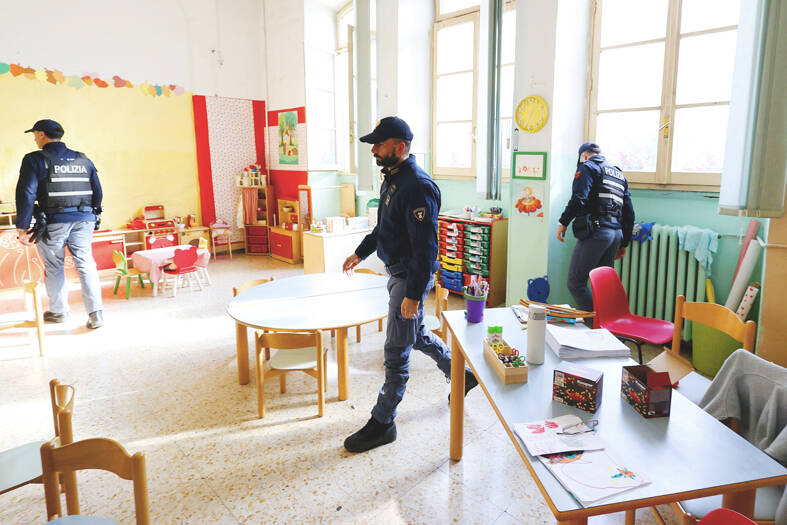
Police bomb squad personnel check the Cairoli nursery school in Prati, Rome, on Wednesday following a bomb threat.
Photo: EPA
The account displayed the name “Liu Fang-chun” (劉芳君) in traditional Chinese characters.
The private university in Changhua County said that an initial investigation found that an alumnus’ e-mail account had sent a large number of e-mails and appeared to have been hacked.
The school suspended the account, while the cause of the incident and the identity of the actual sender remain under investigation, the university said.
Although the e-mails appeared to have been sent from a Taiwanese account, they were signed with a Russian name, Mikhail Andropov, who claimed to be the leader of a virtual group called “Vilayat di Misoginistan.”
The e-mails claimed that bombs fitted with remote detonators had been installed at the schools.
Multiple schools urgently evacuated students and asked parents to pick them up at short notice.
A Taiwanese woman in Rome, surnamed Liao (廖), said that she received a notice in a parent group chat and that her daughter, a high-school student, was evacuated from school.
“She didn’t even have time to retrieve her phone from the classroom and was not allowed to go back in,” Liao said.
Liao said the situation was chaotic, with everyone rushing to leave and no one taking pictures. Armed police soon arrived at the school and found no explosives.
Some schools did not fully evacuate their students. Chen I-wen (陳易文), a former head of a Taiwanese community in Italy — Comunita Taiwanese in Italia Roma — said that his child waited outside the school for only an hour before classes resumed after the school confirmed that there was no danger.
Italian police and cybersecurity experts suspect that hackers hijacked university servers in Taiwan or spoofed e-mail addresses in a relay attack, local media said.
Italian Prime Minister Giorgia Meloni said that police had found no explosives and that there was no concrete danger, adding that the threatening messages were intended to frighten people, waste time, and create chaos and uncertainty.
The incident has been described as part of hybrid warfare targeting Europe, alongside incidents involving the disruption of refrigerators in supermarkets and refrigeration systems in hospital blood banks in France.
Some more schools were reportedly evacuated on Thursday following some 1,800 emailed bomb threats -- this time from accounts in the Philippines, according to local media.
French President Emmanuel Macron said it was too soon to say if "foreign powers" were behind the recent rash of hoax bomb threats across Europe, including against flights and schools.
"As I speak, we do not have sufficient elements to be able to make an attribution," Macron told reporters at a gathering of European leaders in Dublin, adding: "We cannot say if foreign powers are behind these calls."
European Commission spokesman Thomas Regnier said any threats against civilians were "simply unacceptable" and Brussels was following the situation closely.
KioskNews shows a cleaned-up reading view extracted from the publisher’s page — the original always lives on their site, not ours.