Raymond J. de Souza: Restraining AI is a task for natural intelligence
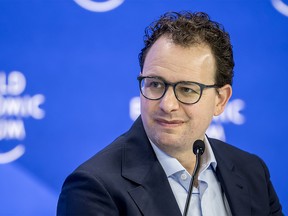
“If this technology is coming, it must go well,” said Christopher Olah, founder of AI giant Anthropic, last May at the Vatican, speaking alongside Pope Leo XIV.
Sign In or Create an Account
On Monday, Bell Canada announced a massive $50-billion AI investment in Saskatchewan. The announcement included Prime Minister Mark Carney, as well as his predecessors Jean Chrétien and Stephen Harper. You might otherwise need a papal funeral to get three PMs on hand. That’s how big AI now is.
The technology is not only coming. It is here. Is it going well?
Last week Jacob Coxon resigned from Anthropic, warning on X that neither OpenAI nor Anthropic “is acting responsibly” but are “gambling with our lives.”
I resigned from Anthropic today. I spent the last three years doing pretraining research at both OpenAI and Anthropic. Neither company is acting responsibly. They are racing straight to self-improving superintelligence and gambling with our lives. More thoughts below.
— Jacob Coxon (@hilbertspaess) September 9, 2026
“The people building AI earnestly believe that it could kill us all by the end of the decade,” Coxon added, setting off a global debate that had some political leaders, previously AI enthusiasts, running to revise their positions. There is a growing popular movement against AI data centres and their rapacious appetite for land, for energy, for raw materials, for microchips, for debt.

Columnist Jesse Kline keeps you up to date with what’s happening in Israel and the effects of antisemitism on life here in Canada. Friday mornings.
By signing up you consent to receive the above newsletter from Postmedia Network Inc.
A welcome email is on its way. If you don't see it, please check your junk folder.
The next issue of Channel Israel will soon be in your inbox.
We encountered an issue signing you up. Please try again
On Saturday, Anthropic CEO Dario Amodei called for a slowing down of AI development — “pacing” — so that it might be possible for AI advances to become a “race to the top” as opposed to the current “race to the bottom.”
“If slowing down bought us even an extra year or two before models reach critical levels of capability, and we used that time to advance alignment, we could greatly reduce the risk that something goes seriously wrong,” Amodei wrote.
President Donald Trump, for this part, mocked Amodei, saying that the only guardrails AI needs are a “STRONG AND SMART (High IQ!) PRESIDENT.” Rest easy, then.
It is refreshingly remarkable that the titans of Big Tech are issuing stark warnings. These have not been trustworthy people when it comes to mitigating the maleffects of their work. Quite the opposite.
The late Steve Jobs was a generational force in imagination, engineering and design. But he did more than anyone else to addict billions — including children — to their screens. He knew the danger, which is why he did not allow his own children to use the iPad. Apple’s marketing did not include such advice for other parents.
Just last month, Mark Zuckerberg’s Meta agreed to a settlement — a whopping US$18 billion, but not a significant dent in Meta’s budget — that included modifying its algorithms to make them less addictive to minors. Which meant that their addiction-promoting algorithms were a choice that they had previously made, with malice-for-money aforethought.
An enormous number of highly talented folks in the tech sector devote their energies to getting more and more people to spend more and more of their time and money on gaming, gossip, gambling and pornography. The sector, by and large, is not noted for restraint in promoting distracting and destructive things.
So when the tech barons say that it is time to reflect, time to worry, time to pull back, time not to do something just because we can do it — then it is high time to listen. Pace, pause, put a stop to AI for AI’s sake. Make the priority AI for humanity’s sake.
The summer of AI reconsideration opened with the publication of the Pope Leo XIV’s first encyclical, Magnificent Humanity, a stark warning about the new world of AI, and an urgent summons to “disarm” it.
“To disarm does not mean rejecting technology, but preventing it from dominating humanity,” the Holy Father wrote. “It means freeing technology from monopolistic control and opening it to discussion and debate, therefore making it human-friendly.”
Human-friendly would, at minimum, require that it not kill us all. Or even kill many of us, as appears to be on the mind of some military planners. Anthropic withdrew from Pentagon plans to use AI for mass domestic surveillance and for autonomous weapons. Good for Anthropic, but isn’t it likely that the American military will find someone else to do the dirty work?
There will always be someone to do the dirty work, and Big Tech knows how to get dirty faster than most.
“Some might believe that matters of AI are best handled by computer scientists like myself,” Olah said in the presence of the Holy Father last May. “They are mistaken: the questions raised by AI are bigger than the AI research community, not just in their implications, but also in their nature.”
Olah knows that his expertise is in the “work of math and programming and science.”
How AI “interacts with the world, how it ought to interact with the world” is not his expertise.
“These are more clearly questions for the humanities, for religion, for philosophy, for society at large,” Olah said, pleading for help.
The questions are more urgent now than even last May. The tech titans need to pause. And then the humanists, the theologians, the philosophers and the leaders of society, including political ones, need to think. It’s a task for natural intelligence — and even more for wisdom.
National Post
Join the Conversation
This website uses cookies to personalize your content (including ads), and allows us to analyze our traffic. Read more about cookies here. By continuing to use our site, you agree to our Terms of Use and Privacy Policy.
KioskNews shows a cleaned-up reading view extracted from the publisher’s page — the original always lives on their site, not ours.