Virtual taekwondo makes Asian Games debut with Singapore's Darren Yap in the fight
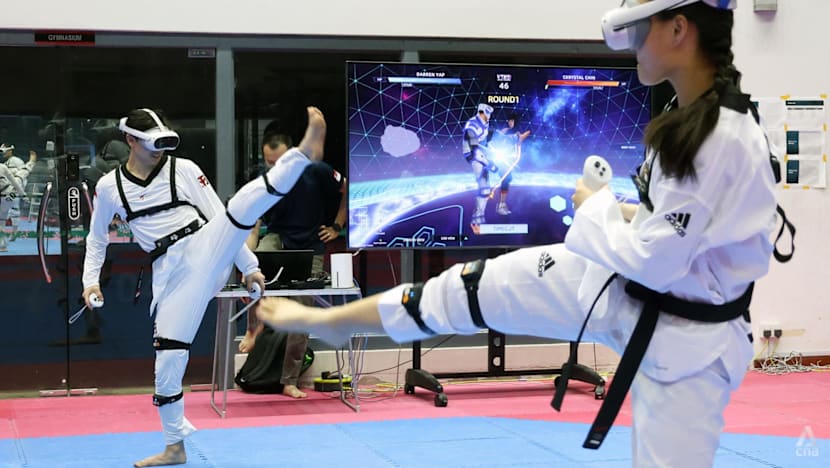
It may look like a video game, but competing in virtual taekwondo is tougher than it seems, says Singapore's Darren Yap.
New: You can now listen to articles.

This audio is generated by an AI tool.

13 Sep 2026 06:00AM
SINGAPORE: Put on a virtual reality headset, strap on motion sensors and start kicking at an opponent - without ever physically touching them.
It might sound like a video game, but virtual taekwondo will make its Asian Games debut in October, with Singapore's Darren Yap among the athletes competing for a medal.
The 22-year-old will take part in the mixed-gender event as part of the 2026 Asian Games in Japan, which run from Sep 19 to Oct 4.
Despite its obvious similarities to gaming, virtual taekwondo is not classified as an esport at the Games.
And for Yap, who has practised conventional taekwondo since he was four, mastering the virtual version has meant learning a different way of fighting.
"You are not fighting against an actual human. You're actually just fighting as an avatar," he told CNA.
"But the main difference is also that gauging your distance when you're fighting is a very big change, and also just getting used to the system, getting used to the equipment."
HOW VIRTUAL TAEKWONDO WORKS
So how does a taekwondo fight take place without either competitor actually hitting the other?
Co-developed by World Taekwondo and Singapore-based technology company Refract Technologies, virtual taekwondo combines the physical movements and techniques of taekwondo with virtual reality and motion-tracking technology.
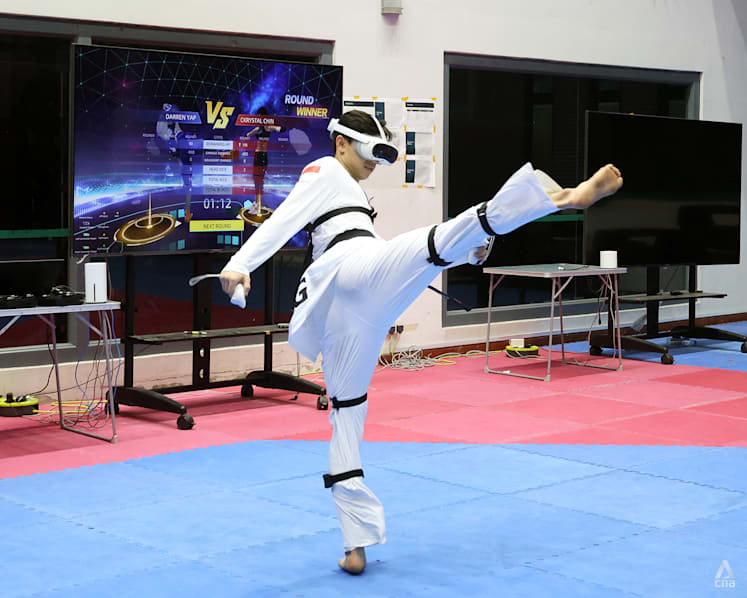
Athletes wear virtual reality headsets and motion-tracking devices, or nodes, on their spine, thighs and shins.
Their movements are translated onto digital avatars, allowing them to kick and attack their opponent in a virtual arena without making physical contact. Successful strikes deplete their opponent's virtual health bar.
Refract Technologies chief operating officer Gerald Lee told CNA that the technology grew out of an idea to use the human body itself as a controller.
After encountering limitations with existing motion-capture technology, the company developed its AXIS motion-capture system, which is now used for the sport.
At the Asian Games, 16 athletes will compete in a mixed-gender knockout tournament, according to the Olympics website.
Matches follow a best-of-three format and are contested in a 4m by 4m space, with each round lasting 60 seconds, according to the Virtual Taekwondo website.
Virtual taekwondo was showcased at Singapore's Olympic Esports Week in 2023 and held its inaugural world championships in Singapore the following year.
Its progression to the Asian Games has been quicker than even its developer expected.
Lee said its inclusion "reflects the credibility the sport has built since 2023".
Virtual taekwondo is also expected to feature at the 2027 SEA Games, AP reported in July.
In Singapore, it featured at this year's GetActive! Singapore Pesta Sukan, with categories ranging from juniors to participants aged 55 and above, including mixed-gender events.
The Singapore Taekwondo Federation also formed a national development squad this year to "sustain the development" of Singapore's virtual taekwondo talent. The squad has 14 athletes.
FROM POOMSAE TO VIRTUAL TAEKWONDO
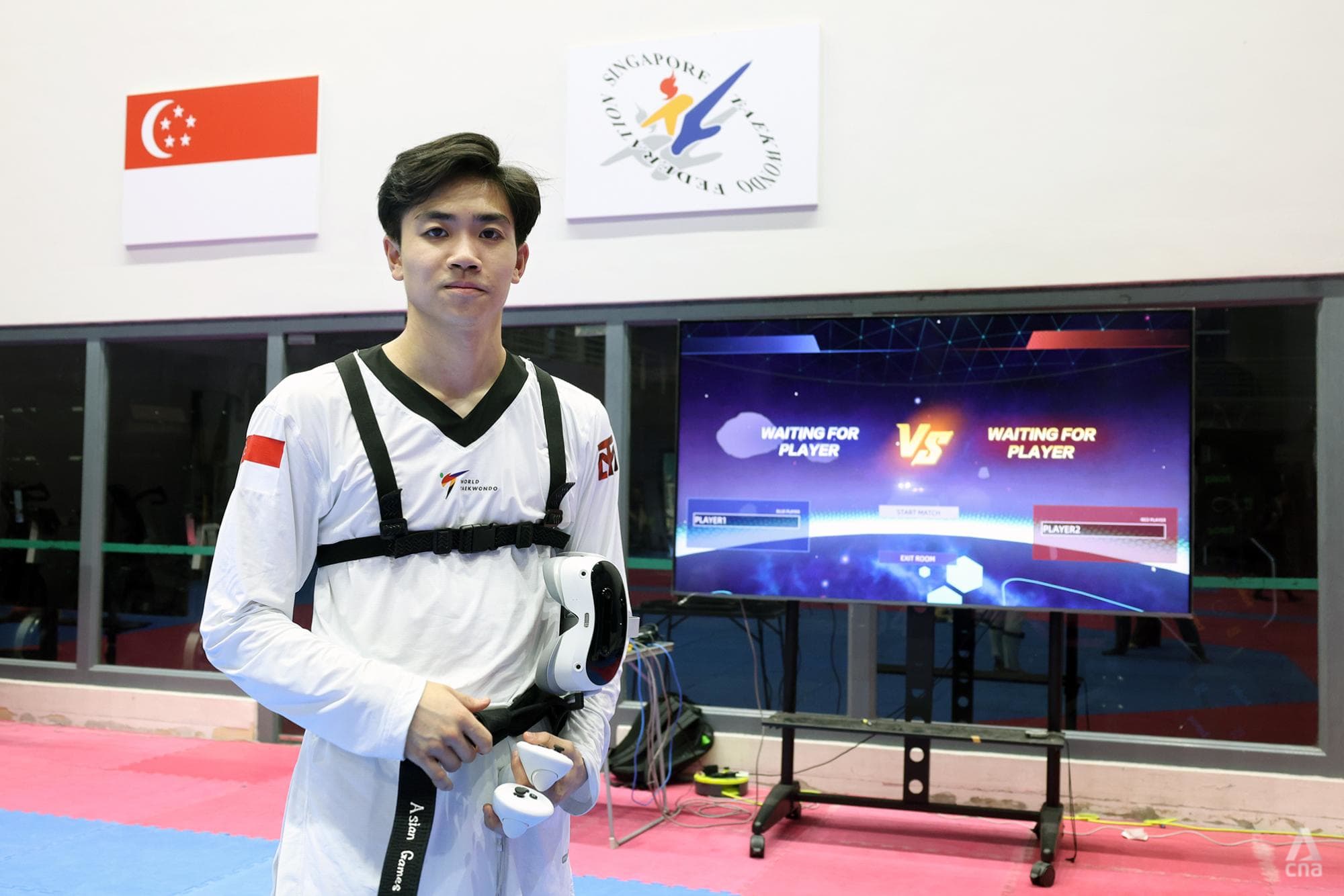
For Yap, the Asian Games involve switching between two very different versions of the same martial art.
His main event is traditional poomsae, a non-contact discipline in which athletes perform choreographed sequences of offensive and defensive techniques.
He won a joint bronze in freestyle poomsae at the last SEA Games in Bangkok and previously competed in the Asian Games in Hangzhou.
Virtual taekwondo, however, is new territory. This will be his first competitive foray into virtual taekwondo.
His selection came after he qualified for the Asian Games in poomsae. The Singapore Taekwondo Federation (STF) was subsequently informed by the Asian Taekwondo Union that Yap had also been selected for the virtual taekwondo competition.
Speaking to CNA at the Bedok National Training Centre, Yap said his first reaction was "shock", as he had not known virtual taekwondo would feature at the Games.
"But after that ... I was quite excited about it because it helps me and helps Singapore taekwondo introduce this to a wider audience in Singapore," he said.
Before beginning training in July, his only experience with virtual taekwondo was trying it at the Olympic Esports Week in Singapore in 2023.
TRAINING FOR VIRTUAL TAEKWONDO
While virtual taekwondo eliminates physical contact between opponents, Yap said competing in it requires considerable adjustment.
He described the sport as an "interesting concept" that looks much easier than it actually is.
"It's actually a very tough event. It's quite tiring, and there's more to it than people outside would think."
One of the biggest adjustments is judging distance in a smaller, virtual competition area. Understanding the technology and equipment is therefore an important part of competing in the sport, he added.
Training sessions last about two hours and include warm-ups, running, cardiovascular exercises, kicking and footwork drills.
Footwork is particularly important because of the smaller competition area, Yap said.
He is also put through scenarios designed to test his decision-making and reactions, as well as sparring sessions that allow him to experiment with "different moves and skills without getting hit".
Techniques do not necessarily transfer directly between virtual and conventional taekwondo either.
"For virtual taekwondo, it's a different technique. It's a different style of kicking that might not work in traditional sparring, and also some kicks in traditional sparring will not work for virtual taekwondo," he said.
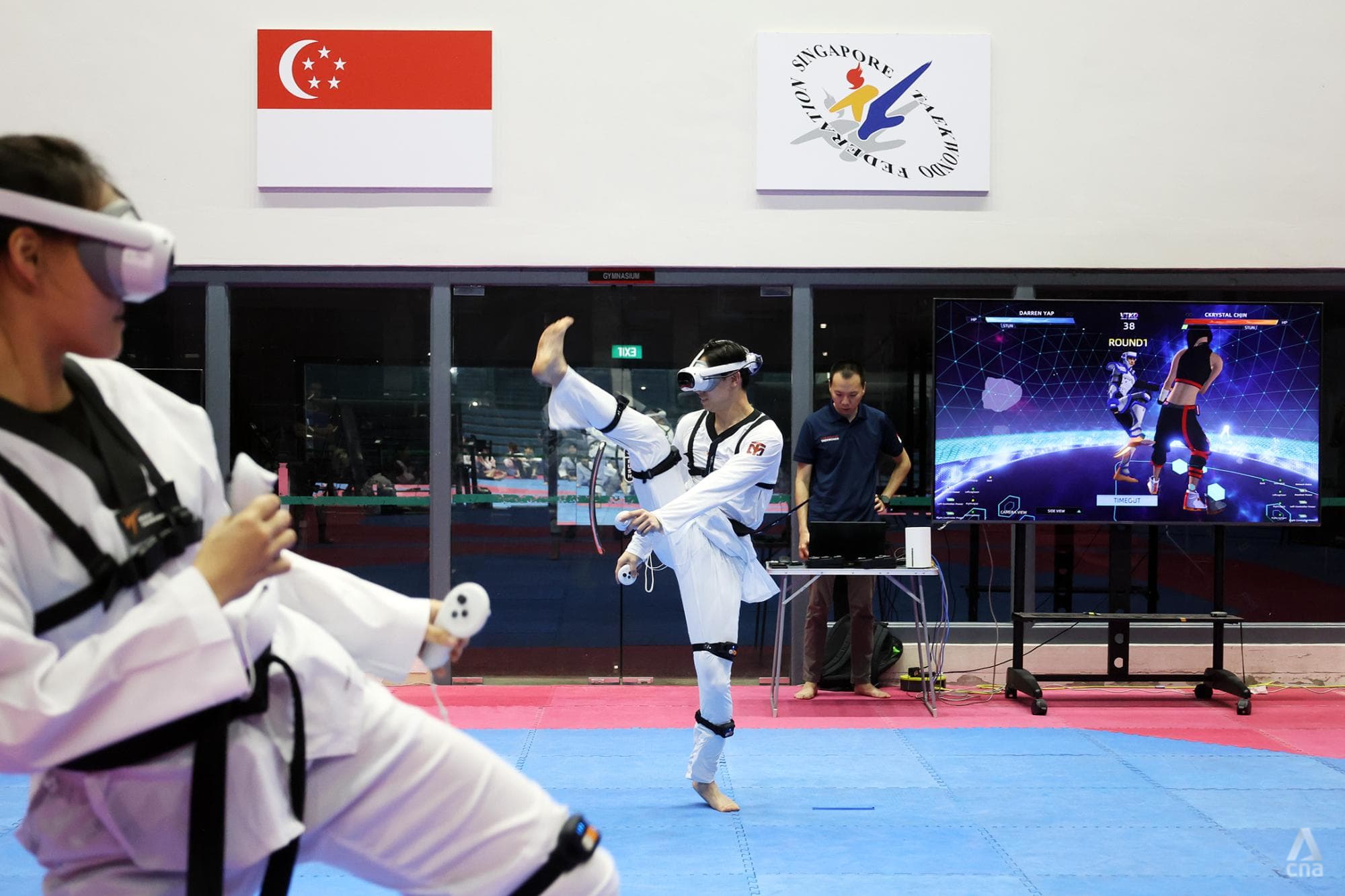
During a training session observed by CNA, Yap strapped motion-tracking nodes to his thighs, shins and chest before putting on the virtual reality headset.
With fellow taekwondo athlete Ckrystal Chin helping to set the boundaries of the competition area, the pair then began sparring - their movements translated into the actions of their avatars.
As part of his preparations for the Asian Games, Yap also attended a four-day virtual taekwondo training camp in South Korea.
He said he hoped the camp would help him learn more about "the different techniques and skills that other fighters might use against me" and better prepare him for the competition.
HOPES FOR ASIAN GAMES
Yap said he is honoured "to wear the Singapore flag" on his sleeve, but feels little pressure given that both he and the event are relatively new to the Asian Games.
"I'm somewhat new to this as well ... and I'm quite excited to participate in this event."
He added that he was trying not to focus on the outcome.
"I just want to do my best, and whatever happens, happens."
"It's a big competition, so my goal is just to have fun, do my best, and get on the podium if I can too," he said.
Singapore Taekwondo Federation's secretary-general Wong Zhen Kang similarly sought to temper expectations.
"The whole scene is really competitive, we're really just there for him to try and as long as he represents Singapore, this is what we're happy for," Wong said.
For Yap, competing at the Asian Games is also an opportunity to introduce more people to virtual taekwondo.
"It's a big opportunity for me to help other players, other taekwondo athletes in Singapore, gain knowledge of this, and maybe outside of taekwondo also," he said.
BEYOND THE ASIAN GAMES
Yap believes Singapore's virtual taekwondo scene is "slowly becoming bigger and bigger", and hopes its Asian Games debut will help broaden the sport's appeal.
He said it could attract people interested in martial arts who are "not a fan of combat or getting hit".
"It's a great way to experience sparring and just the ways of combat or just getting into the Kyorugi (sparring) side of taekwondo," he said.
Refract Technologies' Lee also sees an opportunity to reach people without a taekwondo background.
"We want more people - not just those with a taekwondo background - to understand what VTKD actually is and how approachable it is from the very first session," he said.
Yap acknowledged that some may dismiss virtual taekwondo as simply a "video game", but pointed to the physical skills involved.
"But it (comprises) a lot of taekwondo, traditional taekwondo techniques as well, like kicking, footwork, and all that," he said.
"So I think if you still have your doubts after hearing this, then maybe you should give it a try, and maybe you can find out by yourself."
KioskNews shows a cleaned-up reading view extracted from the publisher’s page — the original always lives on their site, not ours.