Their loss changed Appalachian forests for ever. Now the American chestnut is back
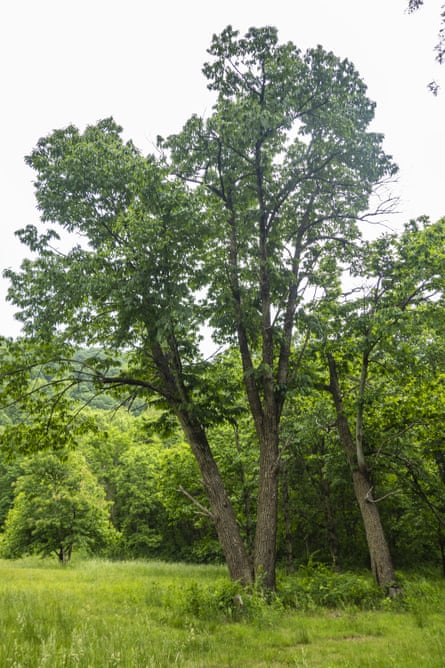
Jeff White is starstruck by a tree. The farmer and environmentalist from rural Maryland has an affinity with the American chestnut but has never seen one stretch from root to sky like this one. “About how tall is it?” he asks. “Over 70ft [21 metres],” says Cassie Stark, director of science implementation for the American Chestnut Foundation (TACF).
“Just incredible,” White says, his gaze fixed upwards. “I’ve never seen one so tall and so healthy.”
The tree, nicknamed Thompson, does indeed appear healthy, as do the neighbouring chestnuts in this 1.6-hectare (4-acre) orchard near the Appalachian Trail, in Nelson county, Virginia.
Here, in the Lesesne state forest, are two thriving chestnut orchards, a living laboratory where research has been conducted since the late 1960s on a species that has been functionally extinct for nearly a century.
-
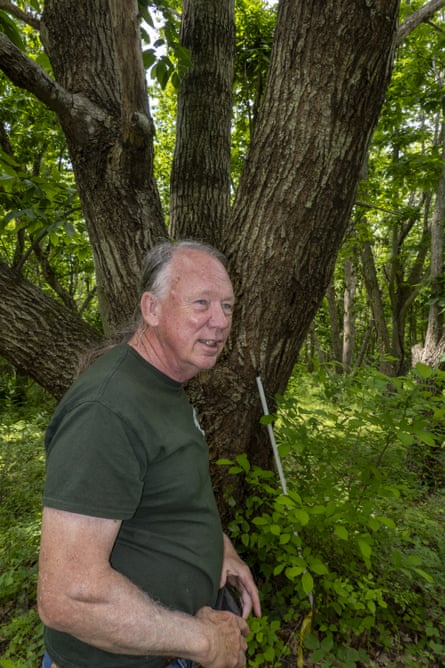
‘Thompson’, above left, is an unusually tall specimen of an American chestnut, a now-rare species once ubiquitous in the US. Jeff White next to ‘Gladys’, a thriving 15-metre-tall pure American Chestnut in Virginia’s Lesesne forest
So dominant was the American chestnut that it is estimated it once made up one in every four trees in the forests of Appalachia and eastern North America.
There is no shortage of superlatives when describing the chestnut. It was a fast-growing tree with rot-resistant wood; its nuts were sweet and provided a reliable crop enjoyed by humans and wildlife alike, including squirrels, wild turkeys, white-tailed deer, the extinct passenger pigeon and black bears.
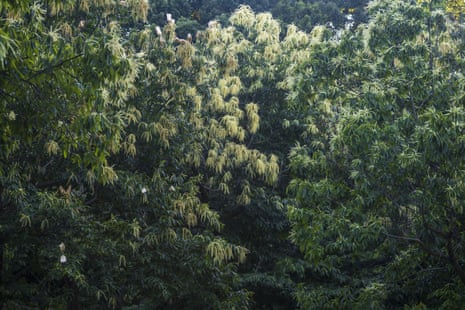
It was a valuable cash crop for rural Appalachian communities and supplied most of the tannins to the leather-making industry. And it was beautiful: in early summer the tree’s long white catkins made the mountain slopes appear covered in snow.
-
Blossom cascades like fireworks on mature chestnuts at the Monocacy orchard in Maryland
But its dominance was checked when chestnut blight (Cryphonectria parasitica), accidentally introduced from Asia, was first discovered in 1904 on infected trees at the Bronx zoo in New York. The airborne parasitic fungus proved a formidable foe.
By 1941, it is estimated that more than 4bn trees had succumbed in one of the worst environmental catastrophes in modern history. By 1950, the tree was functionally extinct and the forests of eastern North America were for ever altered.
-
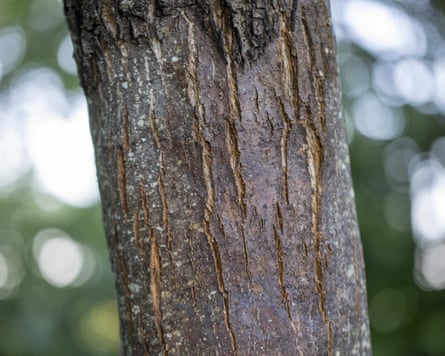
Canker sores – the primary sign of chestnut blight – on the bark of an American Chestnut
Chestnut shoots can still be seen in the wild. But while the underground root system survives, these shoots rarely live long enough to fruit – and those that do become afflicted by blight. The disease eats away at the tree’s inner bark, invading the phloem and vascular cambium to leave behind cankers, rusty-looking sores, sometimes swollen and at other times deep crack-like fissures, disrupting the flow of nutrients and water in the tree and eventually killing it.
This is why the trees at Lesesne forest are so special. The larger orchard, of roughly 12 hectares (30 acres), is a mixture of hybrid chestnuts, the offspring of Americans crossed with blight-resistant Chinese chestnuts. Among the hybrids are even some pure Americans showing blight-resistance, a happy discovery. There is also a thriving hardwood forest of chestnut, tulip poplar and oak.
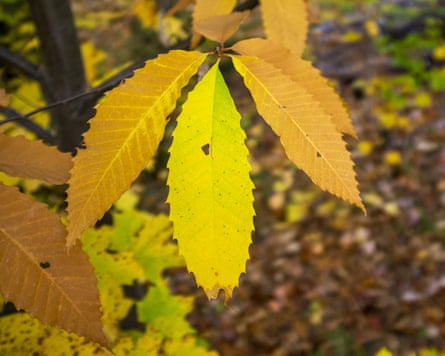
-
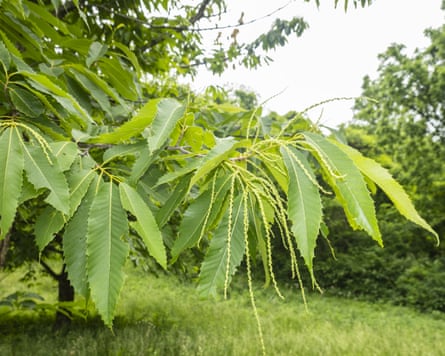
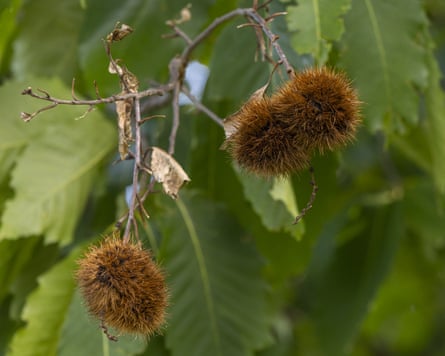
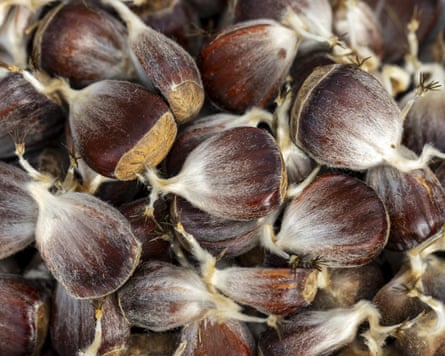
Chestnut leaves and catkins in spring at Lesesne forest, Virginia; spiky chestnut burrs, which protect the developing nuts; a wild American chestnut in Maine in autumn; the fruit of the chestnut traditionally fed a variety of species, including humans. American chestnuts are hairier than Chinese varieties
In the smaller orchard are pure Americans: trees such as Thompson that were produced through grafting. But grafting proved a very difficult approach. More than 1,300 grafts were made between 1980 and 1984, but by the end of that period only about 100 survived.
Today, about a dozen remain. These trees, including Thompson, have been inoculated with a hypovirus, which can weaken the fungus and aid infected trees in containing the pathogen.
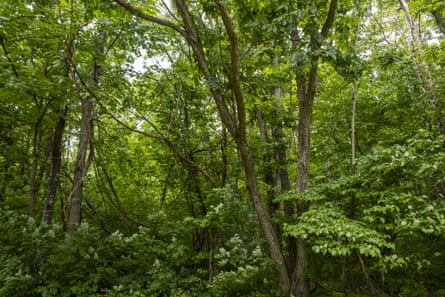
-
Mixed woodland with American chestnut trees in Lesesne forest
In February 2026, researchers working with TACF published a paper in the journal Science describing a newer approach they have adapted to breeding the tree: recurrent genomic selection. The breeding method blends DNA profiles and computer modelling to predict an individual’s breeding value; in other words, what traits it is likely to pass on to its offspring.
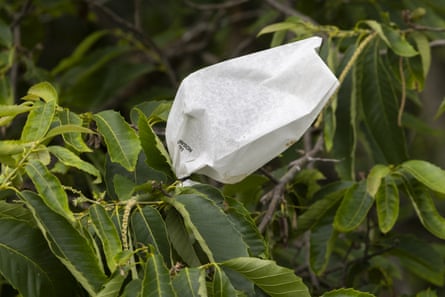
-
Bags are put around female chestnut flowers to prevent uncontrolled natural cross-pollination and allow researchers to control which pollen fertilises the tree
For chestnut restoration that means using hybrid trees: crossing American chestnuts with blight-resistant Chinese chestnuts, while selecting for trees that retain mostly American chestnut ancestry, but with blight resistance.
The process speeds up breeding by allowing researchers to identify promising trees when they are still young, rather than waiting years to see how they grow and respond to blight. Historically, the cost of such technology was prohibitive – hundreds of dollars for a single sequence. Today, they can sequence a whole seedling for $18 (£14).
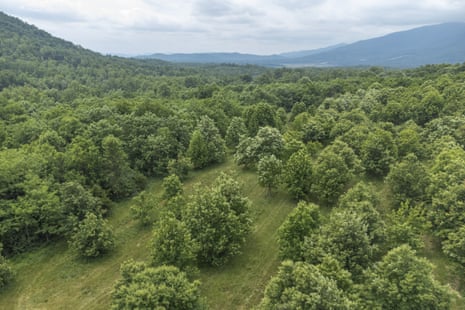
-
Chestnuts in Lesesne forest, with the Blue Ridge mountains beyond
TACF once supported the development of transgenic American chestnuts for blight resistance, collaborating with the State University of New York’s College of Environmental Science and Forestry on a project being studied there, but withdrew its support after field trials showed variable blight resistance, stunted growth and reduced survival.
Recurrent genomic selection, meanwhile, is being used with hybrid trees and surviving American chestnuts. Unusually for a tree research body, TACF is not aiming for purity. Instead, it is hoping to restore the role the chestnut once played in the forests.
“We need to get away from this [idea] that we have to bring back the American chestnut, that it has to be this purity ideal,” Stark says.
-
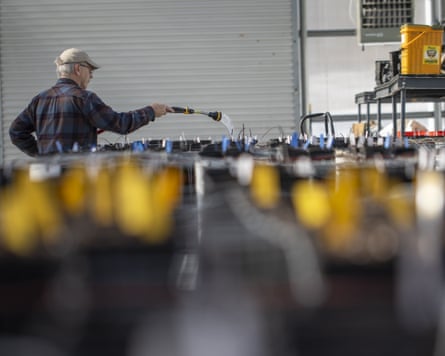
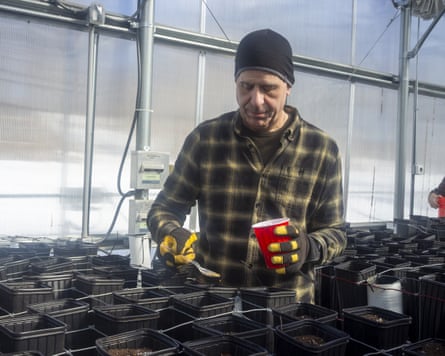
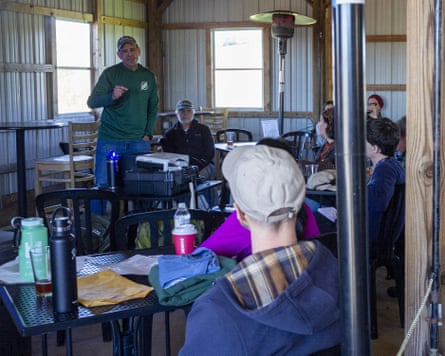
A volunteer at the TACF nursery watering pots after winter sowing; Michael Goergen, TACF president and chief executive, speaking to the Maryland TACF chapter in October in Mount Airy; and sowing seeds during the winter
“What we’re trying to do is restore a phenotype,” adds Michael Goergen, president and chief executive of TACF.
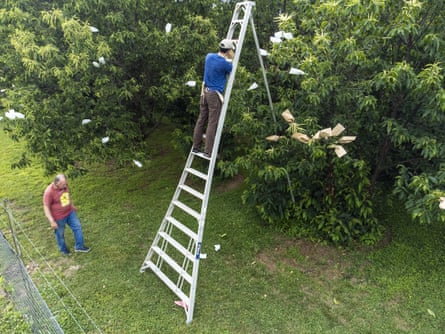
At the Johns Creek Mountain chestnut orchard in Virginia there are 10-metre trees outcompeting maple and poplar. Farther north at the Monocacy chestnut orchard in Maryland there are trees 12 metres tall that require motorised boom lifts, ladders and extension poles for hand-pollination and harvesting work.
-
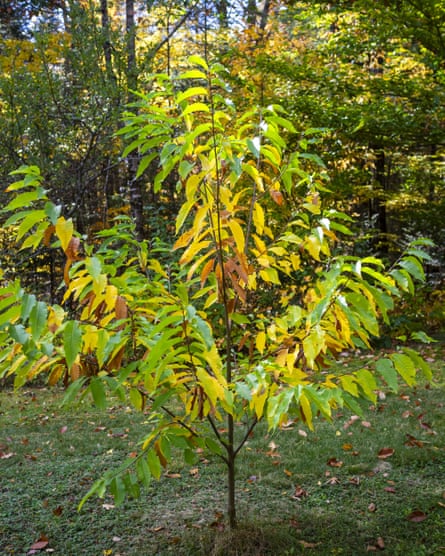
A pure American Chestnut sapling planted in Maine
These trees offer a glimpse of what restored American chestnuts might look like, but getting chestnuts back into the forest on a meaningful scale is another challenge entirely.
“They are finicky trees, you can’t just plant them anywhere,” says Stark. Site selection is crucial due to soil, sunlight and competition from other trees. Then there is the need to build partnerships with landowners and organisations with suitable habitat, volunteer hours, and fencing for young trees to keep out a large deer population.
“It’s a massive commitment of funding – and a big consideration is fencing. Actually, funding for fencing,” says Goergen.
This is where recurrent genomic selection becomes so important. It is impractical to wait 30 to 40 years to determine how resistant and vigorous a tree may be; it is impractical to manage every single tree on a long timescale. For an American chestnut, one generation takes seven to 10 years.
-
Tony Sutton and Jeff White, the Maryland chapter president, pollinating chestnut trees at the Black Hill orchard in Montgomery county, Maryland
Multiply that across several generations and restoration becomes a long-term project. This technology allows breeders to identify promising trees more quickly, when they are young, in order to produce trees that over generations will not rely on the people who produced or planted them.
“Success would be getting the trees out there to fruit and flower; to give back ecosystem services, carbon sequestration and nitrogen filtration,” says Stark. “It doesn’t have to be a dominant tree again.”
For Goergen, the ideal would be: “When I can walk into a forest around the Fourth of July and be surrounded by those white fireworks. That would tell me we did it.”
Find more age of extinction coverage here, and follow the biodiversity reporters Rebecca Ratcliffe, Phoebe Weston and Patrick Greenfield in the Guardian app for more nature coverage.
KioskNews shows a cleaned-up reading view extracted from the publisher’s page — the original always lives on their site, not ours.