Take AI to the ‘kampung’ and SMEs, ex-central banker Andrew Sheng tells Malaysia
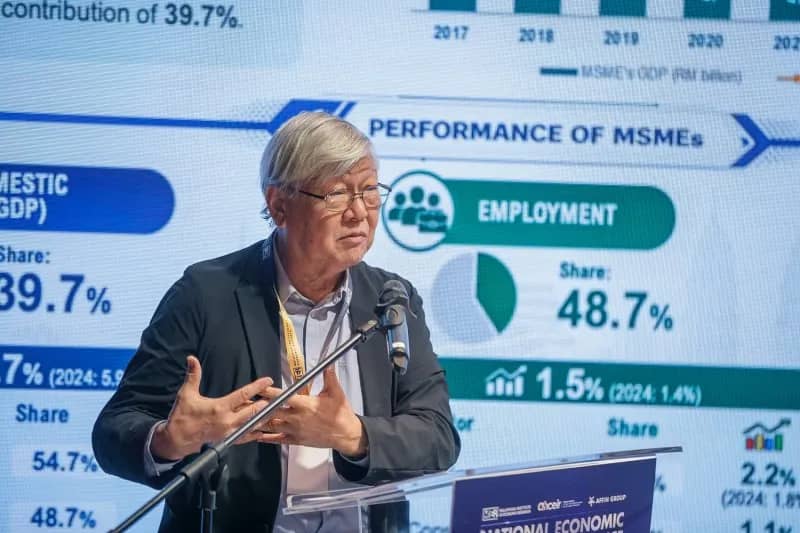
Former Malaysian and Hong Kong central banker Tan Sri Andrew Sheng speaks during the National Economic Outlook Conference organised by the Malaysian Institute of Economic Research in Kuala Lumpur on November 26, 2026. — Picture by Raymond Manuel
By Soo Wern Jun
KUALA LUMPUR, Nov 27 — Malaysia must take artificial intelligence (AI) to the kampung and to small and medium enterprises (SMEs) if its growth is to be more inclusive, former central banker Tan Sri Andrew Sheng said.
Currently a distinguished fellow at the Asia Global Institute, University of Hong Kong, he said Malaysia must move away from top-down development and give ordinary people the knowledge, financing and digital infrastructure to take part in the economy.
“At this point in time, Malaysia talks AI but don’t walk AI,” he said at the National Economic Outlook Conference organised by the Malaysian Institute of Economic Research here yesterday.
Sheng, who also used to head the Hong Kong Monetary Authority and Hong Kong’s Securities and Futures Commission, said AI could break down barriers of language and expertise, but access would mean little without education to help people use it.
He said he was shocked during a visit to Nabawan, Sabah, to find communities still without internet access.
He said AI could help farmers use government data to forecast crop demand, avoid oversupply that drives down prices, and manage warehouses and inventory without relying on officers or specialists.
For SMEs, he said many were still struggling with basic digitalisation, with much of their data still on paper.
In two cases examined in preliminary research by two AI graduates he hired, he said the analysis suggested the businesses were making sales from less profitable products, but their owners lacked the digital records and time to see it.
Sheng said this showed the need to simplify regulations and help SMEs digitise.
He also questioned whether Malaysia’s 17 development finance institutions were doing enough, saying separate targets and application requirements often made it hard for entrepreneurs to get help.
He said young businesses fall into a “valley of death” of negative cash flow with no collateral for bank loans, and proposed more equity-based, risk-sharing Islamic finance alongside zakat (Islamic mandatory annual charity) and waqf (Islamic voluntary endowment).
He said equipping young Malaysians with AI skills was key to tackling graduate unemployment and skills shortages in industries such as semiconductors, noting that studies show one-quarter of graduates stay unemployed for more than six months.
He said Penang semiconductor firms could no longer wait three to five years for universities to produce suitably skilled graduates and were retraining staff, while Malaysia risked losing talent to Singapore, where technology professionals earn more.
He added that succession was a challenge as older business owners resisted change, making it vital to nurture young entrepreneurs willing to take risks.
He cited data from the Department of Statistics Malaysia showing that micro, small and medium enterprises accounted for 40 per cent of gross domestic product, half of employment and 15 per cent of exports.
Sheng said Malaysia must replace fragmented, top-down programmes with an approach linking education, financing, technology and infrastructure, and build its own resilient communities, young entrepreneurs and next-generation companies rather than rely on outside institutions.
“The glass ceiling is not a natural limit. It is the legacy of an obsolete model,” he said.
He said Malaysia could lead in using AI to transform its economy if it empowered more people to take part.
“Grab it or we waste the biggest opportunity that life has given us,” he said.
KioskNews shows a cleaned-up reading view extracted from the publisher’s page — the original always lives on their site, not ours.