Once Bossku, always Bossku? — Khoo Ying Hooi
NOVEMBER 11 — Najib Razak is now at home. After everything, he is still Bossku.
Bossku, that nickname once seemed almost absurd: a prime minister defeated in an election, facing serious corruption charges, finding a second political life as a familiar, approachable figure.
There were photographs, jokes and expressions of affection. The man Malaysians had voted out was becoming someone they were invited to feel sorry for.
Looking back, we should have taken it more seriously.
Bossku gave Najib something that losing office could not take away. He was still their Bossku, whatever the courts decided. His supporters could acknowledge that he had been convicted and still believe he deserved their loyalty. Politically, they had not finished with him.
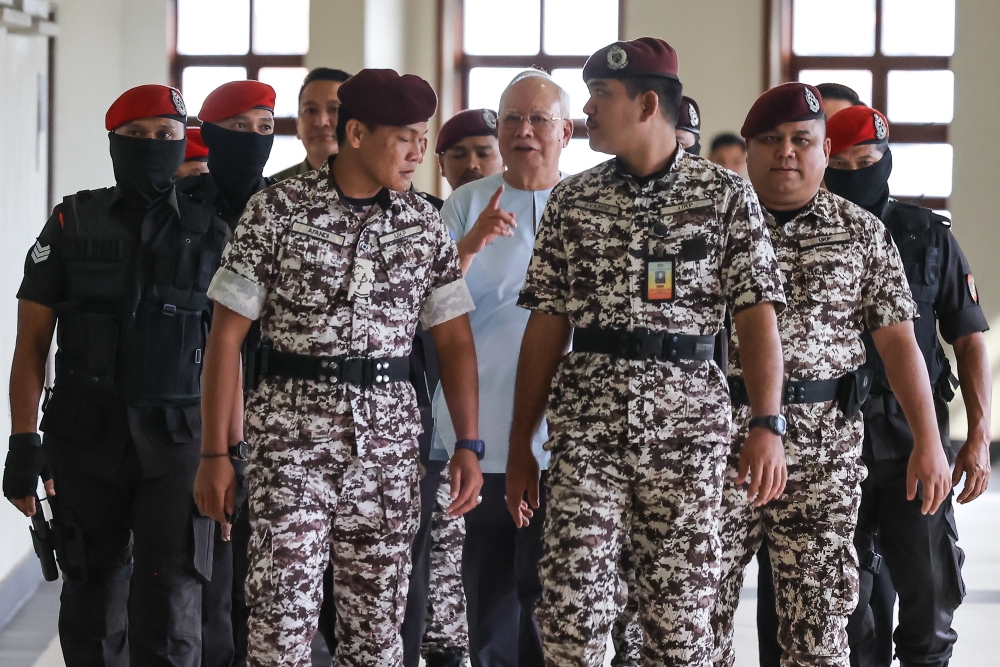
Former prime minister Datuk Seri Najib Razak is pictured at the Kuala Lumpur Court Complex on November 10, 2026. — Picture by Yusof Mat Isa
In 2018, there was exhilaration, certainly, but also relief. A government that had seemed impossible to remove had lost.
For many Malaysians, the hope was straightforward. Public office should no longer protect those who abused it. We knew corruption would not disappear with a change of government. We thought, however, that some consequences might finally become unavoidable.
Najib entering prison is symbolic because it made that hope believable. A former prime minister had been tried, convicted and imprisoned — the first time in our history. For once, political standing had not been enough to keep him out of prison.
But it was enough to keep his cause alive.
That is what Bossku helps us understand. Najib’s political relationships survived his defeat and conviction. Umno continued to advocate for him. Supporters continued to see his treatment as something personally important to them.
While other prisoners disappeared from public attention, Najib remained a question that politicians had to answer.
This is a familiar problem in Malaysian politics. A leader distributes benefits through government, but the gratitude attaches to him personally.
People remember who helped them, who appeared to listen, who made life feel easier. Public resources become part of a personal relationship. Years later, asking that leader to answer for wrongdoing can be received as an act of disloyalty.
It would be condescending to dismiss these attachments as ignorance. People can understand corruption and still remember a leader fondly. But that is precisely the irony. Personal gratitude can make public wrongdoing seem forgivable, especially when supporters believe subsequent governments have done little for them.
Najib does not need everyone to believe he is innocent. He needs enough people to believe he has suffered enough.
The court has now allowed him to serve the remainder of his SRC International sentence at home until August 2028. His conviction remains, although they offer little comfort to those wondering why accountability looks so different when the prisoner is politically influential.
I cannot establish that political bargaining produced this outcome. But the unequal attention surrounding it is hard to ignore. Najib has a party, prominent advocates and supporters who have spent years demanding relief.
Most prisoners have nobody capable of making their circumstances a matter of national urgency. That difference deserves scrutiny, whatever the legal explanation for an individual decision.
For Pakatan Harapan, the irony is difficult to escape. Najib once represented much of what it promised to change. Now it governs with the party that continues to champion him.
Voters who remember the speeches against corruption are left watching the same political figures explain the constraints of coalition government.
Of course those constraints are real. Some argue compromise is sometimes needed. But compromise has to be judged by what it achieves and what it gives away. Keeping a government together cannot indefinitely answer questions about the promises that brought its leaders to power.
What wears me down is how often the burden of understanding falls on voters. We must be patient with reform, realistic about alliances and careful about expecting too much.
Meanwhile, Najib’s supporters have been persistent in expecting something very specific. They have not been embarrassed to demand it.
We underestimated that persistence. We assumed a conviction would settle a political argument. It could establish guilt and impose punishment. It could not persuade a party to abandon a valuable figure or make supporters withdraw their affection.
That required political leadership from those who had promised a different standard. Instead, accountability has become another difficult subject to manage within the coalition.
In 2018, Malaysians proved they could dismiss a prime minister and remove his government. What we have learnt since is that losing office does not mean losing access to protection.
Behind him is a party machinery that has kept his cause alive, political allies who still find him useful, and supporters for whom loyalty outweighs his wrongdoing.
Najib lost the election. He lost his freedom. But he never stopped being Bossku. We removed him from office; we have yet to undo the politics that keeps protecting him.
* Khoo Ying Hooi, PhD is an associate professor at Universiti Malaya.
* This is the personal opinion of the writer or publication and does not necessarily represent the views of Malay Mail.
KioskNews shows a cleaned-up reading view extracted from the publisher’s page — the original always lives on their site, not ours.