World's oldest shipwreck found off Turkey's coast, archaeologists say
Archaeologists have discovered the world's oldest shipwreck off the coast of Turkey, dating it to between 4,400 and 4,700 years old.
The structure of the ship has not survived the nearly five millennia underwater, but its contents of clay jars have been preserved surprisingly well, with some still containing traces of what they transported over 4,000 years ago.
The archaeologists who found the vessel said that it was a nearly 33-foot-long trade ship transporting goods across the Mediterranean Sea and originated somewhere on the eastern Mediterranean coast.
The wreck dates back to the same time period as when the Pyramids of Giza were being built, and will "offer insights into ancient trading connections and the everyday lives of seafarers," according to Turkey's Culture and Tourism Minister Mehmet Nuri Ersoy.
"The shipwreck is a time capsule at the bottom of the sea," Hakan Öniz, an associate professor at Turkey's Akdeniz University who oversaw the expedition to uncover the ship, told CBS News' partner network BBC News.
Alongside the 30 ceramic storage jars in the wreckage, called amphorae, three stone anchors were also discovered.
Öniz told CBS News that when his team first found the wreck four years ago, the amphorae only appeared to be a century or two old.
"However, we later became excited when we saw the same amphora forms in a publication on Egyptian archaeology and returned to the site," Öniz said. "Indeed, they were similar to those found at the Giza pyramids in Egypt. We were incredibly excited."
The design of these amphorae — with two handles, a flat base and a ridge in the middle — was distinctive to pottery from that period of history.
Karin Sowada, an archaeologist at Australia's Macquarie University, examined the pots after they were brought to the surface. She told the BBC that there was still a viscous, glossy residue inside some of the amphorae.
"I looked inside and nearly fainted. I could not believe how much [residue] was visible. It wasn't just like spots … a lot of this material was still remaining," she said.
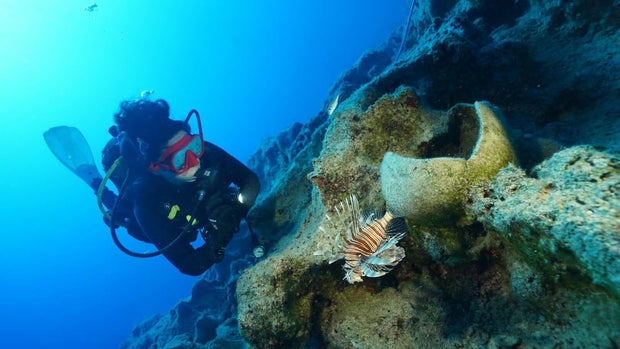
Analysis of the clay used to make the jars suggests that they were produced in workshops in the Middle East's Jordan Valley, located along Jordan's border with Israel and the West Bank.
"It appears the vessel sank while transporting olive oil or wine from that region westward — perhaps to Troy or to the Minoan civilization in Crete," Öniz told CBS News.
Similar examples of amphorae have also been found in Egypt, Troy and Crete, according to Ersoy.
Öniz told the BBC that when he was diving for the wreck, his first thoughts were on the lives of the many people connected to the ship.
"We are the first humans who [have] touched these objects after 5,000 years," he said.
"We are always thinking of the sailors ... the producers of the amphora and the person who carried the amphora on their shoulders to the ship, and the women who were waiting for their husbands, and they unfortunately couldn't go back."
The discovery has taken the record of the world's oldest shipwreck from the previous holder in the Aegean Sea located near Greece, which was dated to 4,200 years ago.
KioskNews shows a cleaned-up reading view extracted from the publisher’s page — the original always lives on their site, not ours.