Wage increase garners mixed reactions: survey
WIDER IMPACT: If businesses decide to pass higher labor costs on to customers by raising prices, some of the wage gains could ultimately be eroded, a researcher said
By Crystal Hsu / Staff reporter


Taiwan’s latest minimum wage increase has drawn mixed reactions from employers and workers, with nearly three in 10 companies saying they might scale back hiring while almost half are considering raising prices to offset higher labor costs, a survey released yesterday by online job bank yes123 showed.
The minimum wage is set to rise for an 11th consecutive year next year, pushing the hourly rate above NT$200 and the monthly minimum above NT$30,000.
About 75.2 percent of employers surveyed said that they plan to raise average starting salaries for their job openings in response to the increase. However, only 33.8 percent of workers expect their own pay to rise, underscoring a gap between companies’ plans to adjust entry-level wages and employees’ expectations of broader pay gains, the survey showed.
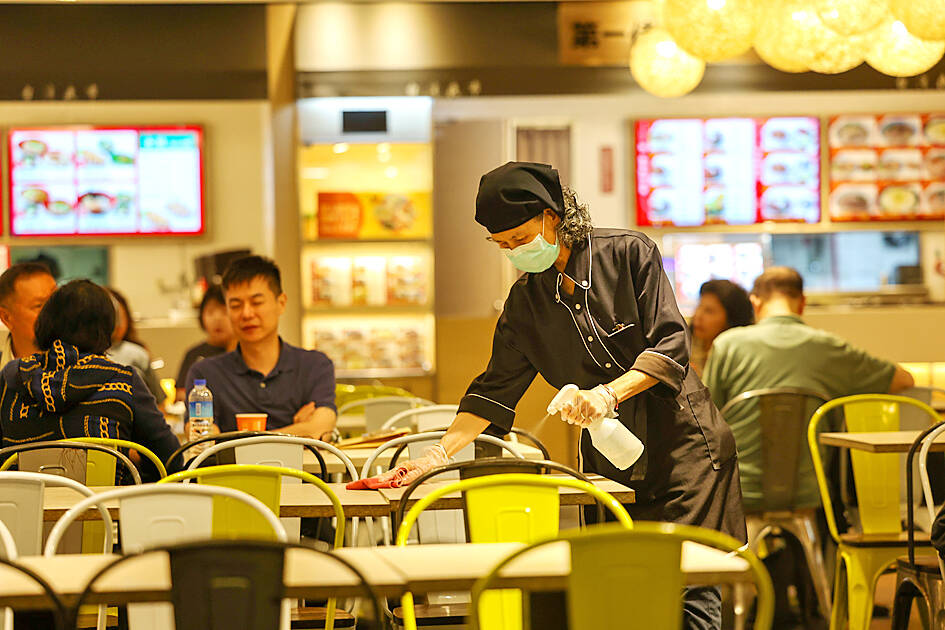
A cleaner works at a food court in Taipei Main Station on May 19.
Photo: CNA.
The increase could also affect hiring decisions, as 29.6 percent of employers said that the higher minimum wage would make them less willing to hire, while 63.6 percent of workers said it would encourage them to take on part-time jobs to supplement their income, the survey found.
At the same time, 61.7 percent of workers expect employers to reduce their reliance on hourly workers and instead increase the workload of full-time employees, potentially adding pressure on existing staff, it indicated.
Businesses are also weighing higher prices, as 46.6 percent said they are considering raising prices for products or services next year to offset higher labor costs, the survey showed.
That prospect is raising concerns among workers, with 88 percent saying that they worry the wage increase would also drive up consumer prices, it found.
Yes123 spokesman Bingo Yang (楊宗斌) said the higher minimum wage is intended to support lower-paid and economically vulnerable workers, who are also among those most exposed to rising living costs.
The increase in the hourly wage could particularly benefit women returning to the workforce, older workers and students who rely on part-time jobs, Yang said.
The monthly increase is likely to directly benefit foreign and dispatch workers, while higher starting salaries for new graduates could also put pressure on employers to raise pay for existing workers, he said.
However, higher labor costs could also prompt companies to pass costs on to consumers, reduce hiring, accelerate automation or, in some cases, close outlets or businesses, Yang said.
Cutting the use of hourly workers while increasing workloads for full-time employees could also increase the risk of burnout and staff turnover, he said.
For service businesses and small companies that rely heavily on part-time labor, the risk of higher prices could be particularly significant. If businesses pass higher labor costs on to customers through more expensive meals and other services, some of the wage gains could ultimately be eroded, Yang said.
The broader economic impact would therefore depend on whether wage gains outpace price increases. If workers’ pay rises faster than consumer prices, their purchasing power would increase, potentially supporting domestic consumption and creating a positive cycle for the economy, the job bank said.
KioskNews shows a cleaned-up reading view extracted from the publisher’s page — the original always lives on their site, not ours.