‘Air-con nation’ Singapore eyes alternatives to cool off
Long dubbed an “air-conditioned nation,” Singapore is experimenting with cooling alternatives from chilled beams to “passive displacement” to curb its thirst for energy-guzzling air-conditioning.
The city-state has the highest per-capita air-conditioner ownership rate in Southeast Asia, with about 99 percent of private residences equipped with cooling units.
Singapore’s local building sector accounts for one-fifth of its emissions, while cooling itself accounts for 40 to 60 percent of a building’s energy consumption, according to studies.
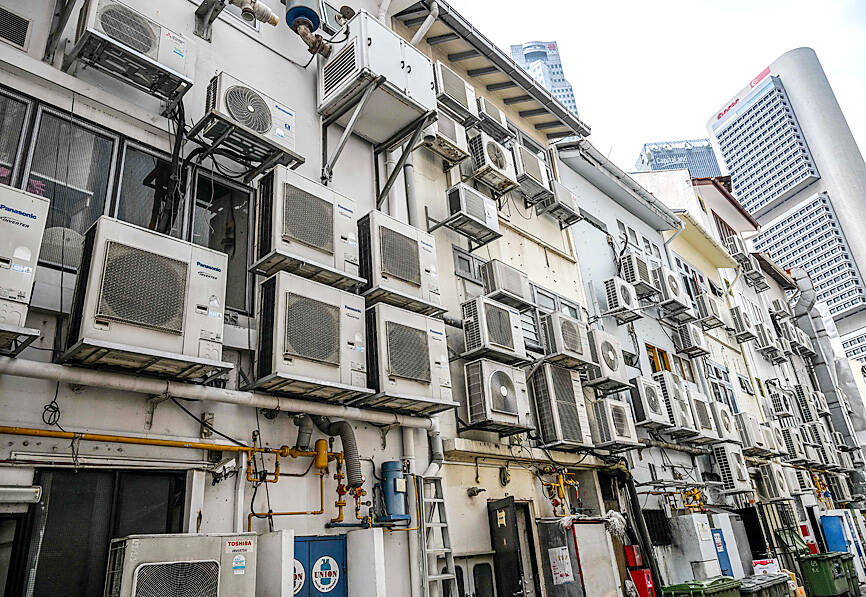
Rows of air-conditioning compressors installed on buildings at Boat Quay, Singapore, are pictured on Aug. 26.
Photo: AFP
A stroll down Orchard Road highlights that dependence. Shoppers are greeted by blasts of cool air that waft into the street as doors swing open — a major draw given that daytime highs hover between 31°C and 33°C year-round.
However, air-conditioning can make the heat problem worse. Compressor units belch hot air back out into the environment, and the electricity that powers the systems can contribute to climate change if generated from fossil fuels.
Some buildings in Singapore are looking at other options, including active chilled beams, which are perforated panels equipped with cooling coils that are mounted on ceilings.
A chiller plant on the building’s top floor cools water down to 9°C, then pumps it into the coils. Simultaneously, air is blasted through small nozzles inside the beams. The jets of air create a low-pressure zone that sucks up warmer air from the room below so it passes over the coils and is cooled before recirculating.
The technology keeps the offices at the eight-story Paya Lebar Green building at a comfortable 24°C.
There is noticeably cooler air flowing from the sleek white panels on the ceiling of the building, described as one of Singapore’s “greenest.”
The system is also quiet, without the constant hum of air-conditioning units.
The system cut energy use by more than 30 percent compared with conventional air-conditioning, DP Architects said, the building’s designers.
A similar system is in use at Singapore’s ports authority maintenance building at western Tuas harbor.
The building uses passive displacement cooling, which taps natural airflow to reduce reliance on mechanical fans. Ceiling cooling coils chill the air, which sinks before naturally rising back to the coils as it warms. This continuous cycle reduces the need for fans, cutting energy use and noise.
Another alternative is radiant cooling, where water chilled to between 14°C and 18°C flows through pipes or panels and absorbs heat radiating from people or objects to reduce ambient temperatures.
The push to find new cooling solutions has government backing.
A 2024 government study identified alternative cooling technologies (ACTs) as a key strategy which found they could save the city up to 48 percent in energy.
By the middle of this year, at least 33 public and 14 private buildings had adopted ACTs, Singapore’s building authorities said.
The city-state has an ambitious goal to achieve net zero carbon emissions by 2050.
The figures are still relatively small, and it can be challenging to find an ACT that is acceptable to users familiar with tried-and-tested air-conditioners.
Supporters of alternative systems acknowledge that they cost more to install than conventional air-conditioning, but say they more than make up for it over time with much lower running costs thanks to big energy savings.
The most popular alternative method remains hybrid cooling — simply turning up air-conditioning to a higher temperature of 25.5°C to 27°C, and pairing it with fans.
KioskNews shows a cleaned-up reading view extracted from the publisher’s page — the original always lives on their site, not ours.