‘I’m not asking for special treatment’: the would-be migrants waiting to start their new lives in Australia

Each year, tens of thousands of people put their hand up to start a new life in Australia. Partners of Australians, family members of citizens and skilled workers lodge visa applications and pay thousands of dollars in the hope of being granted the right to live in the country. Now they have found themselves at the centre of the country’s heated debate over migration.
As part of the push to drive down net overseas migration (Nom) numbers, in July the home affairs minister, Tony Burke, made a bureaucratic tweak to the Australian visa system. He directed his department to process applications for certain visas lodged from within Australia over those lodged overseas. In the short term this helps to reduce net overseas migration (Nom), because granting a visa to an applicant already in Australia doesn’t add to Nom.
The tweak has left many hopeful would-be migrants stuck on the wrong side of the border, their lives kept on hold.
These are some of their stories.
Tebin: ‘We’re unsure when we can meet again’
Tebin, 28, met Sara, 26, on a trip to visit family in south India in 2025. The couple married there in August 2026 and immediately applied for Sara’s partner visa. In 2025-26, the median processing time for a partner visa lodged overseas was 15 months.

Sara and I have spent just a week together since our wedding. I wanted to show her Australia, but her visitor visa was refused. We honeymooned in Malaysia, then I returned to my job in Queensland as an engineer and Sara went back to her job as a dentist in Kerala. We’re unsure when we can meet again.
Sara is preparing to get her dentistry qualifications recognised in Australia, but she can only sit the exams here and for that she needs her visa. Her application is at the back of the queue with the lowest priority.
The government is only doing this so it can have a nice Nom figure.
If Sara had come to Australia as a tourist and applied for her partner visa onshore, then she could have stayed on a bridging visa until the application was finalised. We didn’t try to beat the system and now we’re being punished. It’s rubbing salt in the wound.
I’m active in a support group for couples stuck in the partner visa queue and we’re considering testing the processing delays in court. But the government knows its actions are very hard to challenge.
Australian citizens have the liberty of falling in love with whoever they meet. Preventing partners coming to Australia restricts the rights of Australian citizens.
It’s not a question of migration policy. It’s a question of justice.
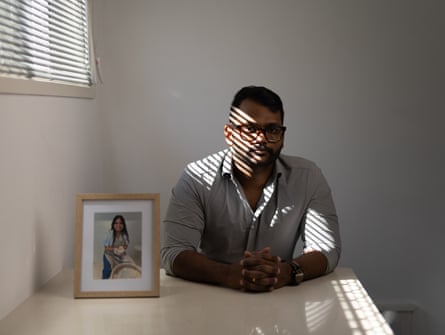
Conrad: ‘The hardest part is how it’s affecting the children’
Queensland firm Elite Refrigeration sponsored experienced mechanic Conrad for a temporary skills in demand visa in March and were advised the application would be finalised in two to five months. Seven months later, Conrad is still waiting.
My wife and I are originally from South Africa, and after 13 years building a successful small business in Scotland, we want to start a new chapter in Australia.
We picture our [four] children [aged two to 16] growing up in a safe environment. We want them to enjoy the outdoors, go to the beach, play sports and experience everything that Australia has to offer.
When I check the estimated processing time for my skilled visa, the Home Affairs guide keeps throwing up different results. So just when we think we have an idea of how long we might have to wait, the timeframe changes.
The hardest part is how it’s affecting the children. They often ask when we’re going to Australia to start our new life. We try to answer them as positively as we can, but the truth is we don’t know if we’re weeks away from a decision or must wait several more months.
We’re about $23,000 out of pocket for visa charges, English language tests, police checks, medicals, migration advice and the cost of getting my skills assessed. Elite Refrigeration has invested another $13,000 in our application.
I’ve wound down my business, telling staff to look for other jobs, because I didn’t want to let them go at short notice.
We’ve sold our family home and settlement is just weeks away. We’re worried we’ll have to relocate temporarily, rather than going directly from Scotland to Australia as planned.
My wife is a senior hair stylist and she has lined up a job in Queensland, but we don’t know if it will still be there when we finally arrive.
I know that it’s for the Australian government to decide how immigration is managed and I’m not asking for special treatment. But families should be given some certainty about how long the process will take.
Sometimes when migration is discussed, people become statistics or numbers, but behind every application there are real people and families who are making decisions about their homes, jobs, children and futures.
after newsletter promotion
Natasha: ‘I need my husband with us’
Natasha and her English husband Warren have already waited 15 months for Warren’s partner visa. Their daughter Ruby is an Australian citizen by birth.
I run my own communications business and have lived in the UK for 24 years. I’ve often contemplated bringing our family home to Australia, but time kept slipping past. Warren and I finally decided to make the move in time for Ruby to start high school in Sydney next year.
We applied for Warren’s partner visa in July 2025 – plenty of time, we thought, to get the paperwork sorted before flying to Australia this November. We want to settle into life in Sydney and I need to find work and a place to live. I can’t enrol my daughter in school until we have a local address.
I’m angry that offshore applicants like Warren have been pushed to the back of the queue. We pay the same amount as people who apply onshore, so we should get equal treatment.
The upfront fee for Warren’s partner application was $9,365. If we’d applied after 1 July 2026, it would have cost us $11,710. That’s just nuts! On top of this, we’ve shelled out $800 for Warren’s medical and police checks. They are valid for 12 months, so if the delay drags on, we may have to pay for those checks again.
There’s been no word on Warren’s application. The system is opaque. You can’t contact anyone. The thought of Warren not being able to come to Australia together with me and Ruby was very upsetting. I need my husband with us at this crucial time. So, we recently hit plan B and applied for Warren to travel as a tourist.
Warren is a senior IT manager at a large financial institution, but he can’t work in Australia on his visitor visa. And a “no further stay” provision means he may have to leave again after six months.
We want to begin building a life in Australia, but we’re stuck in limbo. Warren and I have been together for 18 years and married for 15. If he’s trying to rort the Australian visa system, then he’s certainly playing the long game!
Lyndel: ‘I was drowning emotionally and financially’
Lyndel, from Newcastle, married her husband, Fares, in Lebanon two years ago, and their son was born in September 2025. After almost 20 months, his partner visa has just been granted.
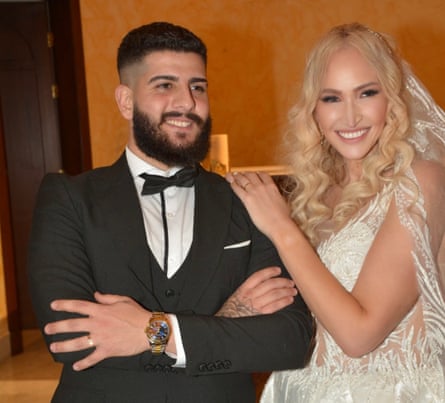
Fares and I met online. We holidayed together in Turkey and Qatar and then in Lebanon, despite “do not travel advice” in place since October 2023. I get on really well with his family. I’m Roman Catholic and they are Maronite Catholic, so we have plenty in common, even though I have no Lebanese background. I’m blond-haired, blue-eyed, “Aussie, Aussie, Aussie!” We married in his church in 2024.
I previously suffered a stillbirth at 36 weeks, so my 2025 pregnancy was high risk. Fares applied for a visitor visa to be with me, and when his application was rejected, we appealed successfully to the administrative review tribunal.
Home Affairs still failed to grant his visa in time for my C-section, but at least Fares got to spend three months with our newborn son and with our three children from my previous marriage.
In April, when our baby was in hospital with life-threatening sepsis, Home Affairs again refused to grant Fares a visitor visa. They claimed he might not leave because of the situation in Lebanon, even though he went back last time. We couldn’t afford another $4,000 to appeal.
The only time Fares has spent with his son this year was the two weeks when I took our baby to Lebanon to be baptised.
This week I had to take time off work because the kids and I got sick with influenza A. I’m a chartered accountant with two degrees and a postgraduate qualification, but for now I work part-time in admin. That’s the only way I can care for four children. If Fares were here to help, I could make better use of my qualifications and professional expertise. Fares is a barber, so he’d have no trouble finding work.
I’ve often imagined our file sitting on someone’s desk gathering dust. I’ve felt like I was drowning emotionally and financially.
Just this week, while we’ve all been sick with the flu, the news came through that Fares’s visa has been granted. Soon, we can be together as a family. I look forward to coming home from work, putting the kids to bed and snuggling up with Fares to watch a movie.
KioskNews shows a cleaned-up reading view extracted from the publisher’s page — the original always lives on their site, not ours.