‘It’s magic’: scientists rediscover how to make ancient Roman colour-changing glass
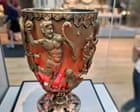
The Romans’ proficiency in the art of glass-making has produced some of the wonders of antiquity, but few of their creations better a 1,600-year-old masterpiece which sits in the British Museum.
Depending on where a light source is positioned, the Lycurgus Cup changes colour, from jade green under normal lighting to ruby red when lit from behind – an astonishing feat of optical engineering that has confounded historians and glass-makers for centuries.
Now scientists from the University of Sheffield have replicated its remarkable optical behaviour, using an ancient recipe derived from a fragment of the Roman “dichroic” (two-coloured) original.
Dr Lisa Hollands, a technician at the university’s school of chemical, materials and biological engineering, said that replicating it has been “a labour of love” and “people have tried it before with limited success”. She added: “To me, it’s magic.”
The fourth-century original bears a mythological frieze depicting the legend of King Lycurgus from the sixth book of Homer’s Iliad. Carved in deep relief, it shows the triumph of the god of wine, Dionysus, over Lycurgus, who is ensnared by a vine.
In 2022, it was recognised as one of the seven glass wonders of the world by an international panel.
Hollands worked with Prof Caroline Jackson, a leading Roman glass expert, in conducting the initial research. Then came the challenge of embedding into glass nanoparticles of gold and silver – each a thousand times smaller than a grain of sand.
A thick molten glass was created and, as it cooled from well over 1,000C, gold and silver nanocrystals started to grow around particles within it.
Hollands said: “White light is made up of many different colours and you see this when there is a rainbow in the sky. Nanoparticles are much smaller than the wavelengths of light and in certain conditions they block certain colours due to the light affecting the electrons in the atoms.
“So, for this glass, if light is shone through it, the gold and silver particles block blue and green light, only allowing reds and oranges to pass through. If light is reflected off the surface, the particles have the effect of scattering the light, giving the opaque green colour we see.”
She added: “If the Romans could have seen me experimenting, they’d probably laugh and ask: ‘Why does she not know how to make this?’”
Sheffield commissioned Elliot Walker, a glass artist, to bring the effect to life in a contemporary glass sculpture that pays homage to its “ancient twin” by combining the Lycurgus story and the Farnese Atlas sculpture, with the globe replaced by a cup. “For me, it’s a connection with the Roman makers,” he said.
It will be unveiled at the Millennium Gallery, as part of the university’s Festival of the Mind from 6-15 November, before a permanent display at the Turner Museum of Glass.
Ian Freestone, emeritus professor of archaeological materials at University College London, said that, although a similar-coloured glass was replicated in the 1960s, Sheffield’s project is much closer to the actual green and red shades of the Lycurgus Cup. “This is more ambitious and more precise,” he said. “I was excited because, for the first time, I was getting a feel of just how difficult it was to get these colours. This will help us understand how the Roman craftsmen actually worked.”
He added: “The colour was quite dependent on conditions in the furnace. If the glass went in a different position in the furnace, then the colour came out differently … The fact that the colour is so sensitive to the position in the furnace suggests that it would have been very difficult for the Romans to control the colour. It makes me think that, with the Lycurgus glass, they hit the jackpot.”
Freestone spoke of the significance of the red-green colours, noting a theory that they symbolised the ripening of the grape: “The depicted scene has grape vines pulling Lycurgus into the underworld. So it could have been used in a drinking ceremony of some sort.”
A letter supposedly written by Hadrian to his brother-in-law in Rome reads: “I have sent you parti-coloured cups that change colour, presented to me by the priest of a temple … I would like you to use them at banquets on feast days.”
KioskNews shows a cleaned-up reading view extracted from the publisher’s page — the original always lives on their site, not ours.