What qualifies as a planet? Icy object beyond Pluto reignites debate
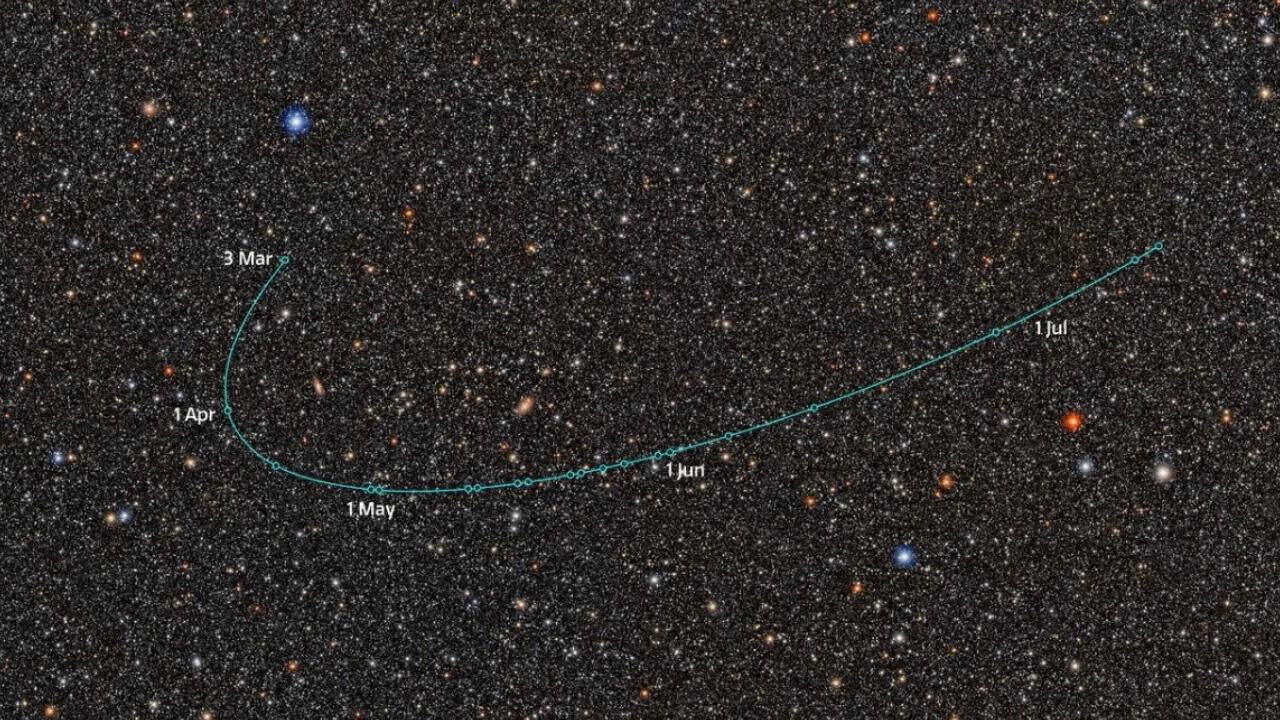
This image shows the orbital pathway of the newly discovered dwarf planet candidate 2026 ED138.
For years, Pluto held a place among the solar system’s nine planets, until its status changed in 2006. Now, a newly discovered icy object lurking beyond Pluto has reignited interest in the distant worlds at the edge of our solar system and the question of what qualifies as a planet.Named 2026 ED138, the object was detected using the Vera C Rubin Observatory in Chile, but further observations are needed to confirm whether it qualifies as a dwarf planet. The discovery was announced at a scientific meeting in Spokane, Washington.Researchers estimate that 2026 ED138 is between 600 and 1,500 km wide and orbits the Sun at a distance roughly 46 times that between Earth and the Sun. Pluto, by comparison, orbits at an average distance of about 40 times the Earth-Sun distance.If confirmed as a dwarf planet, 2026 ED138 would join five objects currently recognised in that category by the International Astronomical Union (IAU): Pluto, Eris, Haumea, Makemake and Ceres. While Pluto, Eris, Haumea and Makemake orbit beyond Neptune, Ceres is located in the asteroid belt between Mars and Jupiter.What qualifies as a dwarf planet?Astrophysicist Matt Holman of the Center for Astrophysics, Harvard & Smithsonian, who first spotted 2026 ED138, told Reuters that the discovery highlights the potential for further findings with the Rubin Observatory and other telescopes.
As per the information available, scientists still need to establish the object's actual size. Current observations capture sunlight reflected from its surface, making it difficult to distinguish between a smaller, highly reflective object and a larger, less reflective one. Observations using Chile's Atacama Large Millimeter/submillimeter Array (ALMA), which can detect light emitted by the object itself, could help researchers measure its size more accurately.To qualify as a dwarf planet, an object must have enough mass for its own gravity to pull it into a nearly round shape. Although 2026 ED138 appears to meet this requirement, further observations are needed to confirm its classification.Pluto was reclassified from the solar system's ninth planet to a dwarf planet by the IAU in 2006 because it did not meet the organisation's formal definition of a planet. Like Pluto, 2026 ED138 lies in a cold region beyond Neptune populated by icy bodies.
KioskNews shows a cleaned-up reading view extracted from the publisher’s page — the original always lives on their site, not ours.