IMF: Nigeria’s banks need stronger safeguards after recapitalisation
*Flags sovereign debt exposure as banking sector risk *Calls for adequate capital, liquidity buffers, timely recognition of bad loans *Warns AI market correction could trigger wider global financial instability
By Babajide Komolafe, Economy Editor, in Bangkok, Thailand
The International Monetary Fund (IMF) has urged Nigerian authorities to strengthen regulatory safeguards in the banking sector following recapitalisation, warning that “the sovereign and bank nexus is also an important area” of concern for African economies.
Read Also: Nigerians still suffer high cost of living, despite economic growth — IMF
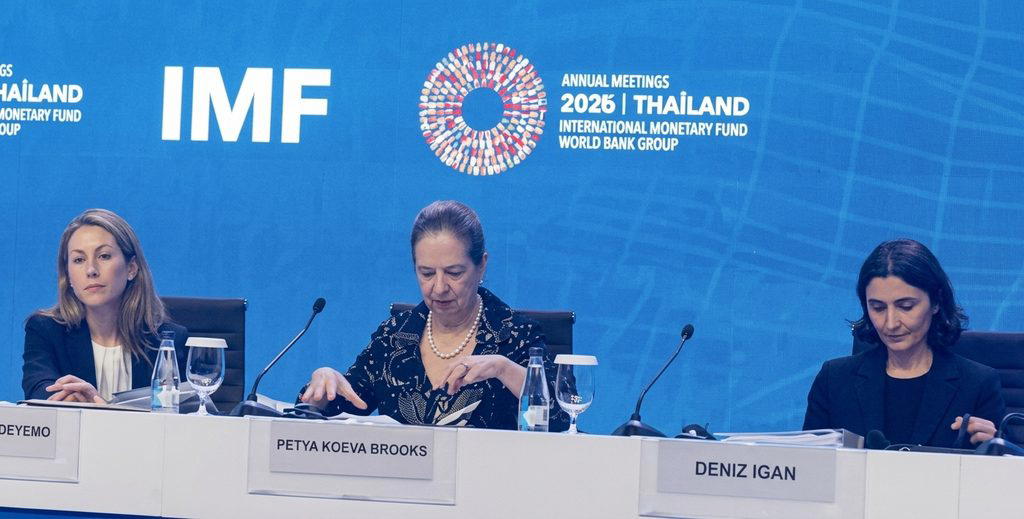
Assistant Director, Monetary and Capital Markets Department, IMF, Jason Wu, gave this recommendation at a press briefing on the release of its Global Financial Stability Report, during the ongoing World Bank/IMF annual meetings in Bangkok, Thailand, stressing that stronger capital bases must be complemented by adequate liquidity requirements, timely recognition of bad loans and effective monitoring of banks’ exposure to government debt to build resilience against financial shocks.
Wu said: “What we often see in emerging economies is that, after recapitalisation, there is a need to impose appropriate regulations to prevent risks from building up in the future.”
He added: “These include adequate capital and liquidity requirements as well as timely recognition of credit losses and bad loans.”
Highlighting the relationship between banks and governments as a critical area requiring closer attention in Africa, Wu said, “In Africa in particular, I think the sovereign, bank nexus is also an important area. So is understanding the exposure to sovereign risks.”
He stressed that these measures were essential to strengthening the banking system, stating: “So I think those are critical elements to building further resilience in the banking sector.”
Monetary policy outlook
Commenting on the recent decision of the Central Bank of Nigeria (CBN) to reduce its Monetary Policy Rate, MPR, by 350 basis points to 23 per cent, following the three consecutive months decline in the country’s inflation rate to 15.39 per cent in August from 15.93 in May 2026, Wu noted that Nigeria’s improving inflation outlook could create room for a less restrictive stance, while emphasising the need for credible, data-driven decisions by the Central Bank of Nigeria (CBN).
“We have seen improvements on the inflation front, which suggests that perhaps a not-as-tight monetary policy stance would be appropriate,” Wu stated, stressing that the CBN must sustain confidence in its policy decisions.
“I think what’s important is credibility. The central bank has to be data-driven and has to be able to explain the decisions clearly. So far, based on what we have seen, it seems like the news is on the good front,” he said.
Wu further emphasised the importance of communication in managing inflation, saying: “Further data dependence, clear, transparent monetary policy communications give a key to containing this wave of inflation shocks.”
AI boom poses global financial risks
Beyond Nigeria, the IMF, in its Global Financial Stability, GFS Report, warned that the growing concentration of investments in artificial intelligence (AI), coupled with ambitious earnings expectations, could expose global financial markets to a potentially destabilising correction.
The GFS report, among other things, highlighted financing arrangements involving AI companies, including equity investments, debt and commitments linked to future revenues.
Explaining the findings from the report, Deputy Director, Monetary and Capital Markets Department, IMF, Athanasios Vamvakidisan, said: “We looked at 14 public transactions and what we found is about $300 billion in equity investments and $650 billion in debt investments.”
Vamvakidisan explained that the transactions involved “$1.4 trillion of future revenue commitments,” adding that the future revenue component made the arrangements unusual.
He warned that the structure could amplify losses if AI companies failed to deliver expected returns.
“If there are questions about the monetisation in AI, the equity investments will deplete the value, the debt may be difficult to service and the revenue commitments in the future may not materialise,” he said.
The GFS report also questioned whether the strong earnings performance that has supported market optimism could continue indefinitely.
“In recent quarters, the actual earnings beat these expectations and the market upgraded the forecast even higher,” Vamvakidisan said, describing a cycle in which positive earnings surprises fuel increasingly ambitious expectations.
He warned that sustaining the trend could become more difficult as expectations rise and market exposures become concentrated.
KioskNews shows a cleaned-up reading view extracted from the publisher’s page — the original always lives on their site, not ours.