Only 9 Sci-Fi Books Are Funnier Than Hitchhikers Guide To The Galaxy
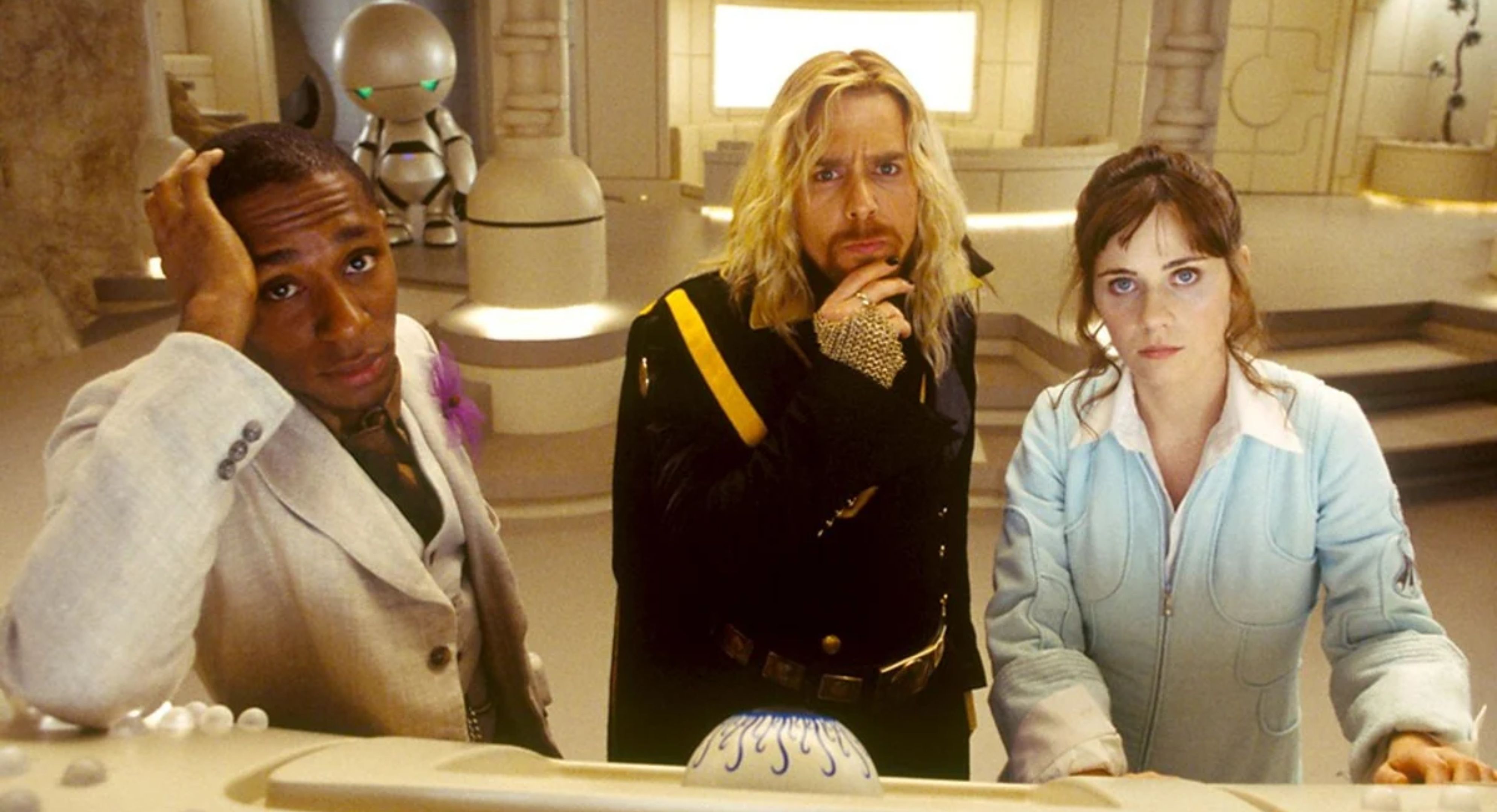
When it comes to books that perfectly blend sci-fi and comedy, few stand out more than Douglas Adams’ The Hitchhiker’s Guide to the Galaxy. The adventures of painfully ordinary Englishman Arthur Dent and his secretly alien friend Ford Prefect are synonymous with hilarious science fiction, and continue to attract new readers decades after it first hit shelves in 1979. Adams made the destruction of Earth the beginning of one of sci-fi’s funniest and most beloved stories. However, being one of the funniest books and being the funniest aren’t necessarily the same thing.
While The Hitchhiker’s Guide to the Galaxy and Adams’ sequels will always be a gold standard for comedy sci-fi, several books beat them at their own game. They might lack the pop culture clout of the Hitchhiker’s name, but their pages contain stories that are just as hilarious, if not more so, than Arthur’s intergalactic search for a peaceful life and a normal cup of tea after Earth’s demolition for a hyperspace bypass.
9 Bill, The Galactic Hero By Harry Harrison (1965)
Military Incompetence Becomes A Viciously Funny Interstellar Nightmare

There’s very little heroic about Bill’s introduction to military service, which is precisely the point of author Harry Harrison’s 1965 sci-fi comedy classic Bill, the Galactic Hero. A farm boy forced into an interstellar war, Bill discovers that survival in the Space Troopers depends less on courage than on navigating spectacular stupidity. Bill, the Galactic Hero attacks the glorious space soldier fantasy with a gleeful, pull-no-punches approach, turning traditional military sci-fi adventure into a conveyor-belt of incompetence.
The military satire of Bill, the Galactic Hero is just as sharp as it is funny. Orders become absurd through repetition, authority rewards the wrong qualities, and bureaucratic logic somehow makes every institutional disaster an individual soldier’s fault. Harry Harrison understands how funny military language and procedure becomes when it tries to make organizational madness sound reasonable. It’s an especially satisfying read for Hitchhiker’s fans who found Douglas Adams’ Vogons particularly hilarious, although there’s much more anger here beneath the jokes.
You can purchase Bill, the Galactic Hero by Harry Harrison here.
8 The Eyre Affair By Jasper Fforde (2001)
Literary Obsession Becomes Wonderfully Absurd Police Business

In the alternative Britain of The Eyre Affair, literature inspires the kind of fierce public devotion usually reserved for sport. That’s not the only reason the world imagined by Jasper Fforde is strange, though. Time travel exists, cloned dodos are pets, and crimes against books require specialist investigators. Central hero Thursday Next works in literary detection, placing her in the path of a criminal whose goal is to literally kidnap Jane Eyre from the pages of Charlotte Bronte’s novel. Fforde treats this extraordinary premise as an everyday workplace comedy, making the eccentricities of this alternate UK even funnier through the entirely practical concerns of the people who have to live there.
There’s a lot to love about the surreal and absurdist humor of The Eyre Affair (especially for Hitchhiker’s Guide to the Galaxy fans), but much of the pleasure comes from watching apparently throwaway jokes acquire plot-changing consequences. A literary reference can become a public controversy, a policing problem, or an important clue in the central mystery. What’s more, while Jasper Fforde rewards readers who know their classics, the humor doesn’t require readers to arrive with an English degree. The sheer seriousness of this alternate Britain’s bookish obsessions is funny enough.
You can purchase The Eyre Affair by Jasper Fforde here.
7 Phule's Company By Robert Asprin (1990)
A Wealthy Commander Turns Military Misfits Into An Exceptionally Entertaining Team

The main source of comedy in Robert Asprin’s 1990 military sci-fi parody, Phule’s Company, is its titular team. All of them are soldiers whose careers have been derailed for one reason or another (usually their own fault), and putting them together in a single team leads to hilarious situation after hilarious situation. Even their commander, the aristocratic Willard Phule, feels like he should be kept as far away from a conflict situation as possible as far as his superiors are concerned. Assigned a company of rejects, Phule’s decision to treat the soldiers under his command as human beings produces a potent combination of personality clashes, unconventional solutions, and a military apparatus increasingly irritated by a unit they expected to remain irrelevant repeatedly failing upwards.
Robert Asprin builds the humor of Phule’s Company around not only the team’s personality clashes, but also the difference between military respectability and actual combat effectiveness. Phule’s money helps, but his willingness to take apparently ridiculous people seriously is what gives the comedy its warmth. Watching someone’s troublesome eccentricity become exactly what a situation requires is consistently satisfying. The result is a sci-fi comedy book with an easy, almost sitcom-like rhythm, with the characters having enough endearing traits beyond their penchant for teasing to make them worth following.
You can purchase Phule’s Company by Robert Asprin here.
6 The Cyberiad By Stanisław Lem (1965)
Brilliant Robots Repeatedly Prove That Intelligence Offers No Protection Against Foolishness

Robots Trurl and Klapaucius can build machines capable of extraordinary things. Unfortunately, extraordinary technical ability does little to eliminate the same vanity, competitiveness, or terrible judgment that plagued their human creators. Their adventures form the backbone of Stanisław Lem’s The Cyberiad, a collection of connected short stories that repackages sci-fi concepts in the language and structure of fairy tales. Lem’s vision of a futuristic robotic civilization reproduces recognizably human foolishness. However, the level of technological power available to characters like Trurl and Klapaucius make the consequences considerably more entertaining.
As an author, Stanisław Lem especially excels at following a ridiculous proposition with absolute seriousness until its hidden problems become unavoidable. The jokes in The Cyberiad emerge from ingenious misunderstandings, excessive cleverness, and solutions whose inventors should have considered the wording more carefully, and each is funnier than the last. Anyone who enjoys Douglas Adams’ ability to make a philosophical problem collapse into a punchline will find The Cyberiad regularly has them howling.
You can purchase The Cyberiad by Stanisław Lem here.
5 Redshirts By John Scalzi (2012)
Expendable Spaceship Crew Members Start Noticing How Suspiciously Expendable They Are

Getting assigned to a prestigious vessel like the Universal Union Capital Ship Intrepid should be excellent news for someone who dreams of a life of adventure among the stars. For Redshirts’ Andrew Dahl, however, the new assignment feels more and more like a death sentence when he discovers that away missions have a troubling pattern: senior officers survive, while junior crew members meet horrible ends. Redshirts takes the familiar Star Trek trope of expendable crew members (almost always depicted wearing red in the original series) and asks what happens when these supposedly disposable characters decide to take responsibility for their survival into their own hands.
The results are absolutely hilarious. Author John Scalzi gets enormous mileage from having sensible characters point out the ridiculousness of storytelling conventions that sci-fi fans normally accept. The dramatic behavior of stereotypical hero archetypes starts looking deranged when seen from the perspective of someone that has to endure its consequences. The dialogue is brisk and argumentative, and the story is full of characters hilariously trying to make sense of a sci-fi workplace dynamic that’s fundamentally unreasonable.
You can purchase Redshirts by John Scalzi here.
4 All Systems Red By Martha Wells (2017)

Martha Wells’ 2017 sci-fi novel All Systems Red is instantly hilarious from its premise alone. The story focuses on Murderbot, a rogue security cyborg who wants to use its newfound free will to watch movies and TV shows whiles avoiding human contact at all costs. Having secretly disabled the mechanism controlling its behavior, Murderbot reluctantly has to continue protecting a scientific expedition while concealing its independence. However, trouble planetside makes that arrangement increasingly difficult. The contrast between its narrator’s formidable capabilities and his profound reluctance to become emotionally involved with anyone, especially the humans under his protection, makes for comedy gold throughout.
In particular, Murderbot’s running assessment of the people around him, including his own increasingly unconvincing insistence that he would prefer not to care about them, is hilarious on basically every page. Handling a dangerous situation is no problem for Murderbot, but being noticed or, even worse, thanked creates a huge and unavoidable problem. Douglas Adams fans who love the exasperation running through Hitchhiker’s, especially with characters like the iconic robot Marvin, will recognize the appeal of All Systems Red immediately, particularly when its absurd universe keeps interrupting the central protagonist’s extremely reasonable desire to be left alone.
You can purchase All Systems Red by Martha Wells here.
3 Space Opera By Catherynne M. Valente (2018)
Humanity’s Survival Depends On A Gloriously Ridiculous Interstellar Song Contest

A key reason that The Hitchhiker’s Guide to the Galaxy is so funny is that Douglas Adams is never ashamed to get absolutely ridiculous with his story and the universe it takes place in. The exact same can be said for Catherynne M. Valente’s Space Opera, which focuses on humanity’s attempt to save itself from destruction after being unwittingly entered into an intergalactic music contest. It’s a premise that leaves little room for subtlety, and Valente is well aware of this. The author approaches alien civilization, the excess of musical celebrity, and humanity’s inflated self-image with outrageous levels of absurdity, and it completely works.
The singing competition premise is already funny, but it’s the narration and Catherynne M. Valente’s writing style that supplies much of the laughter in Space Opera. Alien customs and histories receive lavish explanations that keep finding fresh ways to make the universe feel as magnificent as it is nonsensical. Valente shares Douglas Adams’ knack for digressions from the narrative that become highlights of the reading experience in their own right. In many ways, it’s a spiritual successor to the specific kind of comedy Adams made a genre staple with Hitchhiker’s Guide to the Galaxy, though with a uniquely modern spin.
You can purchase Space Opera by Catherynne M. Valente here.
2 We Are Legion (We Are Bob) By Dennis E. Taylor (2016)
One Sarcastic Software Entrepreneur Becomes An Increasingly Argumentative Population Of Himself

Arguing with oneself is usually seen as a sign of deteriorating mental health, but this isn’t the case for Bob Johansson. The inner voices he finds himself consistently at odds with are incredibly real. After his death and cryonic preservation, Bob awakens as an uploaded consciousness destined to operate a self-replicating space probe. Creating copies of himself seems like a sensible approach to the enormous task ahead, but those copies develop their own identities and priorities. With 2016’s We Are Legion (We Are Bob), author Dennis E. Taylor takes this unique premise and turns it into a hilarious hard sci-fi journey with an expanding cast of characters who are almost all different versions of the same man.
Bob’s conversational voice, especially his tendency to assess his new strange existence with familiar cultural references, ensures that reading We Are Legion (We Are Bob) without grinning ear-to-ear is almost impossible. However, the true genius is that the comedy doesn’t overshadow the sci-fi. The Bobs have to handle scores of immense scientific challenges, which they do with impressive competence. The hilarity comes from the fact that they debate ways to overcome these obstacles like hobbyists enjoying a very elaborate personal project. Their interactions make the increasingly large setting feel surprisingly intimate and give it a lot of human charm that Hitchhiker’s fans are bound to fall in love with.
You can purchase We Are Legion (We Are Bob) by Dennis E. Taylor here.
1 Dungeon Crawler Carl By Matt Dinniman (2020)
Alien Bureaucracy, Outrageous Violence, And A Furious Everyman Make The Apocalypse Hilariously Absurd

If any book deserves to be considered the Hitchhiker’s Guide to the Galaxy of the modern era, it’s Matt Dinniman’s Dungeon Crawler Carl. Both begin with Earth’s destruction, then introduce survivors to a universe where human suffering barely registers as an inconvenience. Here, that suffering is turned into intergalactic entertainment. Carl must navigate a deadly dungeon broadcast to trillions of alien viewers, accompanied by his ex-girlfriend’s talking cat, Princess Donut. Survival means mastering a competition whose rules prioritise audience engagement over anything resembling fairness or common sense.
Matt Dinniman manages to turn every aspect of Carl and Donut’s new reality into something absolutely hilarious. Even the LitRPg trappings like achievement notifications become insulting commentaries on Carl’s decisions. The rewards given by the system AI running the huge dungeon Earth becomes carry humiliating implications, and encounters with horrifying monsters invariably escalate into gloriously ridiculous, hyper-violent spectacles. Holding everything together is Carl’s practical thinking, which makes the surrounding nonsense even funnier (especially when he turns the dungeon’s absurd rules against its organizers). The combination of vicious corporate satire, inventive vulgarity, and ordinary frustration makes this essential reading for anyone who loves the cosmic absurdity that’s cemented The Hitchhiker’s Guide to the Galaxy as a sci-fi comedy household name.
You can purchase Dungeon Crawler Carl by Matt Dinniman here.

- Release Date
- April 29, 2005
- Runtime
- 109 minutes
- Director
- Garth Jennings
- Writers
- Karey Kirkpatrick, Douglas Adams
- Producers
- Gary Barber, Jay Roach, Jonathan Glickman, Nick Goldsmith, Roger Birnbaum
KioskNews shows a cleaned-up reading view extracted from the publisher’s page — the original always lives on their site, not ours.