Japan licenses allow ‘Taiwan’ listing
ORIGINS: A Taiwanese doctor practicing in Japan said he no longer needed to cover the nationality label on his license with a sticker, as it used to confuse his patients
By Lin Tsuei-yi / Staff reporter in Tokyo


Starting this month, Taiwanese professionals working in Japan can list “Taiwan” as their place of origin following Tokyo’s easing of rules on “nationality” in official licensing documents.
The change was announced yesterday by the Japan-Taiwan Friendship Parliamentarians’ League in Tokyo. The license revision covers 322 professions, including doctors and nurses.
Previously, Taiwanese had to list “China” as their nationality on professional certifications and licenses, but the new rules updated the “nationality” to “nationality and region” or “nationality, etc,” allowing Taiwanese to use the name “Taiwan.”
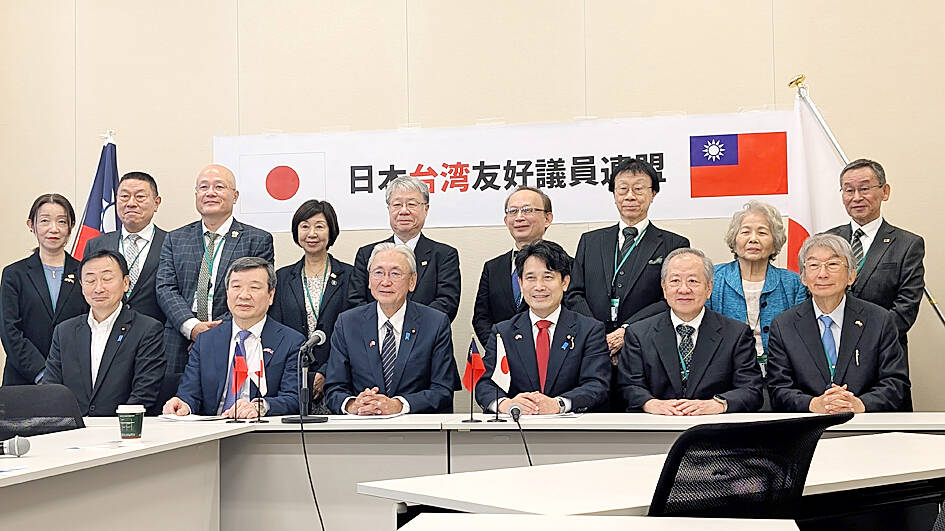
Representatives from Japan-Taiwan Friendship Parliamentarians’ League and Japan-based Taiwanese medical professionals attend a press conference in Tokyo yesterday.
Photo: Lin Tsuei-yi, Taipei Times
The league held a meeting about the revision at the House of Representatives Members’ Office Building in Tokyo yesterday, and overseas Taiwanese were invited to attend.
Japanese Representative Keiji Furuya, head of the league, said the reform represents a significant progress in Taiwan-Japan relations, but application and local administrative procedures need further refinement.
The league’s task force will continue its work until all Taiwanese can have “Taiwan” listed on their national qualification certificates, he said.
Hirofumi Takinami, a member of the Japanese House of Councillors who is also head of the task force, said the reform started in 2022, when several Taiwanese petitioned the league to allow “Taiwan” to be listed on Japanese household registries.
The league responded by establishing a task force, which pushed the Japanese Ministry of Justice to amend ministerial ordinances, he said.
“Taiwan” was officially included in the nationality column of household registries in May last year, he said.
It continued to coordinate with government agencies, including the Japanese Ministry of Health, Labour and Welfare, ultimately completing the reform for national qualification certificates, he said.
Takinami said that updating medical licenses is handled by local public health centers and administrative agencies, but, based on their experience with the household registration changes, local officials might not be familiar with the new regulations.
As such, the league has asked central authorities to request that service centers be properly notified, he said.
It also asked that the no application deadline be set, so that Taiwanese who might not have heard of the changes would still be able to apply for changes later, he said.
Norifumi Nakazato, a Taiwanese doctor practicing in Japan who used a sticker to cover the word “China” on his medical license, said the reform has a deep, personal significance, because he can finally display a license that matches his real identity.
“It brings me such peace of mind, and I am truly happy,” said Nakazato, who has been involved in the task force for the past four years.
He said that when Japanese patients saw his license in the past, they would ask in confusion: “Didn’t you say you were Taiwanese? Why does your license say Chinese?” so he had to cover it with a sticker.
Nakazato estimated that there are approximately 2,000 Taiwanese healthcare professionals who have obtained national qualifications in Japan.
Seiei Hirouchi, another Taiwanese physician who has lived in Japan for 47 years, said that when he entered a Japanese national university many years ago, the certificate issued by the school listed ‘Taiwan,” but after passing the Japanese national examination, the professional license he obtained listed him as from “China,” leaving him deeply perplexed.
While Taiwan and China have different cultures and lifestyles, Taiwanese were often mistaken as Chinese in the past due to license documentation issues, which affected their sense of identity in professional settings, he said.
Hirouchi lauded the change, calling it a major step forward for Japan’s administrative system.
He thanked the Japanese lawmakers, medical organizations and the Taipei Economic and Cultural Representative Office in Japan for their long-standing support.
Representative to Japan Lee Yi-yang (李逸洋) said many Taiwanese professionals live and work in Japan, making long-term contributions to Japanese society, yet they have been unable to have their place of origin listed accurately on their national qualification certificates.
Their long-cherished wish has finally been fulfilled, marking another big step forward in protecting the rights and interests of Taiwanese in Japan, he said.
Lee also expressed his gratitude to Keiji Furuya, Hirofumi Takinami and all the individuals across various sectors in Japan who helped promote this effort.
KioskNews shows a cleaned-up reading view extracted from the publisher’s page — the original always lives on their site, not ours.