What Xi really wants from Trump
The US must not underestimate the ambitions of China under Xi Jinping, whose foreign policy has been focused on securing the support of the Global South while pursuing the long-term goal of seizing Taiwan and achieving global pre-eminence
On Thursday, US President Donald Trump met with Chinese President Xi Jinping (習近平) in Washington. As leaders of the two most powerful countries, they preside over the world’s most consequential bilateral relationship, but if Trump assumes that this means China’s foreign policy revolves around relations with the US, he is gravely mistaken.
Xi is a disciplinarian and an ideologue. He requires China’s foreign policy establishment to pursue a global strategy based on the principles of the “Xi Jinping Thought,” which shape how China assesses its national interests and responds to pressure from the US. Chief among these principles is that preserving Xi’s leadership and Chinese Communist Party rule takes precedence over all other national interests. Close behind is enhancement of China’s global standing. China’s defiant response to Trump’s tariff war reflects these priorities. In effect, Xi’s approach makes it nearly impossible for China to capitulate to US pressure.
What, then, does Xi’s China want? Its ultimate objective is enshrined in what Xi calls the “China Dream of National Rejuvenation,” to be fulfilled by 2050. As Olivia Cheung and I explain in our book, China’s Global Strategy Under Xi Jinping, achieving this goal requires a dual pivot.
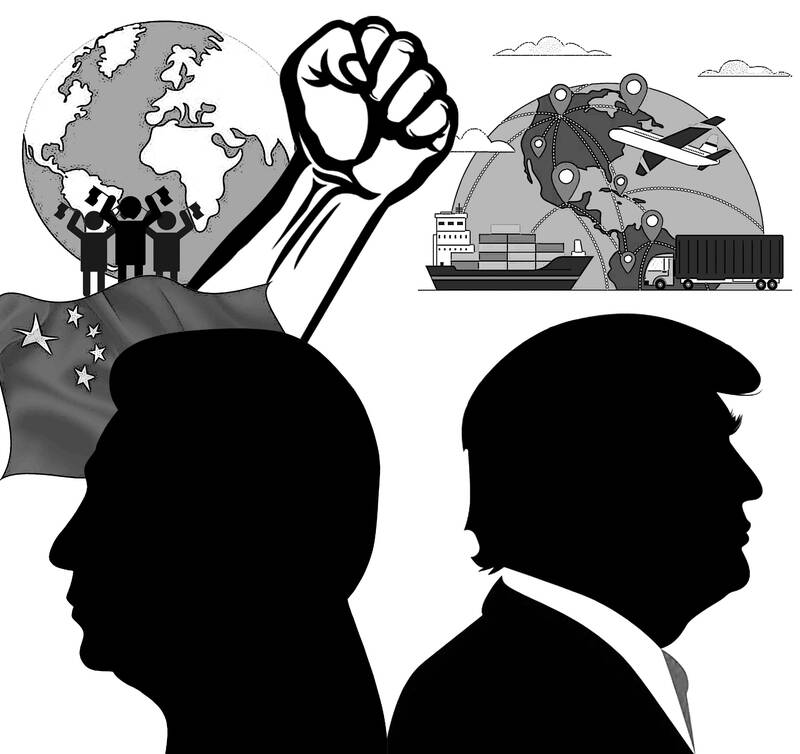
Illustration: Constance Chou
The first pivot, and the focus of Chinese diplomacy, is to secure overwhelming support from the Global South for China’s foreign policy agenda. Xi has rationed his overseas travel since the COVID-19 pandemic, making his recent appearance at the Shanghai Cooperation Organization summit in Bishkek, his state visit to Egypt and his visit to India particularly telling.
The second pivot is to seize Taiwan. Given Taiwan’s position within the First Island Chain in the Pacific Ocean and its importance to the US’ strategic interests in the region, annexing it would demonstrate China’s supremacy over the US, marking the advent of Chinese global pre-eminence and the fulfillment of the “China Dream.” Such a mission cannot be launched until China is certain of success, and the 2050 deadline suggests Xi is in no hurry.
By courting the Global South, China seeks to forge a “common destiny for humankind” under its leadership, a Xi formulation that is regularly — and often deliberately — mistranslated by the Chinese government and media as “building a community of shared future.” To achieve this objective, Xi promotes the “democratization of international relations,” aimed at transforming the international order into a China-centric one.
In Xi’s conception, the liberal international order is of, by, and for an elitist West that represents a minority of UN member states and the global population. Western dominance is thus inherently undemocratic. By contrast, the Global South — of which Xi insists China is and will remain a part — encompasses most of the world’s countries and people. Making the UN and other multilateral bodies accountable to the Global South would achieve the “democratization of international relations” and enable China to shape the future international order.
More Global South countries are autocracies than democracies, which suggests that many of their leaders might find the prospect of the US’ international leadership giving way to China — which regularly reassures them of their right to govern as they see fit — quite appealing. China’s Belt and Road Initiative offers another incentive in the form of development loans without the accountability and transparency imposed by Western democracies and the multilateral development institutions they control.
The US cannot engage China effectively without recognizing what drives Xi’s overtures to the Global South and his determination to transform the international order from within. Crucially, China’s goal is not just to end US hegemony, but also to discredit the idea that democracy represents the best path forward for the developing world. It has no interest in helping the US rectify its foreign policy mistakes. In fact, it benefits when the US is seen as a threat to global peace, security and prosperity.
The Iran war is a case in point. While China did not want the US to attack Iran, it is benefiting significantly from the Trump administration’s use of force and its failure, despite overwhelming military superiority, to achieve any of its objectives. The more the US alienates its traditional allies, disrupts the global economy and harms countries in the Global South, the easier it is for China to win support.
Xi’s top priority in meeting Trump is to ensure that the summit is seen as a great success. Reaching a trade deal comes second. Helping the US extricate itself from its self-inflicted Middle Eastern mess is not even on his agenda. If pressured, he is likely to push back hard. Nevertheless, he has every reason to engage Trump positively, deliver good optics and benefit from the US’ litany of unforced errors.
Steve Tsang (曾銳生), director of the SOAS China Institute at SOAS University of London, is the coauthor (with Olivia Cheung) of China’s Global Strategy Under Xi Jinping.
KioskNews shows a cleaned-up reading view extracted from the publisher’s page — the original always lives on their site, not ours.