Can restored wetlands help protect San Francisco Bay from rising seas?
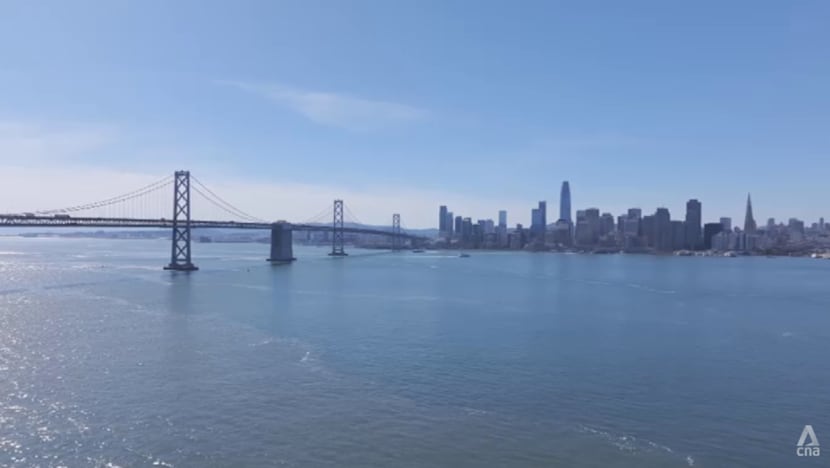
SAN FRANCISCO: Rising sea levels are threatening communities around San Francisco Bay, prompting efforts to restore wetlands and other natural coastal defences that once helped protect the shoreline.
The Bay’s waters are the heart of one of the United States' most important regions, home to San Francisco, Silicon Valley and over 7 million residents.
For centuries, rivers flowing from California's mountains into the Pacific Ocean have fed the Bay, an estuary spanning more than 1,200 sq km.
But the shoreline today looks very different from what it once was.
“If you look around the edge of San Francisco Bay (now), there are wastewater treatment plants, there are highways, there are bridges, there are airports, there are business parks,” said executive project manager Dave Halsing.
He oversees the South Bay Salt Pond Restoration Project, which is converting former salt ponds back into tidal wetlands.
Much of the Bay was once surrounded by vast tidal marshes that helped separate land from water.
But most have disappeared, with land reclaimed for salt ponds, agriculture, factories and housing.
“Something like 80 to 90 per cent of that habitat, those marshes, were lost,” Halsing said.

GROWING BACK MARSHES
Halsing and other conservationists are now attempting to reverse that trend.
“We opened in 2023 and within just three years we already have a couple inches of bay sediment deposited on the bottom, which is sufficient to let plants start to settle on it, and start growing,” he said.
Experts say restoring marshes can help reduce coastal flooding by absorbing wave energy and slowing incoming water.
The project also includes a gently sloping area known as an ecotone slope, which is intended to complement those efforts by giving rising water more space to spread out.
“The marsh is an important sea level rise adaptation feature, but the ecotone, the habitat transition slope that we build, makes that even better by making that water also run uphill and slow down even more,” Halsing said.
The restoration work comes amid warnings from scientists that flooding along the Bay's heavily developed shoreline may become more frequent and severe.
“As sea levels rise, the high tides get higher and start to inundate infrastructure and communities that are currently sitting on the bay edge,” said Mark Stacey, a professor of civil and environmental engineering at the University of California, Berkeley.
He warned that a developing El Nino event in the Pacific could provide a preview of future conditions by raising water levels along the California coast by as much as 30cm.

GREEN BARRIER
Along the Hayward Shoreline, a regional park on the Bay's fringes, local agencies are exploring another approach that combines flood protection with environmental restoration.
“What we're trying to do now is push away in an ecological way the salt water that's going to be coming in and trying to maintain an ecological buffer,” said Lou Andrade, director of the East Bay Regional Park District.
The plans involve a horizontal levee, which would not only provide protection from rising seas but also support wastewater treatment.
“Our wastewater facilities are at the low point of any community because they're fed by gravity and so we're especially vulnerable to sea level rise,” said Jackie Zipkin, general manager of the East Bay Dischargers Authority, a public agency that manages treated wastewater in the area.
She added the design would feature a gradual slope planted with vegetation that can adapt as waters rise, while treated wastewater moving through the levee would help remove pollutants such as nitrogen.
The project, known as the First Mile Project, is scheduled to begin construction in 2028.
Experts, however, warn that natural solutions alone will not be enough, with many Bay Area communities already experiencing flooding.
Cities like San Rafael are increasingly affected during king tides - exceptionally high tides that occur several times a year, and scientists warn the impacts of rising sea levels will intensify in the decades ahead.
“There needs to be some other structure there. That means we need to be thinking about hybrid solutions, where you bring these green infrastructure elements together with constructed and engineered elements,” said Stacey.
But Halsing noted that restoring wetlands around the Bay could buy conservationists "many more decades to grapple with that problem as a region".
That extra time could prove critical as communities race to adapt to rising seas that are already reshaping parts of the Bay shoreline.
KioskNews shows a cleaned-up reading view extracted from the publisher’s page — the original always lives on their site, not ours.