NUS student with hearing loss once focused on what she lacked. Then she found what she could give
SINGAPORE – Pursuing a double major in psychology and philosophy is just one part of 22-year-old Leticia Peh’s schedule.
The final-year National University of Singapore undergraduate also volunteers as a befriender to deaf individuals while helping to raise awareness of disability inclusion through two student groups.
For Peh, who has genetic hearing loss, giving back is deeply personal. She knows what it feels like to be misunderstood and struggle in ways others may not see.
Growing up, she also had to shoulder responsibilities beyond her years, helping to care for her three younger siblings while worrying about her family’s finances.
Speaking to The Straits Times on Nov 18 at NUS’ University Hall, Peh explained her condition matter-of-factly.
She cannot hear higher-pitched sounds like consonants, though mid- to lower tones like vowels are audible.
Hearing aids leave her overstimulated and give her headaches, so she wears them only occasionally and relies on lip-reading to communicate. Her ears are adorned with sparkling jewellery instead.
Peh readily speaks up for herself, such as informing lecturers about her condition and asking for captions to be turned on in videos.
She did not always carry this steady air of confidence.
As a child, she dreaded listening comprehension exams, knowing that she would struggle to make out words.
Schoolmates thought she was rude when she did not respond to them. Others made unkind remarks.
It was only in Primary 6, after she failed a listening comprehension test, that her mother took her to an audiologist and she was diagnosed with hearing loss.
Later, the family found out that Peh’s three younger siblings all had inherited the condition from their father’s side. Both her father and grandfather have hearing loss.
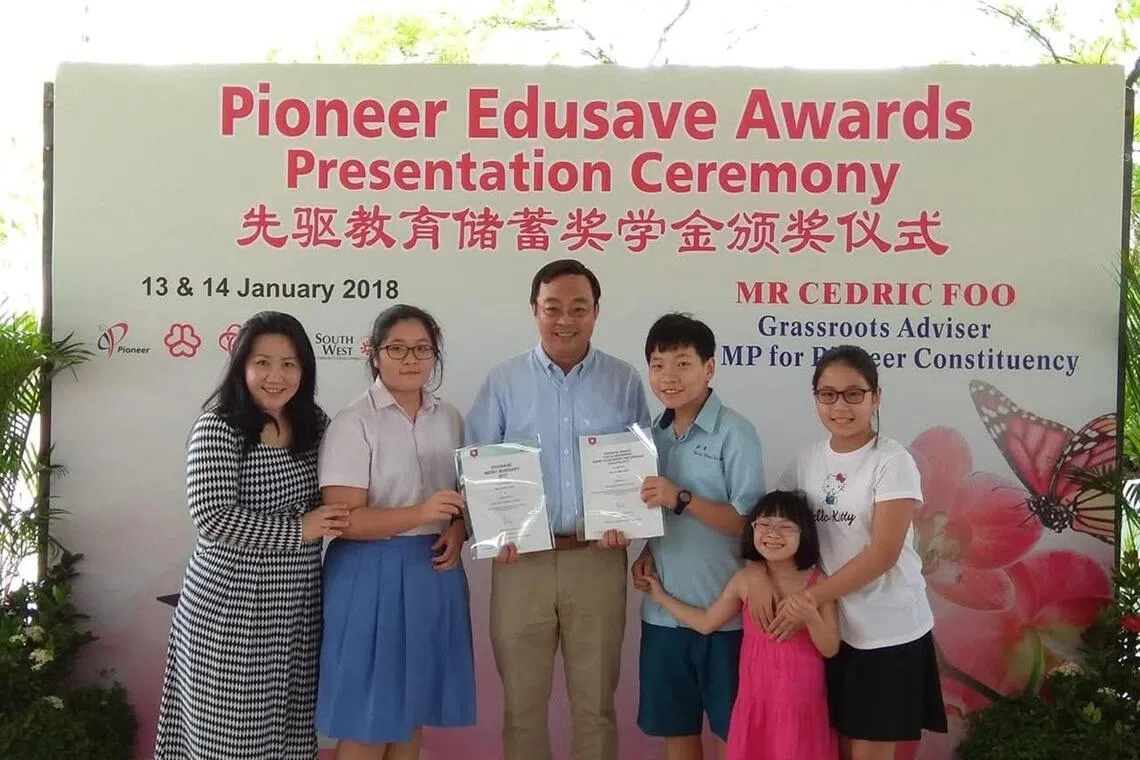
Leticia Peh (second from left) with her siblings and mother at an Edusave Awards ceremony in 2018. With them is former Pioneer SMC MP Cedric Foo.
PHOTO: COURTESY OF LETICIA PEH
Other troubles weighed on her mind. Her father went through periods of unemployment and her mother, a deputy general manager in the marine industry, was the main breadwinner, said Peh.
Her parents divorced when she was 16. As the eldest child, she felt like she had to step up. She stopped taking an allowance in secondary school and worked part-time jobs to save for university.
She helped care for her siblings, especially her youngest sister, who has Down syndrome.
“I felt like I had to be the second pillar in the family,” she said.
Over time, she found support from her secondary school. Teachers would put her in the front row and place her close to the radio during listening comprehension exams.
After getting a diploma in design from Ngee Ann Polytechnic, she decided to pursue her interest in psychology.
Finding meaning in helping others
At NUS, she picked up sign language through a student interest group, SIGNapse, that teaches Singapore Sign Language classes and helps healthcare workers engage the deaf community.
“There was an element of personal connection (to the community),” said Peh. “But I feel like my experience versus someone who is deaf growing up is very different. So there are a lot of things I have to learn.”
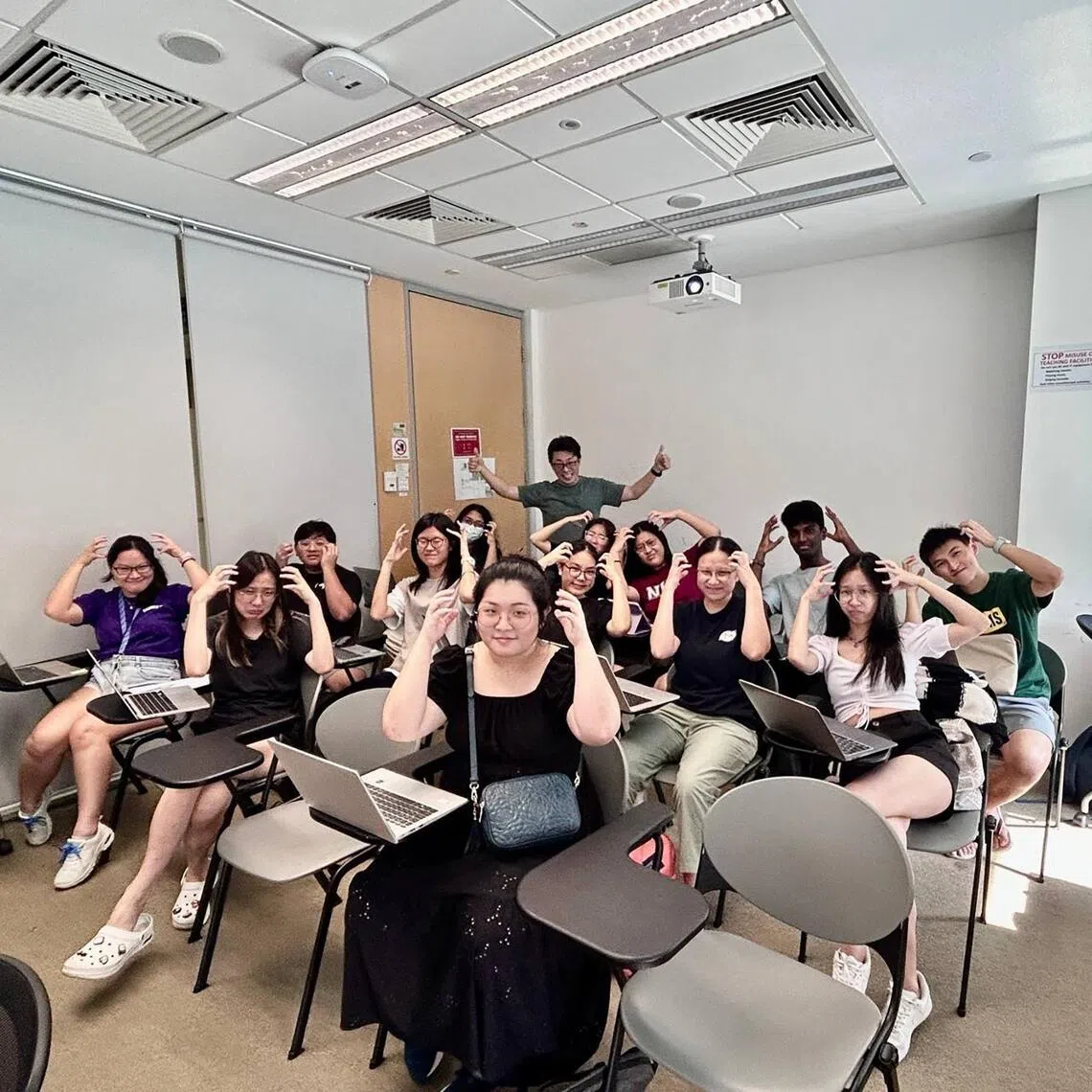
Leticia Peh (first row, in black dress) and her Singapore Sign Language (SgSL) classmates signing “stressed” before the SgSL exam.
PHOTO: SIGNAPSE
In her third year of university, she enrolled a course that allowed NUS students to befriend families on the ComLink+ programme, a scheme by the Ministry of Social and Family Development (MSF) to help lower-income families improve their circumstances.
The course, GEN2070 (ComLink+ Befrienders), is under NUS Communities & Engagement, which is part of the university’s common curriculum for undergraduate students.
Knowing sign language, Peh asked to be matched with a deaf family. She was assigned to a couple and their teenaged son living in a rental flat.
She interpreted between them and their ComLink+ family coach, who had previously relied on writing messages. These were sometimes lost in translation, as the family did not speak much English.
Realising her sign language was still rudimentary, Peh attended church services for the deaf community to improve her skills. Subsequently, she interned at the Singapore Association for the Deaf (SADeaf), where she shadowed social workers and helped to plan events, among other tasks.
There were moments she felt out of her depth as she could not solve all the issues the family faced. For example, they repeatedly missed medical appointments as they could not call the hospital to reschedule.
One day during her internship, she saw the family walk through the doors of SADeaf. She had been telling them about the additional support the association could provide, and they had decided to seek help.
“It felt like my presence and encouragement had connected the family to tangible resources they needed,” said Peh, who started volunteering at SADeaf after her internship ended.
No more ‘woe is me’
For much of her growing-up years, she had often dwelt on her problems.
Volunteering helped her shift her attention from her own challenges to the needs of others.
“It also helps you build a sense of self-esteem because now you’re not thinking about ‘What am I lacking?’ It’s more of ‘How can I contribute? Because I want to make things better for other people.’”
She is also involved in NUS Enablers, a student interest group advocating for more accessibility and inclusion in the university.
In October, she received the Asia Pacific Breweries (APB) Foundation Scholarship for Persons with Disabilities. The scholarship is administered by SPD, a charity that serves people with disabilities. It will fund her tuition fees for her final year in NUS.
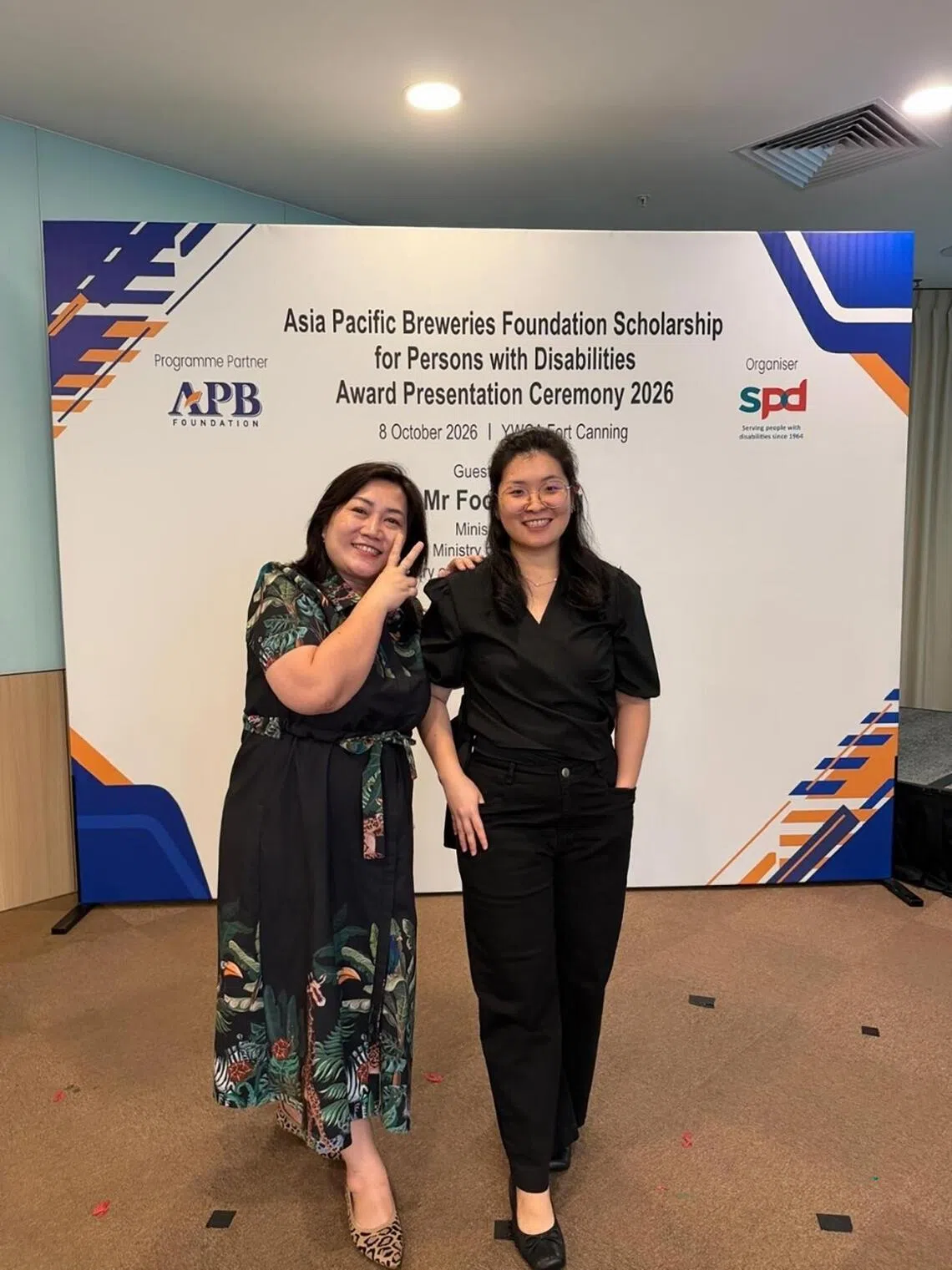
Leticia Peh (right) with her mother at the Asia Pacific Breweries Foundation Scholarship for Persons with Disabilities award presentation ceremony.
PHOTO: COURTESY OF LETICIA PEH
An APB Foundation spokesperson told ST the judging panel was impressed by Peh’s “resilience, sense of purpose and commitment to making a positive difference for others”.
“Beyond her academic and professional achievements, we hope she continues to grow in confidence, broaden her experiences and use her voice and lived experience to help advance a more inclusive society,” added the spokesperson.
Peh is among over 1,200 NUS students who have volunteered through the university’s ComLink+ Befrienders course. As at June 30, they had befriended more than 2,000 ComLink+ families.
For its efforts, NUS received the MSF Outstanding Partner Award 2026, becoming the first institute of higher learning to do so.
Over a year has passed since Peh befriended the deaf family, and she hopes to keep in touch with them although her course has ended.
She also has a longer-term dream of being a clinical psychologist for people who are deaf or hard of hearing.
“It’s very easy to (think) ‘Oh woe is me, I suffered so much.’ But now, it’s a different mindset.”
KioskNews shows a cleaned-up reading view extracted from the publisher’s page — the original always lives on their site, not ours.