5 Funniest ‘Calvin and Hobbes’ Sci-Fi Comics, Ranked

Collier Jennings is an entertainment journalist with extensive experience. Collier, or "CJ" to his friends and family, is a dedicated fan of genre films - particularly science fiction, fantasy, and comic book adaptations, not to mention all forms of animation. This stems from a close bond with his father, who introduced him to these genres via copies of X-Men comics and reruns of the original Ultraman series. With his near-encyclopedic knowledge and bottomless love of genre, he's tackled a wide variety of articles.
Sign in to your Collider account
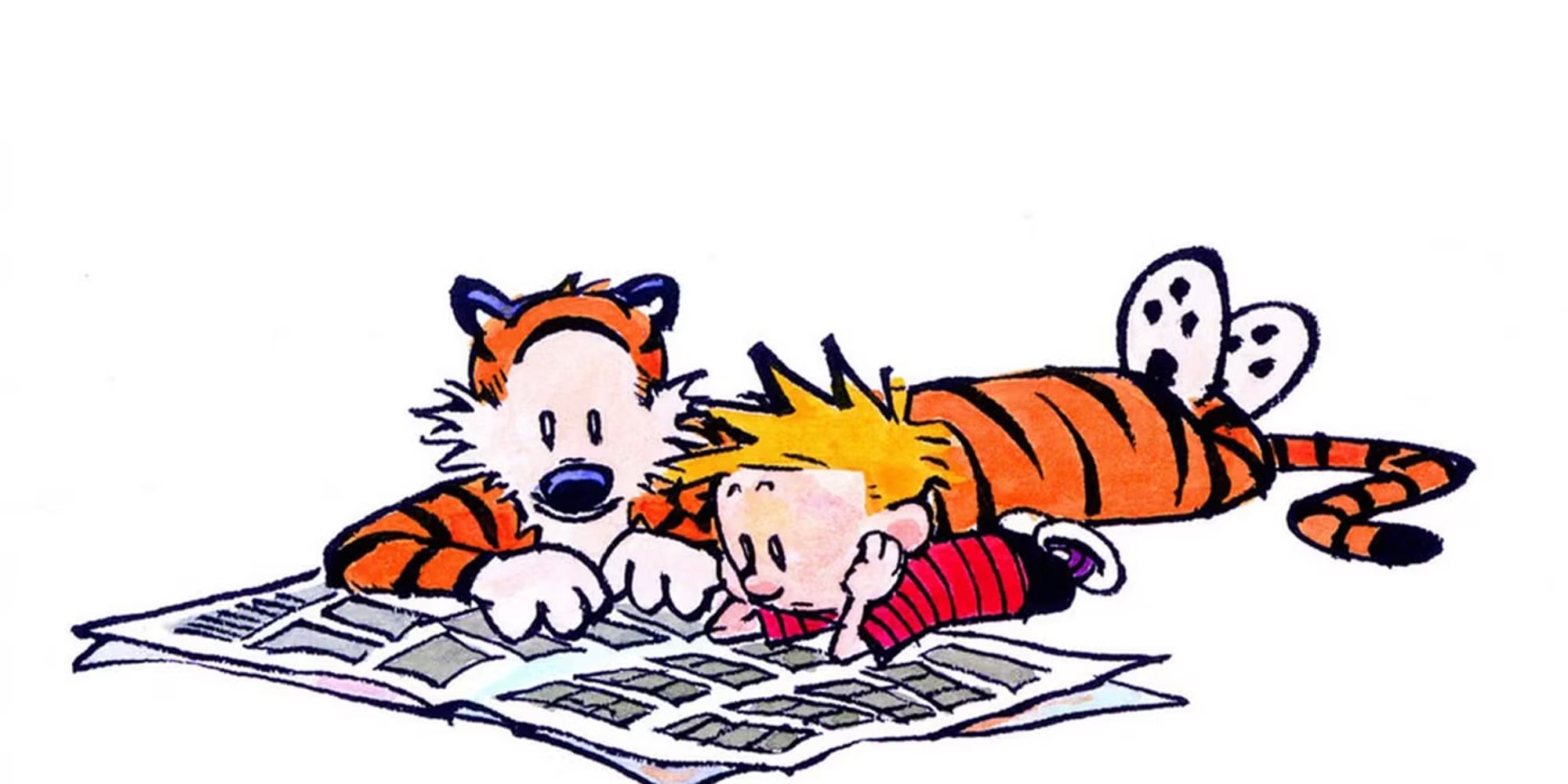
Calvin and Hobbes is a comic strip unlike any other. Part of what makes it special is that its creator, Bill Watterson, ended the strip at the height of its popularity, giving it a timeless quality. Its humor is also grounded in deep truths about the world, which you wouldn't expect from a comic about a six-year-old boy and his talking stuffed tiger. But the main draw of Calvin and Hobbes remains its ability to shift between different genres based on Calvin's flights of fancy. The most prominent of those genres is science fiction, which has led to some iconic moments in the strip's history.
Whether Calvin slips into the alter ego of his Flash Gordon-style hero Spaceman Spiff or whips up a new invention out of cardboard boxes, Calvin and Hobbes seemed to thrive whenever it tackled sci-fi concepts. It's no surprise, as the series thrives on a child's boundless imagination. What genre can bring that imagination to life better than science fiction? Here are five of the best sci-fi stories that Calvin and Hobbes ever told, ranked on their concept and the humor they bring to the table.
Calvin Clones His "Good" Side

Among Calvin's many inventions is his "duplicator," a seemingly normal cardboard box that lets him make copies of himself. To get out of schoolwork and chores, he tinkers with the duplicator so it splits him into his "good" and "evil" halves. The "good" Calvin is the complete opposite of the Calvin fans know and love: his spiky hair is neatly combed, he attends school and does his homework, and he respects his parents rather than bringing terror into their lives. This results in some hilarious moments, including Calvin's mom brushing up on child psychology after she witnesses Calvin willingly taking a bath and going to bed.
All good things must come to an end, and for Calvin, it's learning that his "good" side is attempting to be nice to his next-door neighbor, Susie Derkins. This sends Calvin into a tailspin, as he can't fathom being nice to Susie; likewise, Susie is suspicious when the "good" Calvin hands her a homemade Valentine. Eventually, both Calvins fight, and the "good" one disappears after having an "evil" thought. At a time when Spider-Man was struggling with his own clone saga, Calvin and Hobbes put a fun spin on the concept by not revealing the split until halfway in the storyline. It works, as readers will question whether Calvin has truly changed.
Calvin Creates a Killer Snowman
Winter is the season that Calvin and Hobbes is best associated with, thanks to strips that saw the duo careening down fresh piles of snow on Calvin's trusty sled. It also led to one of the series' best running gags: Calvin creating a macabre series of snowmen that were either getting eaten, impaled, or run over (and leading his father to question his sanity). That gag took a dark turn in the collection Attack of the Deranged Mutant Killer Monster Snow Goons, as Calvin unwittingly brings one of his mutant snowmen to life. The snowman immediately starts making more misshapen snow creatures, forcing Calvin and Hobbes to come up with an inventive way of defeating the icy creatures.
Admittedly, Attack of the Deranged Mutant Killer Monster Snow Goons leans a bit more toward horror than sci-fi. Part of that's because the titular snow goons are so off-putting: one has two heads, and another has sticks jutting out of its head instead of arms. Yet the reason the snow goons come to life is never revealed, which lands in the sweet spot between sci-fi and fantasy. Whatever genre this story fits, it leads to a hilarious moment where Calvin decides to spray the snow with water, freezing the goons in place. Unfortunately, his father goes outside and gets caught in the crossfire.
Calvin and Hobbes Travel To The Time of The Dinosaurs

Calvin and Hobbes proves that a cardboard box can be truly versatile, as Calvin uses it for many of his "inventions." Turning the box on its side creates the "duplicator," while turning it upside down makes a "transmigofier" that changes him into any form he wants. When the box is right side up, it becomes a time machine, which gives Calvin an idea. He plans to go back to the Jurassic era and take pictures of dinosaurs, selling them for money in the present. Naturally, the duo run afoul of carnivorous dinosaurs and manage to get back to their own time.
Throughout Calvin and Hobbes, Calvin shows his deep love for dinosaurs. He often daydreams about turning into a dinosaur. He's captivated when he sees a fossil at a museum. In one strip, he even digs up his yard to find dinosaur bones. It makes perfect sense that he'd want to go and see the dinosaurs in their prime, even if he has to twist Hobbes' arm into accompanying him. Like most of Calvin's schemes, his time travel trip doesn't turn out the way he wanted, as his parents think he just took pictures of all his dinosaur toys. Still, it's fun to watch him and Hobbes flying in a cardboard box, and to see Bill Watterson's rendition of certain dinosaurs.
Collider Exclusive · Sci-Fi Personality Quiz Which Sci-Fi Hero Are You Most Like? Paul Atreides · Captain Kirk · Princess Leia · Ellen Ripley · Max Rockatansky
Five iconic heroes. Five completely different ways of facing an impossible universe. One of them shares your instincts, your values, and your particular way of refusing to back down. Eight questions will tell you which one.
🏜️Paul Atreides
🖖Capt. Kirk
✊Princess Leia
🔦Ellen Ripley
🔥Max Rockatansky
01
How do you lead when the stakes couldn't be higher? The way you lead under pressure is the most honest thing about you.
02
What is your greatest strength in a crisis? The quality that keeps you alive when everything else fails.
03
What is the thing you'd sacrifice everything else for? Your deepest motivation is your truest compass.
04
How do you relate to the people around you? Who you are to others under pressure is who you really are.
05
You're facing a threat that no one else believes is real. What do you do? How you respond when you're the only one who sees it defines everything.
06
What has your heroism cost you personally? Every hero pays. The question is what — and whether they'd pay it again.
07
How do you feel about the rules of the world you're in? Every hero has a relationship with the system. What's yours?
08
When everything is on the line, what keeps you going? The answer is the most honest thing about you.
Your Hero Has Been Identified Your Sci-Fi Hero Is…
Your answers point to the iconic sci-fi hero who shares your instincts, your values, and your particular way of facing the impossible.
Paul Atreides
You carry a weight most people would crumble under — the knowledge of what you're capable of, and the burden of what you might have to become.
- You see further ahead than others and you plan accordingly, even when the vision frightens you.
- You are driven by loyalty to your people and a sense of destiny you didn't ask for but can't escape.
- Paul Atreides is not simply a hero — he is someone who understands the cost of power and chooses to bear it anyway.
- That gravity, that willingness to carry what others won't, is exactly you.
Captain Kirk
You lead with instinct, warmth, and an absolute refusal to accept a no-win scenario — because you've always believed there's a third option nobody else has thought of yet.
- You take the mission seriously without ever taking yourself too seriously.
- Your crew would follow you anywhere, not because you demand it, but because you've earned it.
- Kirk's genius isn't tactical — it's human. He reads people, bends rules with purpose, and wills outcomes into existence through sheer conviction.
- That combination of warmth, audacity, and relentless optimism is unmistakably yours.
Princess Leia
You are the kind of person who holds the line when everyone else is losing faith — not because you're fearless, but because giving up simply isn't something you're capable of.
- You lead through conviction. Your voice carries because your belief is unshakeable.
- You gave up everything ordinary the moment you chose the cause, and you've never looked back.
- Leia is not a supporting character in her own story — she is the moral centre of the entire rebellion.
- That same fierce, principled, unbreakable core is what defines you.
Ellen Ripley
You are not reckless, not grandiose, and not particularly interested in being anyone's hero — you just refuse to stop when it matters.
- You see threats clearly, you document the truth even when no one listens, and when the time comes you handle it yourself.
- Ripley's heroism is earned, not performed. She doesn't have a speech — she has a flamethrower and a plan.
- You share her composure under the worst possible pressure, and her refusal to pretend the monster isn't there.
- When it counts, you don't flinch. That's everything.
Max Rockatansky
You have been through fire that would break most people — and what came out the other side is something the world underestimates at its peril.
- You don't ask for help, don't need validation, and don't wait for anyone to tell you the rules no longer apply.
- Your loyalty, when it finally arrives, is absolute — but it's earned in silence and tested in action, not in words.
- Max is not a nihilist. He is someone who lost everything and found, against his will, that he still has something worth protecting.
- That bruised, stubborn, ultimately human core is exactly yours.
Calvin Duplicates Himself

While Calvin used his duplicator to split himself into his "good" and "evil" halves, it wasn't the first time he used the device. The collection Scientific Progess Goes Boink! has Calvin testing the duplicator and creating a clone of himself. Things go south when Calvin tries to order the clone to do his chores. Not only does the clone refuse, but he also makes more clones, meaning that Calvin is dealing with multiple versions of himself. And if one Calvin was a handful, then six turn out to be a fountain of chaos.
Part of the fun of this storyline is watching Calvin come to terms with how obnoxious he can be sometimes. Not only are his duplicates getting him in trouble at school, but in trouble with his parents. This leads Calvin to finally trick his duplicates into walking in his transmigofier, which he uses to turn them into worms. The cherry on top is a sardonic quote from Hobbes, who asks Calvin exactly what lesson they learned. When Calvin can't respond, the tiger wryly says, "Live and don't learn, that's us."
Calvin and Hobbes Go To Mars

Calvin and Hobbes' biggest journey came in the collection Weirdos from Another Planet!, and it showed how the strip could balance outlandish flights of fancy with sobering truths. In this case, the revelation that Earth is facing a horde of environmental problems leads Calvin to decide to go to Mars, taking Hobbes with him. Once on the planet, they soon learn that they're not alone, as an alien has been watching them. Naturally, the duo freak out and travel back to Earth. It's the closing moments of this storyline that really hit home. After Calvin and Hobbes agree that they should go back to Earth, Calvin delivers what might be one of the most profound statements of the entire strip:
"We ought to fix up our own planet before we go messing around with other people's planets. After all, there's only one Earth, and its got to last us a while."
These words show that Calvin is wise beyond his years and highlight a very real issue, as good sci-fi should. Whenever it fully tackles the sci-fi genre, Calvin and Hobbes turns out some of its best work.

- Release Date
- December 5, 1980
- Runtime
- 111 Minutes
- Director
- Mike Hodges
- Writers
- Alex Raymond, Lorenzo Semple Jr.
KioskNews shows a cleaned-up reading view extracted from the publisher’s page — the original always lives on their site, not ours.