‘The sea washed away trees, then a whole row of houses. I knew it was time to get out’ – This is climate breakdown

-
Location: El Bosque, Mexico
-
Disaster: Sea encroachment
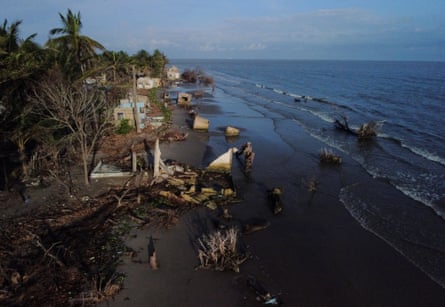
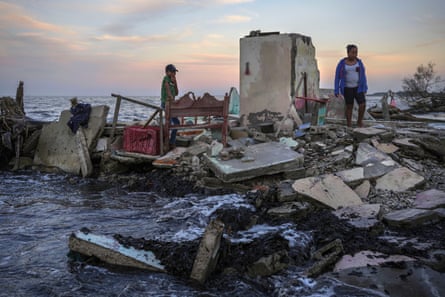
The fishing village of El Bosque was the first community in Mexico to be recognised as climate-displaced. The inhabitants were moved in 2023. By then, coastal erosion and flooding had already taken many of the homes.
I was 12 when my family moved to El Bosque, and I never imagined ever living anywhere else. It’s where my children were born, and my grandchildren. My whole life was in El Bosque. I used to say I would only leave feet first – as in, straight to the cemetery.
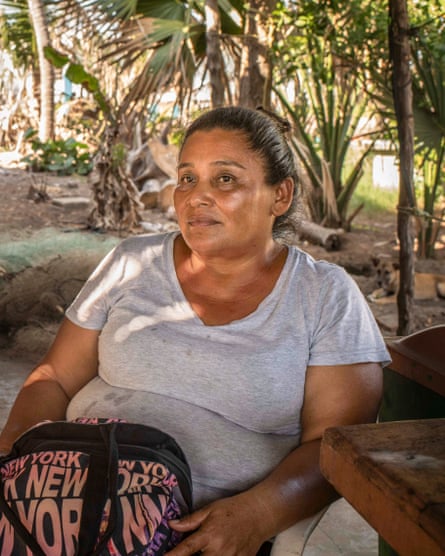
El Bosque, which means “the forest”, was a fishing community. One hundred per cent of people lived from the sea.
The men fished out at sea, while the women would catch crabs and throw nets at the shore. We’d keep an eye on each other’s children or they’d come with us and play on the beach, so it was easy for us to work, and we contributed a steady source of income to the household. The older women would make food for the fishermen and tourists, things such as ceviche, fried fish and El Bosque’s famous empanadas: tortillas stuffed with crab or fish and deep-fried in lots of oil outside on a wood stove. People used to say: “If you went to El Bosque and you didn’t try some empanadas, you were never really there.”
I first noticed we were losing trees back in 2017, old ones that had been there for years. Then we lost the first house, that was in 2019, but I never imagined losing the community, not even in my wildest dreams.
I still remember the day that the climate scientist Dr Lilia Gama came to El Bosque, in 2022.
As soon as she stepped out of her truck, the very first thing I said to her was: “Doctor, tell me El Bosque is going to be saved.” She’s very gentle, but she said: “No, El Bosque is already irreparably broken. The coastal erosion is very advanced and it’s happening really fast.” She told us we’d have to leave; that it was a matter of when, not if.
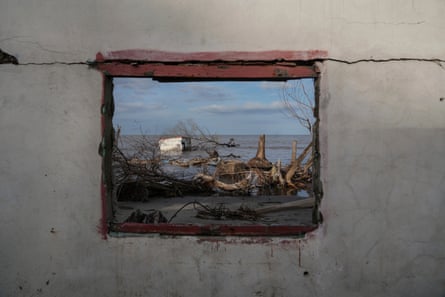
By then, the sea had taken an entire street of houses, so we knew the sea was coming towards us but I still had faith it would stop. But Dr Gama said no, climate change was making the winds stronger and the water warmer, and we had no natural barriers left because of the construction and deforestation, and the oil platforms in the sea. She said that the next northerly winds might take another row of houses. And that’s what happened just a few months later. A storm on 7 November 2022 took my sister Cristina’s house and my mum’s. They were big houses, well built – my mum’s had been there for 30 years. That’s when I realised there was no turning back. I didn’t want to leave, but El Bosque was going to disappear.
We had been trying to organise as a community since 2019 but we didn’t know which door to knock on. I mean, how were we supposed to know? It wasn’t until organisations such as Conexiones Climáticas and Greenpeace came to El Bosque that we saw some light. But by then, it was too late: the sea was moving forward very fast, and relocation was the only option.
The first days of 2023 were horrible. Houses collapsing, the power going out – people lost everything, even their clothes. We started writing letters to the federal government, and we were in all the newspapers. In the end, the president agreed to help us, and the land to build Nuevo Bosque [New Forest] near the city of Frontera was donated to us by the Tabasco state government. They chose where we were going to live. Obviously, if they’d let us choose, we would’ve wanted to be close to the sea. But they put us here for safety, far from the sea, from the river, from the water.
We’re happy that we succeeded in getting the relocation, but city life is so different. Sometimes my blood sugar suddenly spikes and I get in such a bad mood that I just can’t take any more. Our entire day-to-day rhythm of life has changed. We’re stuck inside here, and everyone seems more irritable. I think we’re still grieving. I mean, losing our territory, our everyday life, our fishing, our sea, our river … It’s not easy to recover from that. This new place is fine, it’s nice, but it just doesn’t compare to what we had back there.
Our elders are really struggling for income and they get sick more, because they’re inside all day and can’t go down to the shore. The sea guarantees you food, and everything is so expensive here. Some of the women still go to El Bosque to help the fishermen, but it’s hard without your own transport. So this source of income, the fishing life for women, is fading away. Our whole day-to-day rhythm of life changed. But if you ask the women of El Bosque what they do, most will still say: ‘I’m a fisherwoman.’
I especially worry about the kids now – my God, what are they going to do? In El Bosque, fishing was a good trade. It’s something parents passed down to their children: fishing, love for the sea, the knowledge gained out at sea. My son, he’s a fisherman like his dad, it’s like an inheritance. But we’re losing that connection – the little one might not even learn to swim!
All along the Tabasco coastline the sea is right up at the shore, and when the erosion speeds up, who knows how many homes are going to be swept away. I really hope the authorities learn from El Bosque, because there are a lot of things that shouldn’t be repeated. For me, relocating coastal communities should be the last resort, because honestly, it’s horrible. I wouldn’t wish it on anyone. The government needs to act now, to build up dunes, plant trees. Mangroves are crucial. And communities should be at the centre of these discussions.
I know it’s not going to last for ever, that El Bosque is going to disappear when the sea and river come together. But we’re going to keep going back and fishing as long as we can, because we’re fishers. Look, I consider myself a person of the sea, and without the sea, I’m nobody.
KioskNews shows a cleaned-up reading view extracted from the publisher’s page — the original always lives on their site, not ours.