Determination as to the true nature and character of a law must be made by reference to, and be guided by, the Constitution — Hafiz Hassan
OCTOBER 26 — Eight months ago, I shared the Australian experience of conflict between federal and state when both authorities or governments passed legislation on the same subject.
Australia is a federation of six states.
The Australian Constitution establishes a federal system of government in which legislative powers are distributed between the federal parliament/governments and the six state parliaments/governments.
Section 109 of the Australian Constitution provides that “when a law of a State is inconsistent with a law [passed by the federal parliament], the latter shall prevail, and the former shall, to the extent of the inconsistency, be invalid.”
Canada too has seen similar conflicts.
Canada is also a federation with one federal government, three territorial governments and ten provincial governments sharing lawmaking responsibilities.
All levels of government derive their authority from the Constitution of Canada – not unlike in Malaysia.
Sections 91 and 92 of the Canadian Constitution distribute powers between the federal and provincial governments, with each government having jurisdiction to make laws over certain subjects or areas.
Section 91 of the Canadian Constitution lists thirty areas within federal jurisdiction – not unlike Article 74(1) of the Federal Constitution which enumerates in the Federal List in the Ninth Schedule matters in respect of which the federal government may make law.
Canada’s federal list includes regulation of trade and commerce, criminal law, and a general power to make laws in all matters not assigned to the provinces.
Section 92 of the Canadian Constitution lists fifteen areas within provincial jurisdiction – again, not unlike Article 74(2) of the Federal Constitution which enumerates in the State List in the Ninth Schedule matters in respect of which the state government may make law.
Examples from Canada’s provincial list are property and civil rights in the province, local works and undertakings, and all matters of a merely local or private nature in the province.
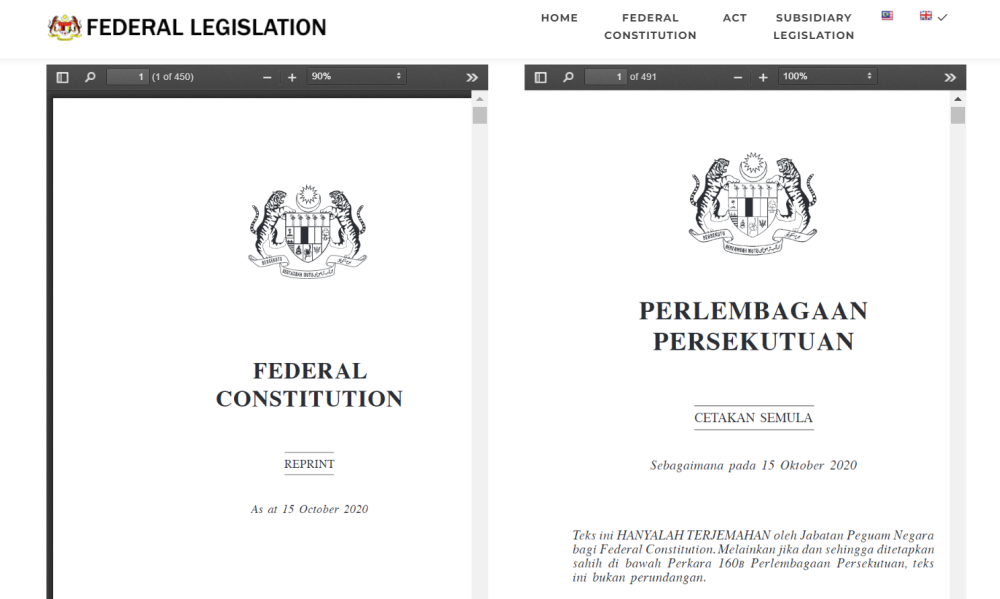
A screen capture shows the Federal Constitution in both English and Malay displayed on the website of the Attorney General’s Chambers.
In the same year Malaysia was ‘born’, noted Canadian constitutional scholar and the first dean of the Faculty of Law of Queen’s University, William R. Lederman wrote:
“[The] federal and provincial categories of power are expressed, and indeed have to be expressed, in quite general terms. This permits considerable flexibility in constitutional interpretation, but also it brings much overlapping and potential conflict between the various definitions of powers and responsibilities.
“To put the same point in another way, our community life – social, economic, political, and cultural – is very complex and will not fit neatly into any scheme of categories or classes without considerable overlap and ambiguity occurring. There are inevitable difficulties arising from this that we must live with so long as we have a federal constitution.
“Accordingly, the courts must continually assess the competing federal and provincial lists of powers against one another in the judicial task of interpreting the constitution. In the course of judicial decisions on the [Canadian Constitution], the judges have basically done one of two things.
“First, they have attempted to define mutually exclusive spheres for federal and provincial powers, with partial success. But, where mutual exclusion did not seem feasible or proper, the courts have implied the existence of concurrent federal and provincial powers in the overlapping area, with the result that either or both authorities have been permitted to legislate provided their statutes did not in some way conflict one with the other in the common area.” (See “The Concurrent Operation of Federal and Provincial Laws in Canada” (1963) McGill Law Journal Vol 9:3)
The words ‘exclusive’ and ‘exclusively’ occur in both Sections 91 and 92. But there may be matters, as Lord Fitzgerald observed more than 130 years ago in Hodge v The Queen (1883), “which in one aspect and for one purpose fall within Section 92, may in another aspect and for another purpose fall within Section 91”.
For instance, a law providing for suspension or revocation of the right to drive a car upon a highway because the driver was drunk has the provincial aspects of control of highways as local works and of the right to drive as a civil right in the province. These fall under provincial responsibility for safe and efficient circulation of traffic under Section 92.
Yet the law also touches on criminal law, which is a federal matter under Section 91.
So, where does the power to make the law reside, or do both federal and provincial governments have it?
According to Lederman, where a law displays several features, one of which at least falls within a federal matter, and another one of which falls within a provincial matter, the basic solution lies in the relative importance of the federal features and the provincial features.
One must ask: when does the need for a national standard by federal law outweigh the need for provincial autonomy and possible variety as developed by the laws of the several provinces, or vice versa?
The answers must be guided by the Constitution.
Lederman wrote:
“If the federal features of the law are deemed clearly to be more important than the provincial features of it, then the power to pass that law is exclusively federal.
“In other words, for this purpose the law is classified by its leading feature, by its more important characteristic, by its pith and substance.
“And if, on the other hand, the provincial features are deemed clearly more important than the federal ones, then power to pass the law in question is exclusively provincial.”
The “pith and substance” test is also used in Malaysia. The test has been borrowed from India.
Guess where the subcontinent borrowed it from?
No prizes for guessing right.
In Malaysia, when a question arises whether a law pertains to a matter in the Federal List or State List, the courts will seek to ascertain the true nature and character of the law and then decide under which matter the law falls.
The courts will examine the legislation in question as a whole and then ascertain what its true nature and character is in order to determine under which item in which list (Federal or State) it falls.
If according to its “pith and substance” the law falls within the powers conferred on the legislature which has enacted it, then the law does not become invalid merely because it incidentally encroaches on matters assigned to the other legislature.
To ascertain the true character of a law, it must be looked into as an organic whole. It is the substance and not the form or outward appearance of the legislation which must be considered.
The object, purpose and design of the law must be investigated for the purpose of ascertaining the true character and substance of the legislation and the class of subject matter of legislation to which it really belongs.
The test was last used by the Federal Court in 2024 in the case of Nik Elin Zurina bt Nik Abdul Rashid & Anor v Kerajaan Negeri Kelantan where the apex court, by a majority (8:1), found provisions in the Kelantan Syariah Criminal Code (I) Enactment 2019 fell under matters of criminal law in the Federal List.
The provisions were therefore invalid on the ground that they provided for matters with respect to which the Kelantan State Legislature had no power to make laws and that the provisions were void under Article 4(1) of the Federal Constitution.
The gist is this: ascertain the true nature and character of a law and then decide under which matter the law falls.
In Canada, it is either federal or provincial.
In Malaysia, either federal or state.
The determination must be made by reference to, and be guided by, the Constitution.
* This is the personal opinion of the writer or publication and does not necessarily represent the views of Malay Mail.
KioskNews shows a cleaned-up reading view extracted from the publisher’s page — the original always lives on their site, not ours.