Is China building a fleet of drone motherships to extend its naval reach?
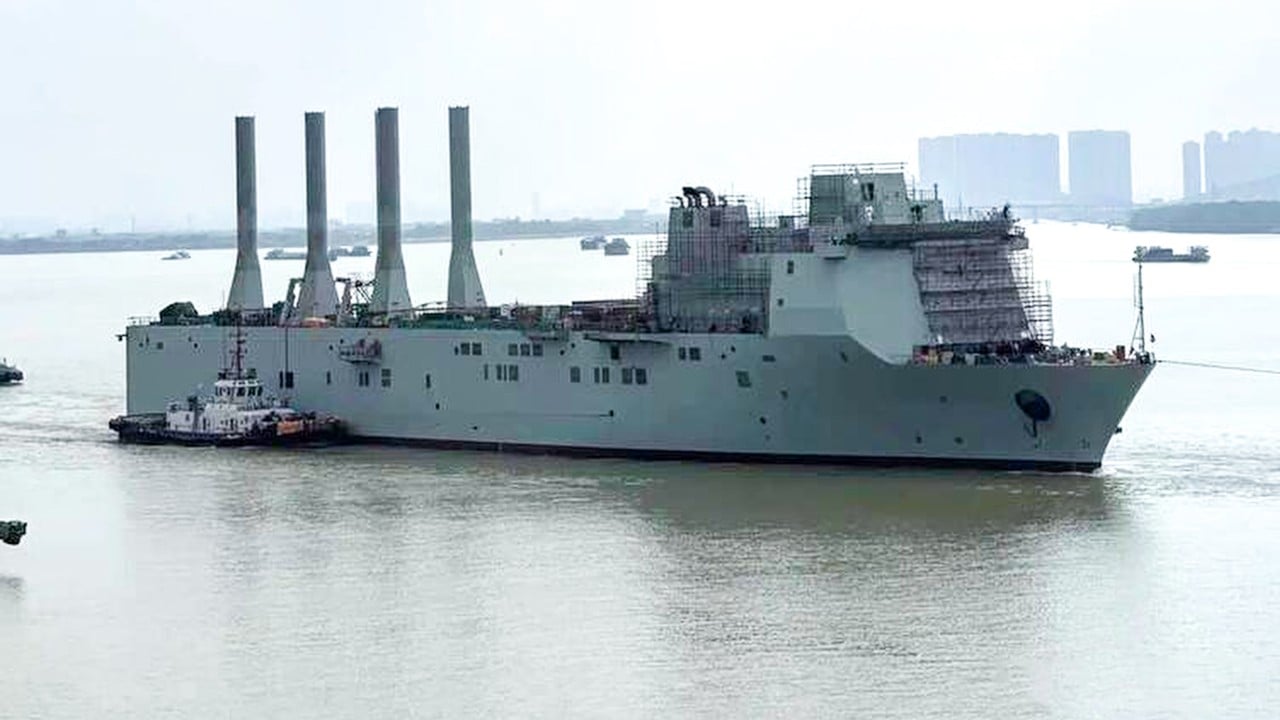
A second unusual Chinese vessel suspected of being designed to launch and recover large underwater drones has appeared in Guangzhou, raising questions over whether Beijing is developing a fleet of specialised motherships to extend its undersea operations beyond coastal waters.
Both feature conspicuous vertical structures at the stern that naval analysts believe could be used to lower large underwater drones into the water and recover them.
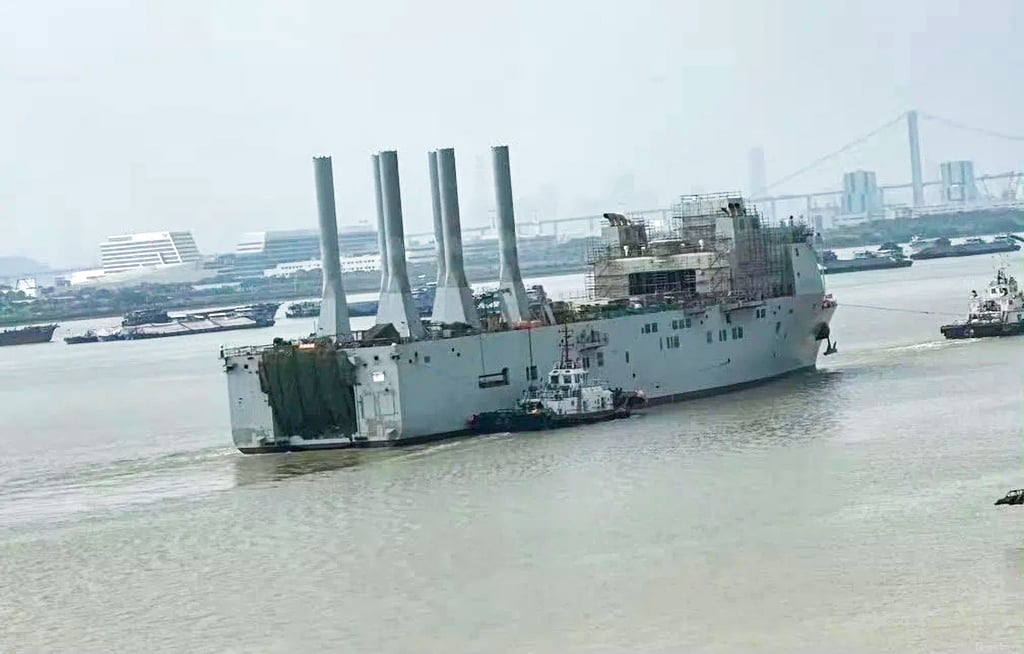
If confirmed as military motherships, the vessels could enable the People’s Liberation Army (PLA) Navy to deploy and recover large uncrewed underwater vehicles (UUVs) far from Chinese ports, potentially expanding its ability to conduct undersea surveillance, seabed mapping and other military missions in the western Pacific, including waters east of Taiwan.
However, neither ship’s intended purpose nor operator has been confirmed.
The US-based defence news website TWZ said satellite imagery taken on October 2 showed the second vessel at the Guangzhou Shipyard International facility on Longxue Island before its launch.
The Naval News website also identified the Longxue Island shipyard as a possible builder, but said further imagery was needed to confirm the vessel’s origin and where it would be fitted out.
The media outlet said images of the vessel came from two short videos originally circulated on the Chinese social media platform Weibo, and that the authenticity of the footage remained unconfirmed.
The images show tugboats moving the vessel near Guangzhou’s Panyu district. Scaffolding remained on the ship, while sensor and communications equipment had yet to be fitted, according to Naval News.
Naval News estimated the Guangzhou vessel’s length at about 150 metres, compared with slightly more than 200 metres (656 feet) for the Shanghai vessel.
Although their hull shapes differ, both have raised deckhouses towards the bow, hangar-like spaces and large openings at the stern.
The Guangzhou vessel has six tall vertical posts near its stern, compared with 12 of varying heights on the Shanghai ship.
01:29
China’s first 076 ‘drone carrier’ amphibious assault ship begins sea trials
Thomas Lim, an associate research fellow with the Military Studies Programme at the S. Rajaratnam School of International Studies in Singapore, said the vessels appeared to be able to carry multiple underwater drones, with the rear openings and ramps supporting the mothership hypothesis.
However, he cautioned that the imagery offered only a “partial fit” and that confirming their intended role would require evidence of completed supporting facilities, including cranes and docks, as well as “proof of concept in deployment or tests”.
Neither ship has been observed deploying underwater drones.
In a Naval News report on September 15, analyst H.I. Sutton assessed the Shanghai vessel under construction at Hudong-Zhonghua shipyard as a possible mothership for very large underwater drones.
An experienced military imagery analyst who reviewed the same September 10 imagery for the South China Morning Post said he could independently identify the apparent stern launch-and-recovery system.
A cradle positioned behind the vessel seemed narrow enough to pass through its rear opening, the analyst added at the time.
The construction of the suspected motherships comes as China has been testing two very large underwater drone prototypes measuring an estimated 35 and 45 metres long in Hainan, according to Sutton. So far, floating docks have been used to carry these craft out to sea for testing and recovery afterwards.
If built for that role, the two vessels could offer greater flexibility by transporting underwater drones towards distant operating areas, recovering them after missions and providing facilities for maintenance or preparation between deployments.
Peter Jones, a retired Australian vice-admiral, said the smaller vessel might be intended to support “a different class of UUV” or reflect “another base ship design”, potentially one familiar to its builder.
He said that if underwater drones proved effective, more motherships would be needed as their numbers increased. That could require modifying existing vessels or adapting established designs to allow “multiple shipyards to meet the demand”.
Lim, however, noted that the differences in size could reflect “variety” within the same design or requirements for “different operational theatres”, rather than evidence that China was moving beyond experimentation towards a broader underwater drone capability.
While the vessels might still be for civilian purposes, they face risks in contested waters if deployed militarily. In the SCMP’s report on the Shanghai vessel in September, China military analyst Timothy Heath warned that such a large support ship would be a vulnerable target, better suited to operating relatively close to China in less hostile conditions.
KioskNews shows a cleaned-up reading view extracted from the publisher’s page — the original always lives on their site, not ours.